
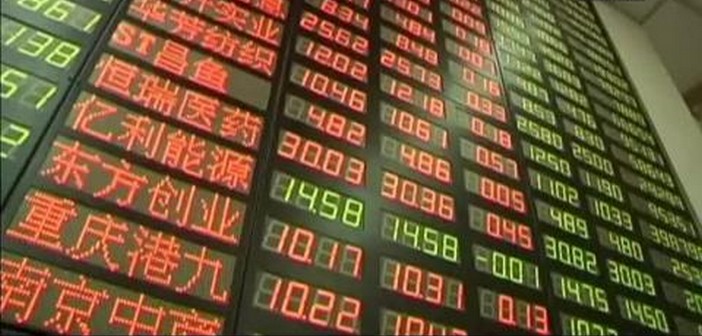
The fall of the Shanghai Stock Exchange, -32% in one month, is spreading. Companies are suspending their trading to protect themselves from panic.
While Europe is only thinking about Greece, a large part of the rest of the world has its eyes fixed on the rout of Chinese stocks. The CSI 300 index, which includes the main stocks listed in Shanghai and Shenzhen, fell by 6.75% on Wednesday, taking its decline to 32% since June 12. A drop that is starting to make neighboring markets nervous. Hong Kong’s Hang Seng plunged 5.8% on Wednesday, its largest drop since November 2008, at the beginning of the financial crisis. Taiwan, for its part, lost nearly 3%.
Overwhelmed Companies
The fear is all the greater because nothing seems to be able to slow down the correction of the Chinese market, not even the numerous measures taken by the authorities. As a result, overwhelmed companies have no choice but to ask the regulator for a suspension of their trading to try to escape the onslaught. On the CSI 300, 85 shares of major industrial, energy, transport, media, and health groups had no trading on Wednesday, twice the number on Tuesday. In total, according to Bloomberg, trading is impossible for 1,249 Chinese company stocks, or 43% of the board. These stocks account for nearly a third of the Chinese stock market capitalization. On the ChiNext index of innovative and growth stocks, which has plunged 40% since June 3, only 23 stocks were traded … for 76 suspended! Stocks that local investors were very fond of.
This explains a generalized downward movement that also affects major listed companies. The stock market decline is indeed largely linked to the explosion of the margin trading system that allowed millions of individuals to speculate on the stock market with borrowed money… As for the other investors, “they are paralyzed by fear that the Chinese economy will be affected by this crisis.”
Immature Market
A crisis that clearly shows the immaturity of the Chinese stock market and the glaring lack of institutional investors able to have a longer-term vision and stabilize the market in case of panic.


