
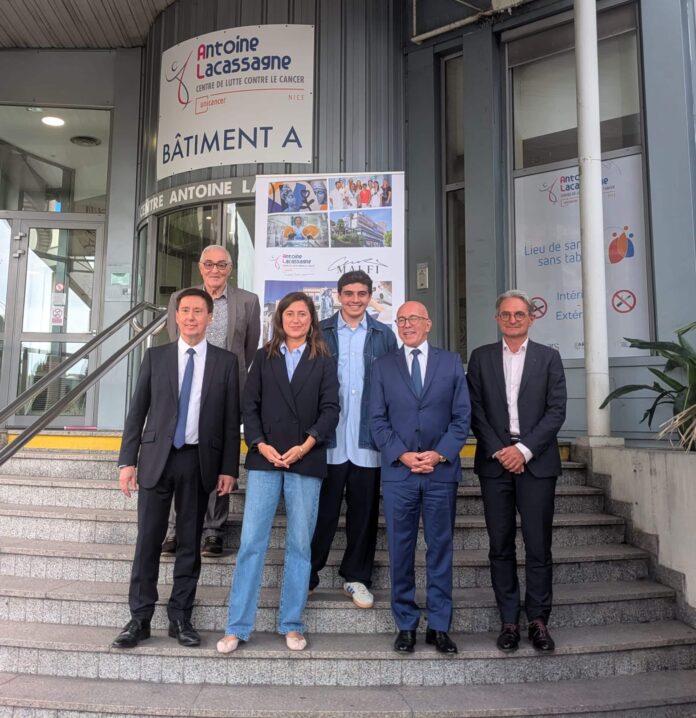
The Antoine Lacassagne Centre officially unveiled three monumental murals last Friday, 3 October, created by Nice-based artist César Malfi. Painted on the main façade of the centre, the works symbolise medicine, resilience and love. The inauguration took place in the presence of, among others, Professor Emmanuel Barranger, Chief Executive Officer of the centre, and Éric Ciotti.
Under an autumn sky, the façade of the Antoine Lacassagne Centre was adorned with vibrant colours last Friday. The three large-scale murals, imagined and painted by César Malfi, were officially inaugurated before an audience of around twenty people, including donors, centre staff and individuals close to the artist, as well as Professor Emmanuel Barranger and Éric Ciotti. The project, conceived and launched in 2022, was completed in August after nearly three years of work.
This powerful moment took place just three days after the launch of Breast Cancer Awareness Month (Pink October), reinforcing the symbolic link between art, care and the fight against cancer.
An Artistic Project at the Crossroads of Medicine and Humanity
Visible from the street, the artworks blend mythology and modernity. On the wall, Asclepius, the god of medicine, stands alongside Athena, symbol of wisdom and strength, Venus, embodiment of beauty and rebirth, and Cupid, messenger of love.
These symbolic figures are described by the self-taught artist as “a contemporary interpretation of care, resilience and hope.”
“Reviving the Three Graces on the walls of the Antoine Lacassagne Centre, just a few steps from my earliest memories, is about offering a gesture of hope in the face of cancer — a humanist message where art and medicine meet,” said César Malfi. Simple flowers, a recurring motif in his work, appear throughout the murals “as signs of blossoming and continuity.”
A Work Born from Personal History
Addressing the gathered audience, the artist delivered a deeply emotional speech.
“This project has been of vital importance to me. After my accident on the railway tracks, I spent more than thirty days at Pasteur Hospital, just across the street. That was when my career as an artist began,” he explained.
He added:
“I also lost my father in the building opposite. That is what gave me the strength to come here and create these works. These murals are a message of hope for patients, but also for those who work here, because it is you who convey humanity and strength.”
A Collective and Symbolic Project for the Centre
Professor Emmanuel Barranger, Director General of the Antoine Lacassagne Centre, highlighted the collective nature of the initiative.
“This project is a collective process,” he emphasised.
“Staff members of the centre were able to take part in choosing the final colours of the murals. These works, which depict Greek deities, reflect our values: medicine, determination, resilience, support and beauty.”
For the director, the murals fully embody the centre’s mission of combining medical excellence with human-centred care.
“One patient told me that these murals evoke modernity and reassure her. That means this is a place that inspires confidence,” he said, adding:
“This project enhances the cultural visibility of the city of Nice and brings a sense of calm when you look at it.”
A Message of Hope Supported by the City
Also present at the inauguration, Éric Ciotti praised the work of both the artist and the centre’s staff, underlining the importance of initiatives where art and healthcare come together to convey a message of humanity.
The Alpes-Maritimes MP reaffirmed his attachment to the Antoine Lacassagne Centre, describing it as “a key player in research and healthcare in Nice.”
Made possible thanks to the support of sponsors and private donors, this collaboration may not be the last.
“There may be other projects in 2026,” suggested Professor Barranger, expressing a desire to continue opening the centre to cultural initiatives in the future.


