
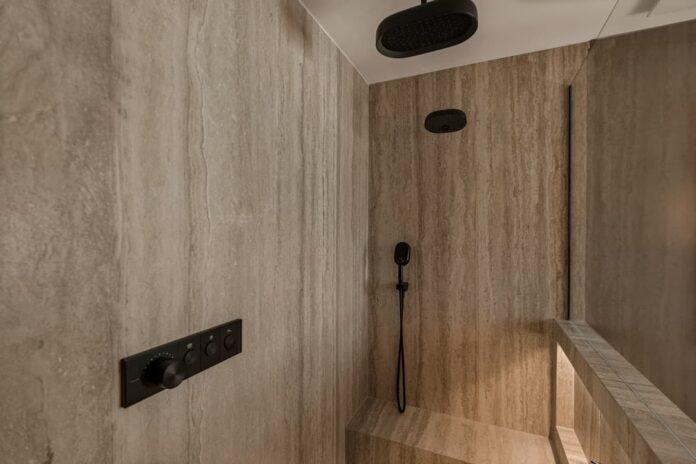
There are materials that transcend the seasons without really going out of style. Natural stone is one of them.
In 2026, travertine is regaining a particularly visible place in interior projects: textured floors, low tables, basins, bathrooms and kitchens use it to bring warmth and irregularity that perfectly uniform surfaces no longer necessarily seek to reproduce.
On the French Riviera, this desire for mineral materials seems almost natural. Between terraces, stone walls, Mediterranean light and homes widely open to the outside, travertine makes it possible to extend an aesthetic already very present in the landscape to the interior.
Travertine, a stone with an immediately recognizable character
Travertine belongs to the family of limestone stones. Its structure is often distinguished by small cavities and irregularities linked to its formation, which can be preserved, partially filled or worked according to the desired finish.
Its hues generally range from warm whites to beiges, honey tones and more muted shades.
These variations are precisely what explain much of its decorative interest.
No two slabs are ever perfectly identical. Differences in texture and tone are part of the material and should be considered a characteristic rather than a defect.
The Natural Stone Institute also notes that travertine and limestone are used both indoors and outdoors, but that their performance varies depending on the variety of stone and the intended application.
Why does it return so much in interiors in 2026?
The return of travertine is part of a larger trend: interiors are becoming less smooth and seeking more texture, material and character.
Architectural Digest cites travertine among the trends that remain present in 2026, alongside natural materials, dark wood and decoration that is less uniformly minimalist. In kitchens, professionals interviewed by House Beautiful also mention the return of textured stone floors and travertine.
This obviously does not mean that all homes must now be covered in stone.
The appeal of travertine lies rather in its ability to function both as a main material and in small touches.
A palette naturally suited to the Mediterranean
Cream, sand, beige, honey: the most common colors of travertine combine particularly easily with southern light.
In a Côte d’Azur interior, you can pair it with white or slightly whitewashed walls, linen, natural woods, rattan, artisanal ceramics or a few touches of deep green.
The result doesn’t need to be rustic either.
Used in large slabs with very simple lines, travertine can create an extremely contemporary interior. Conversely, a more traditional laying or sculptural elements can emphasize its Mediterranean character.
One of the most interesting uses on the French Riviera is to create visual continuity between interior and exterior: the same mineral spirit can accompany the living room, then the terrace or the edges of a swimming pool, provided of course that you choose for each area a stone and finish suited to the use.
The bathroom, one of its natural territories
Travertine naturally finds its place in bathrooms.
Floor, walls, basin or simple shelf: it allows you to create a mineral atmosphere without multiplying materials.
But a bathroom also imposes particular technical constraints.
In a shower or on a regularly wet floor, the choice should not be made solely on aesthetics. Slip resistance depends in particular on the type of stone and its finish. The Natural Stone Institute emphasizes that these characteristics must be adapted to the intended use and that slip performance is among the parameters to verify for floor coverings.
A highly polished finish therefore does not necessarily belong everywhere.
In wet areas, it is better to ask the supplier or installer for the precise characteristics of the product and choose a finish whose adhesion is suited to the use.
In the kitchen, beautiful but more demanding
Travertine can also be used as a splashback, on an island or for certain countertops.
However, it is here that its limestone nature requires the most attention.
Like marble and other stones rich in calcium carbonate, travertine is sensitive to acids. Lemon juice, vinegar or certain cleaning products can cause a chemical attack on the surface and leave a dull or altered area.
This does not make its use in a kitchen impossible, but you must accept the behavior of the material.
For a heavily used countertop, it is better to discuss with the marble worker or supplier the precise type of travertine, its absorption, its finish and any protection to be applied.
The Natural Stone Institute further notes that different limestone stones have highly variable absorption levels and not all are equally suitable for countertops.
On the floor, the charm of mineral continuity
In a living room or dining room, travertine works particularly well over large surfaces.
Its relatively soft color allows you to dress a floor without making it too prominent, while its variations prevent the whole from becoming completely uniform.
The laying can also radically change the result.
A Roman opus brings a more traditional character, while large rectangular or square slabs immediately give a more contemporary look.
In villas and apartments widely open to a terrace, this mineral continuity can be particularly interesting.
But again, using the same aesthetic does not necessarily mean using exactly the same product: an interior finish and an exterior finish may need to meet different constraints, particularly in terms of adhesion and exposure. Professional projects precisely use more textured finishes on the exterior to maintain visual continuity while adapting the stone’s performance.
And the sensation of coolness underfoot?
This is a quality often associated with stone floors, particularly appreciated in Mediterranean climates.
A stone can indeed give a cool sensation to the touch, particularly because it rapidly exchanges heat with the foot.
However, we must avoid concluding that a travertine floor alone is sufficient to cool a home.
The thermal comfort of a home depends on many parameters: insulation, thermal mass of the entire building, sun protection, ventilation, orientation and even the temperature of the walls.
Travertine can contribute to a pleasant mineral interior in summer, but it is not a substitute for appropriate thermal design.
Marble, alabaster, limestone: travertine is not alone
The return of natural materials goes far beyond travertine.
Marble remains very present, particularly in kitchens and bathrooms, sometimes in more colored tones or with more expressive veining.
Light limestones also offer many possibilities for floors or walls, while alabaster is more commonly used for decorative objects and lights when seeking a translucent effect.
Burgundy stone can also create beautiful warm interiors, but it would be misleading to systematically present it as a less expensive solution: depending on its origin, finish, format and quality, it can belong to a high price segment.
The choice of stone should therefore start from the project and its use, not solely from its appearance in a photograph.
Maintenance: much simpler if you respect the nature of the stone
Travertine does not necessarily require complicated maintenance.
For routine cleaning, the Natural Stone Institute recommends knowing the composition of the stone and using mild, non-acidic products on limestone stones. Cleaners containing lemon, vinegar or other acids can dull or attack the surface, while certain abrasive products risk scratching it.
Regarding protection, you must also forget the simplistic rule of “treatment every year.”
An impregnation product can make certain stones more resistant to stains, but it does not make them completely waterproof. Some stones may not even require this treatment.
The frequency of application or renewal depends on the material, the product used, the location and the intensity of use. The right approach is therefore to follow the stone supplier’s recommendations and the treatment manufacturer’s instructions.
A material that accepts living
This is perhaps where travertine’s appeal ultimately lies.
Natural stone is not a perfectly fixed surface.
It has variations, can develop a patina, react to certain uses and change slightly over time. For some, this is a flaw. For others, this is precisely what gives it its character.
In Mediterranean interiors, this evolution can be particularly appealing: a floor that carries light, a slightly irregular basin, a table whose hues change depending on the time of day.
Luxury is then no longer the absolute perfection of the surface, but the quality and presence of the material.
Choosing stone with the light of the French Riviera
Before ordering several dozen square meters, it is always better to observe real samples.
Natural stone can change considerably depending on the lighting. A fairly cool beige in the store can become much more golden under late afternoon light, while a very uniform slab on a small sample can reveal more variations when laid over a large surface.
For a project in Nice or on the French Riviera, the ideal is therefore to view the stone in the room where it will actually be installed, at different times of the day.
And above all, to choose the material with its use in mind: interior floor, terrace, shower, kitchen or decorative element do not necessarily require the same characteristics or finish.
Travertine is not a miraculous material, nor is it reserved for luxury interiors.
It is simply a natural stone with its qualities, its constraints and a remarkable ability to dialogue with light.
And on the French Riviera, it is probably where it is most to its advantage.
NicePremium is a free, independent local news outlet.
Help us keep going by supporting our work from €5 per month.


