
« `html
Emblematic of Nice gardens and Mediterranean landscapes, the oleander illuminates the villas, terraces and promenades of the Côte d’Azur throughout the summer. Good news for gardeners: the month of August offers excellent conditions for propagating it. In water or directly in soil, taking oleander cuttings is within everyone’s reach, provided you follow a few simple rules.
Why oleander is essential on the Côte d’Azur
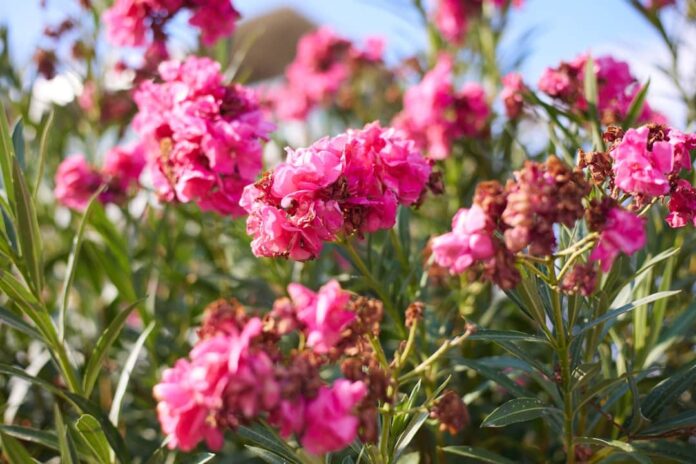
With its generous pink, white, red or salmon flowers, oleander (Nerium oleander) is part of the summer scenery of Nice and the entire Riviera.
It embodies in itself a certain idea of the Mediterranean garden: luminous, generous and capable of withstanding periods of intense heat and drought once properly established. A quality particularly appreciated as water restrictions in the Alpes-Maritimes remind us each summer of the importance of choosing plants adapted to the Mediterranean climate.
Planted as a hedge, in a bed or cultivated in a pot on a sunny terrace, it offers long flowering. Under the mild climate of the Côte d’Azur, this can extend from spring to autumn, sometimes from April to November depending on conditions and varieties.
Its evergreen foliage also allows it to maintain a beautiful green presence during winter.
Another advantage: oleander is relatively easy to propagate. Making your own cuttings allows you to reproduce a particularly appreciated shrub, complete a hedge, furnish a terrace or simply offer a young plant to your loved ones.
And summer is precisely a very good time to try this.
Why August is a good time to take oleander cuttings
Oleander propagates easily by cuttings, a characteristic also highlighted by the National Society of French Horticulture.
Oleander can be propagated from cuttings at different times of the year. But in summer, stems known as “semi-ripened” present particularly interesting characteristics.
They are no longer as tender as the young shoots of spring, without being completely woody yet. They therefore have a good capacity to produce new roots.
On the Côte d’Azur, the high temperatures of August also promote rooting. You simply need to protect the young cuttings from the burning midday sun and ensure they don’t dry out.
How to choose an oleander stem to take cuttings from
Success begins with the choice of stem.
Take a healthy shoot from the current year, free from disease or pests, approximately 15 to 20 centimeters long. Ideally, choose a stem that does not bear flowers so the plant can dedicate its energy to root production.
Make a clean cut just below a node, that is, the point where leaves are attached to the stem.
Then remove the leaves located on the lower third of the cutting and keep only a few leaves in the upper part.
This reduction in foliage limits water loss and helps the cutting dedicate its resources to rooting.
Always use clean, sharp secateurs or a knife.
Oleander cutting in water or in soil?
Both methods are possible and relatively simple for taking oleander cuttings.
Taking an oleander cutting in water
This is probably the most spectacular method for beginner gardeners, as it allows you to directly observe the appearance of roots.
Place the lower part of the stem in a glass or container filled with water, ensuring that no leaves are immersed.
Install the container in a bright location, but without direct sun during the hottest hours.
Regularly change the water to keep it clean and clear.
Over the weeks, small white roots should appear. When they are sufficiently developed, the young plant can be gently transferred to a pot containing light substrate.
Taking a cutting directly in soil
This second method avoids the step of transferring from water to soil.
Prepare a small pot with drainage holes at the bottom with light, draining substrate. A mixture of potting soil with coarse sand or perlite works perfectly.
Insert the lower part of the stem a few centimeters deep, gently pack the substrate around it, then water without making the soil soggy.
A rooting hormone can promote root development, but it is not essential for oleander.
Where to place the cuttings during rooting?
Cuttings need warmth and light, but not the intense sun of an August afternoon on the Côte d’Azur. During periods of extreme heat, a few precautions can also help protect plants from heat waves and limit their drying out.
A bright location benefiting from the soft morning sun, for example facing east, is particularly suitable.
For cuttings made in pots, it is also possible to create a humid atmosphere by covering them with a transparent bell jar or plastic bag that does not directly touch the leaves.
This technique helps limit drying out.
However, you must air them regularly to renew the air and reduce the risk of mold development.
How long does it take to get roots?
There is no absolutely identical duration for all cuttings. The speed of rooting depends in particular on temperature, stem vigor, humidity and the method chosen.
Under good summer conditions, the first roots can appear in a few weeks.
For a cutting placed directly in the substrate, slight resistance when gently pulling on the stem can indicate that new roots are beginning to develop.
However, there is no need to be impatient: it is better to let the young plant build a sufficiently strong root system before handling or repotting it.
Warning: oleander is a toxic plant
This is an essential precaution to recall before any pruning or cutting operation.
As Anses reminds us, oleander is a highly toxic plant. All parts of the plant should be considered dangerous if ingested.
The leaves, flowers, stems, seeds and sap must therefore be handled with care.
It is recommended to wear gloves while taking cuttings, avoid touching your face and wash your hands thoroughly after handling the plant. The tools used must also be cleaned.
Oleander pruning waste must not be burned.
Particular vigilance is also necessary in gardens frequented by young children or domestic animals.
When to repot an oleander cutting?
Once the root system is sufficiently developed, the young cutting can be placed in an individual pot.
During its first months, it is better to provide it with a bright, protected location and avoid extreme conditions.
For permanent planting in the garden, choose a very sunny location and well-drained soil. Oleander loves light: generous exposure will promote its future flowering.
Although it resists drought well once adult and properly established, a young oleander requires more attention. During its first year, regular watering will allow its roots to develop deeply.
In a Mediterranean garden, water-saving irrigation solutions, such as oyas, can also help better manage this precious resource.
Plants grown in pots also require more regular watering than specimens planted in open ground.
How to maintain an oleander on the Côte d’Azur?
Once established, oleander requires relatively little maintenance.
It appreciates sun and well-drained soil. In particular, you must avoid locations where water might pool during rainy periods.
Light pruning can be done to maintain a harmonious shape and remove branches that have become too cumbersome. Be careful to always wear gloves when doing this operation.
For specimens grown in pots, an appropriate supply of flowering plant fertilizer during the growth period can accompany flowering, respecting the dosages indicated by the manufacturer.
Over time, a simple cutting can become a true shrub, dress up a fence, form a hedge or find its place in the arrangement of a Mediterranean terrace in Nice.
Taking cuttings to share a piece of your garden
Propagation has a charm that buying a new plant doesn’t quite have.
A cutting from an oleander that you have been growing for several years can be given to a neighbor, friends or family members. It then becomes a small piece of garden that you pass on.
On the Côte d’Azur, where terraces and gardens naturally extend living spaces, oleander has found particularly favorable territory.
And in this month of August, a few cuts with secateurs can be enough to take oleander cuttings and prepare the shrubs that will flower in the summers to come.
Frequently asked questions about oleander cuttings
Can you take oleander cuttings in August?
Yes. Summer is a favorable period for taking semi-ripened stem cuttings. On the Côte d’Azur, the heat of August offers good rooting conditions, provided you protect the cuttings from direct sun during the hottest hours.
Can you take an oleander cutting in water?
Yes. Oleander propagates easily in water. You simply need to immerse the lower part of the stem, without letting the leaves soak, and regularly change the water.
How long does it take for an oleander cutting to develop roots?
The first roots can appear after a few weeks, but the duration varies depending on temperature, the stem and growing conditions. It is preferable to wait until the root system is sufficiently developed before repotting the cutting.
Do you need to use rooting hormone?
It is not essential. Rooting hormone can promote rooting, particularly for cuttings made directly in a substrate, but oleander naturally has a good capacity to produce roots.
Is oleander dangerous?
Yes. Oleander is highly toxic if ingested. It is recommended to wear gloves when pruning and taking cuttings and to keep plant waste away from children and animals.
« `
NicePremium is a free, independent local news outlet.
Help us keep going by supporting our work from €5 per month.


