
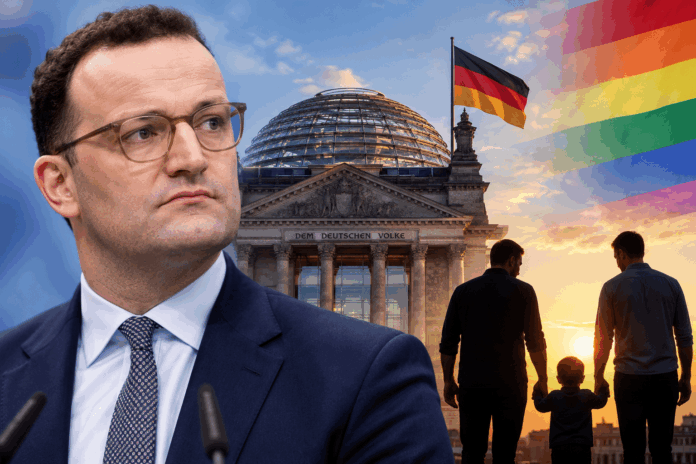
The resignation of the German conservative leader, who became a father with his husband through surrogacy in the United States, reignites the debate on same-sex parenting, unequal access to parenthood, and the consistency between public commitments and private choices.
The birth of a child should remain an intimate event. For Jens Spahn, it became a national political affair instead.
A major figure in German conservatism, former federal Minister of Health and outgoing president of the CDU-CSU parliamentary group in the Bundestag, Jens Spahn announced that he had become a father with his husband, journalist Daniel Funke. Their son was born in the United States through surrogacy.
A personal decision that quickly sparked fierce controversy in Germany. Surrogacy is banned there and the CDU, Jens Spahn’s party, recently defended maintaining this ban, even when practiced without compensation for the surrogate mother.
Facing accusations of inconsistency and mounting pressure within his own ranks, Jens Spahn announced on July 18, 2026, his resignation from the presidency of the conservative parliamentary group. Chancellor Friedrich Merz described this decision as just and inevitable, recalling that credibility remains an essential quality in political life.
A family turned into a public matter
Openly homosexual, Jens Spahn has been married to Daniel Funke since 2017. When he announced the birth of their son, the politician expressed the couple’s happiness and stated that the child now represented the center of their family life.
But the controversy does not concern the sexual orientation of the two fathers nor, in principle, their right to form a family. It mainly concerns the method used to become parents and the gap between this private decision and the positions publicly defended by their political family.
The CDU believes that surrogacy carries ethical, medical and social risks, particularly regarding the economic exploitation of women and the commodification of the human body. The party thus refuses its legalization in Germany, even in an allegedly altruistic form.
Jens Spahn and his husband resorted to surrogacy in the United States, where this practice is permitted and regulated in several states.
His opponents see this as a form of double standard: personally benefiting, thanks to financial means and the ability to travel, from an option that his own party refuses to make accessible in his country.
A question of particular concern for LGBT families
Surrogacy is not exclusively an LGBT issue. Heterosexual couples facing infertility also resort to it, as do some single individuals.
However, it occupies a particular place in the debate on male same-sex parenting. For two men, the possibilities of having a child biologically linked to one of the parents are more limited than for a female couple, which can notably access medically assisted reproduction in several European countries.
Jens Spahn’s situation thus illustrates a reality often denounced by LGBT associations: equality in marriage does not necessarily mean equality in parenthood.
Male couples wishing to start a family must generally turn to adoption—when this is possible—or to surrogacy practiced abroad. These paths are lengthy, complex and costly, creating significant inequality between families based on their financial resources and their ability to cross borders.
The case thus raises a delicate question: can one defend the visibility and social success of LGBT people while supporting policies that concretely limit their access to certain family models?
A gay leader within a conservative party
Jens Spahn’s trajectory has long embodied the contradictions running through part of European right-wing politics on LGBT issues.
His homosexuality did not prevent his rise within a Christian-democratic party attached to a traditional conception of the family. His presence at the highest levels of power was thus perceived as a sign of normalization: an openly gay man can hold the highest political responsibilities without his sexual orientation alone defining his public identity.
This visibility does not, however, mean that he supports all the demands made by LGBT associations. Like other homosexual figures from conservative backgrounds, Jens Spahn has always distinguished his personal journey from debates relating to filiation, procreation or the rights of same-sex families.
The current controversy thus reveals the limits of LGBT representation that does not necessarily come with political progress for all families concerned.
And in France, what does the law say?
In France, surrogacy remains prohibited.
Article 16-7 of the Civil Code provides that any agreement concerning procreation or gestation for the account of another person is void. This prohibition, introduced in 1994, is a matter of public policy and applies to both commercial surrogacy and arrangements presented as altruistic.
Surrogacy therefore cannot be legally organized on French territory. Some French families nonetheless travel abroad, particularly to jurisdictions where this practice is permitted.
French law is gradually distinguishing between the prohibition of surrogacy itself and the legal protection of children born from it. Courts have thus evolved the conditions for recognition of birth certificates and filiation decisions established abroad.
On July 3, 2026, the Court of Cassation, meeting in plenary session, further clarified the conditions under which a foreign decision establishing the filiation of a child born through surrogacy can take effect in France. However, this recognition is not automatic: the French judge must verify that the foreign decision meets the conditions of international regularity, particularly the absence of fraud and respect for fundamental procedural safeguards.
The evolution does not legalize surrogacy on the national territory, but aims to prevent children concerned from being deprived of legally recognized filiation because of choices made by their parents.
The principle is therefore two-fold: France continues to prohibit the practice, while seeking to protect the rights and family stability of children legally born abroad.
Between the right to parenthood and protection of women
The debate on surrogacy is deeply divisive, even within feminist and LGBT movements.
Its supporters believe that strictly regulated surrogacy could allow consenting adults to build a family while guaranteeing the rights of the woman carrying the child. They also condemn legislation that in practice reserves this possibility for people wealthy enough to organize a process abroad.
Its opponents contend that no regulation can completely eliminate the risks of economic pressure, exploitation or contractualization of women’s bodies. They also fear that the legitimate desire to have a child may gradually be transformed into a right to obtain a child.
These concerns should not, however, lead to calling into question the dignity or legitimacy of families already formed. Whatever position is adopted on surrogacy, the child cannot be held responsible for the conditions of their birth, nor should the existence of a same-sex family become an argument in a political battle.
Visibility is not enough
The Jens Spahn affair ultimately goes beyond the path of a single German leader.
It shows that an LGBT person can reach the highest political offices while evolving within a party that remains hostile to certain forms of parenthood. It also reveals that a possibility banned on national territory remains accessible to those with the necessary resources to resort to it abroad.
The question is therefore not only whether Jens Spahn had the right to become a father. It also involves asking why a possibility used in his private life remains refused, in the name of collective principles, to other families without the same means.
His resignation does not close the debate. Rather, it makes it more visible: between political convictions, the desire for children, protection of women and equality of families, surrogacy remains one of the most sensitive and complex subjects in the European debate on LGBT rights.
NicePremium is a free, independent local news outlet.
Help us keep going by supporting our work from €5 per month.


