
Mediterranean sun: a pleasure that deserves some precautions
Summer on the Côte d’Azur is synonymous with swimming, walks along the Promenade des Anglais, sea outings, hikes in the hinterland and long days on terraces. But this Mediterranean sun, so appreciated by locals and visitors alike, also comes with a UV index that is often very high in July and August. Excessive exposure can cause sunburn, accelerate skin aging and increase, in the long term, the risk of certain skin cancers.
Choosing an appropriate sunscreen is therefore much more than a simple comfort measure: it is a true prevention measure. Still, one must know how to navigate among protection indexes, different types of filters and the many textures offered. Here are the main recommendations for fully enjoying the Côte d’Azur summer while effectively protecting your skin.
SPF, UVA, UVB: understanding the indications
The SPF (Sun Protection Factor) measures the level of protection against UVB rays, which are primarily responsible for sunburn.
As a guide, an SPF 30 filters approximately 97% of UVB, while an SPF 50 blocks nearly 98%. The difference may seem small, but it becomes important during prolonged exposure, for fair skin or in the presence of a particularly high UV index.
UVA rays, for their part, penetrate deeper into the skin. They notably contribute to premature skin aging and participate in certain cellular alterations linked to repeated exposure.
For optimal protection, choose a sunscreen bearing the UVA logo surrounded by a circle, which guarantees protection compliant with European requirements.
Mineral or organic filters: what are the differences?
Sunscreen products today use two main families of filters, each with specific characteristics.
Mineral filters
Composed mainly of zinc oxide or titanium dioxide, mineral filters protect the skin by absorbing and dispersing ultraviolet rays.
They are generally recommended for:
- sensitive skin;
- young children;
- people prone to skin reactions.
Long criticized for their whitening effect, modern formulations now offer textures that are much more discreet and pleasant to wear.
Organic filters
Organic filters, often called chemical filters, absorb UV rays and dissipate their energy in the form of heat.
They present several advantages:
- a light texture;
- pleasant application;
- an invisible finish on the skin;
- an excellent base under makeup.
Products sold in the European Union are subject to strict safety requirements. However, some people with particularly sensitive skin may prefer mineral formulas, after consulting a healthcare professional.
Today, many sunscreens combine different filters to offer broad-spectrum protection while maintaining excellent ease of use.
Adapting your protection to your skin type
Fair and photosensitive skin
People with fair skin, children or those with particular photosensitivity should opt for an SPF 50 or 50+, especially during days spent at the beach or during prolonged outdoor activities.
Wearing a hat, covering clothing and seeking shaded areas remain essential, even with high sun protection.
Combination to oily skin
During strong summer heat, fluid textures, gels and “oil free” formulas generally help limit shine while providing effective protection.
Dry or mature skin
Dry skin benefits from creams enriched with hydrating actives such as glycerin, hyaluronic acid or certain plant butters, which combine sun protection and skin comfort.
Acne-prone skin
Contrary to popular belief, sun does not permanently improve acne. Temporary improvement can be followed, several weeks later, by a breakout of pimples.
Dermatologists generally recommend non-comedogenic products that are light and suitable for oily skin.
The right steps for effective protection
Even the best sunscreen will only be fully effective if used correctly.
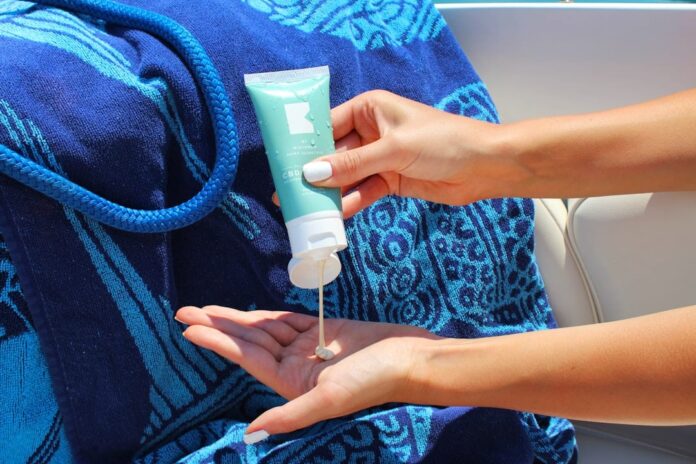
For the face and neck, dermatologists recommend a quantity corresponding approximately to two lines of cream applied with the index and middle finger, a simple method that allows for applying a sufficient amount of product.
The protection must be reapplied:
- every two hours during prolonged exposure;
- after each swim;
- after significant perspiration;
- after drying off with a towel.
Even products advertised as “water-resistant” require reapplication to maintain their effectiveness.
In July in Nice, the UV index can be very high
In mid-summer, the UV index frequently reaches very high levels on the Côte d’Azur, particularly between 11 am and 4 pm.
During this period, it is advisable to limit prolonged exposure, seek shade as much as possible and supplement sun protection with a wide-brimmed hat and glasses that filter UV rays.
After-sun care, an often forgotten ally
Skin protection does not stop after swimming or sunset.
After-sun care products, rich in hydrating agents such as aloe vera, panthenol or certain plant extracts, help restore skin comfort after a day in the sun and contribute to maintaining well-hydrated skin.
Nice Premium’s advice
Before enjoying the Côte d’Azur sun, a few simple reflexes can reduce the risks associated with exposure.
• Check the UV index for the day: on the Côte d’Azur, it frequently reaches very high levels in summer.
• Choose protection suited to your activity: an SPF 30 minimum is suitable for limited urban exposure, while an SPF 50 or 50+ is recommended for the beach, water activities or long hikes.
• Apply your sunscreen generously before exposure and reapply every two hours, as well as after each swim or heavy sweating.
• Always complement your protection with a hat, certified anti-UV sunglasses and, when possible, favor shaded areas between 11 am and 4 pm.
• Remember to hydrate regularly: in hot weather, dehydration can develop quickly without immediately causing a sensation of thirst.
• Infants and young children should never be directly exposed to the sun during the hottest hours of the day.
Fully enjoy summer… while protecting your skin
The sun is an integral part of the art of living on the Côte d’Azur. By adopting appropriate sun protection, regularly reapplying it and following a few simple safety rules, everyone can enjoy the pleasures of summer while preserving their skin in the long term.
If you are unsure about choosing protection, particularly for very sensitive skin, dermatological history or particular exposure, the advice of a dermatologist or pharmacist remains most appropriate.
The information presented in this article is based notably on the recommendations of European health authorities and leading dermatological societies concerning sun protection.
NicePremium is a free, independent local news outlet.
Help us keep going by supporting our work from €5 per month.


