
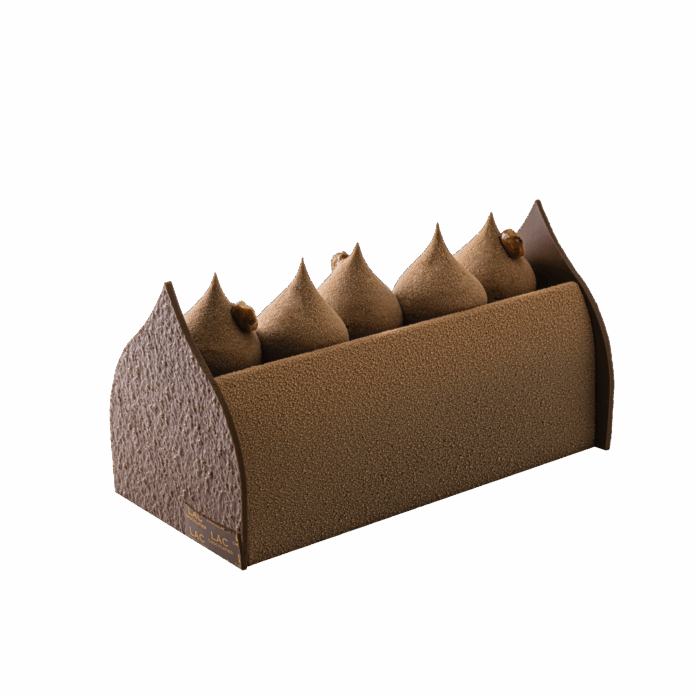
As the end-of-year holidays approach, Pascal and Julien Lac have decided to share the steps involved in making their famous DÉSIR yule log. A creation designed to be made by professionals or seasoned amateurs.
The DÉSIR yule log has been part of Maison LAC’s Christmas collection for many years. This gastronomic creation relies on a precise pastry construction, combining biscuit, praline, and milk ganaches. The aim is to achieve a balance between soft textures, firmer layers, and milky sensations without multiplying decorative effects.
Described by its creators as “a dessert like a perfume”, the DÉSIR yule log stands out with a structured approach, where each element finds its place in a progressive assembly. The recipe is designed for six people and requires careful organization, especially concerning the anticipation of certain preparations.
A biscuit base designed for structure
The process begins with an almond hazelnut dacquoise, which forms the base of the yule log. This biscuit is made with whipped egg whites and sugar, into which are incorporated nut powders, icing sugar, and a small amount of flour. The resulting batter is poured into a frame with precise dimensions and then baked at 180 degrees in two successive stages.
The baking must ensure the biscuit is sufficiently cooked to maintain its structure while retaining a soft texture. Once cooled, this dacquoise receives a layer of praline, applied directly on its surface to create the first textural contrast.
The praline combines a base of processed nuts, melted butter, milk chocolate, and crushed caramelized hazelnuts. This preparation provides a firmer structure and requires some resting time to set before the assembly continues. The biscuit is then cut into distinct strips, destined to be integrated into the mold during the final assembly.
Ganaches and interior construction
Two milk chocolate-based preparations are involved in the next part of the recipe. First, a poured ganache is made and then layered over the praline to create a transition between the biscuit and the creamier elements. This ganache must be smooth and homogeneous to ensure even distribution.
A second ganache, intended to be whipped, plays a central role in the structure of the yule log. Prepared in advance and kept cold, this ganache is whipped on the day of use to obtain a flexible and stable texture. The assembly begins with piping at the bottom of the mold, gradually moving up the sides to form an interior shell.
The assembly continues by adding a part of the poured ganache, then placing the biscuit strips. Each step aims to maintain a balance of volumes without compressing the previous layers. The mold is then entirely filled with the whipped ganache before being placed in the freezer to allow uniform setting.
A finish that can be modified
Once the yule log is frozen and unmolded, several finishing options are possible. Choices can include glazing, flocking, or a simple dusting of cocoa. Piping whipped ganache on top also visually recalls the dessert’s interior composition.
This freedom in the finishing contrasts with the rigorous assembly and highlights a desire to allow for interpretation without compromising the structure of the recipe.
By offering this detailed approach to the DÉSIR yule log, Maison LAC emphasizes a pastry based on precision of actions and understanding of balances, rather than an accumulation of visual effects. The yule log then becomes an exercise in construction, accessible as long as time, order, and method are respected. So, who will take on the challenge?
NicePremium is a free, independent local news outlet.
Help us keep going by supporting our work from €5 per month.


