
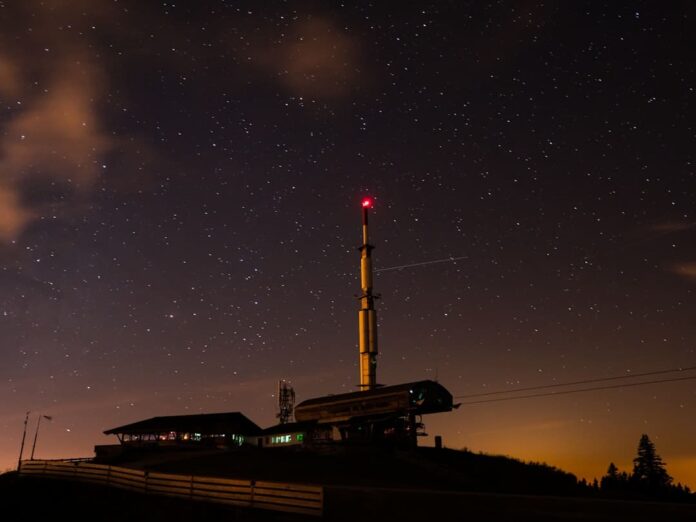
Long reserved for amateur astronomers and space enthusiasts, astrotourism is now establishing itself as a new way to travel. The total solar eclipse of August 12, 2026, visible notably from Iceland and parts of Spain, has shone a spotlight on this phenomenon. From Nice, however, there is no need to travel thousands of kilometers: at the gates of the Côte d’Azur, Mercantour is now home to one of Europe’s most remarkable territories for contemplating the night sky.
When the sky becomes a destination
Traveling to observe an eclipse, contemplate the Milky Way, follow a meteor shower or spend a night far from any light pollution: astrotourism is gradually transforming the way we envision vacations.
The principle is simple: choose your destination not only for its landscapes, heritage or gastronomy, but also for what happens above our heads.
The solar eclipse of August 12, 2026 provided a spectacular illustration. On that day, a total eclipse was visible from eastern Greenland, western Iceland, the northern half of Spain and a small part of northeastern Portugal. In much of the rest of Europe, including France, the phenomenon was observable as a partial eclipse.
Thousands of travelers thus chose their summer destination based on the trajectory of the Moon and Sun, transforming an astronomical event into a genuine tourist experience.
A trend that should continue: Europe has several major celestial phenomena coming over the next few years.
Spain, a privileged destination for eclipse chasers
From Nice, Spain naturally appears as one of the most accessible destinations for discovering astrotourism.
Beyond Barcelona or Madrid, certain Spanish regions benefit from low light pollution and vast spaces conducive to nocturnal observation. The high plateaus of Castile, Extremadura or certain rural areas of Andalusia allow you to find a sky that has become rare around major European metropolises.
And Spain has not finished attracting attention.
After the eclipse of August 12, 2026, a new total solar eclipse will cross southern Spain on August 2, 2027. In certain areas near the Strait of Gibraltar, total darkness will last several minutes.
Then, on January 26, 2028, an annular eclipse will be visible notably from Spain and Portugal.
For travelers who missed this summer’s spectacle, the next appointment is already set.
The Canary Islands, an open-air observatory
To go further, the Canary Islands have long been among Europe’s great destinations for astronomy.
Their altitude, climate and atmospheric quality have favored the installation of major scientific observatories. Tenerife and Teide have become references for enthusiasts wishing to combine vacation with sky discovery.
Several excursions now allow you to reach the heights of the island at sunset before continuing the evening with observation of stars and planets.
The experience perfectly captures the spirit of astrotourism: transforming a simple evening into a genuine travel memory.
Iceland, between eclipses and northern lights
Further north, Iceland operates in a different category.
The country was situated on the path of totality of the eclipse of August 12, 2026 and already has a long tradition of tourism linked to celestial phenomena.
In winter, it is naturally the northern lights that attract visitors. Far from Reykjavik, hotels, lodges and specialized excursions allow you to search for them when weather conditions are favorable.
The offering has gradually become more professional: specialized guides, isolated accommodations, detailed weather forecasts and nocturnal excursions are now part of the experience.
From Nice, Iceland generally requires more organization than a trip to Spain, but it remains one of Europe’s most spectacular destinations for those wishing to build a trip around the sky.
From Nice, one of Europe’s most beautiful skies is much closer
But do you really need to take a plane?
The answer is no.
Just dozens of kilometers from the lights of the Côte d’Azur lies a territory recognized internationally for the quality of its nocturnal environment: the Alpes Azur Mercantour International Starry Sky Reserve.
And 2026 marks an important milestone for the region.
The reserve, created in 2019, officially expanded its perimeter this year to now encompass the entire Mercantour National Park.
Its area thus increased from approximately 2,300 to 3,700 km², while the number of affected municipalities increased from 75 to 92.
This expansion also has international significance: Alpes Azur Mercantour became the first International Starry Sky Reserve in the world to have officially enlarged its certified territory.
A recognition that places the Nice hinterland among the reference territories for protecting the night sky.
Just a few kilometers from the Mediterranean, rediscovering true night
The contrast is striking.
In just a few hours, it is possible to leave the lights of the Azure Coast to reach the valleys and peaks of Mercantour, where darkness progressively reveals a sky that many city dwellers have almost forgotten.
The Milky Way becomes more visible, constellations stand out with greater precision and, with minimal equipment, planets and celestial objects become accessible.
The experience is not even reserved for experts.
Mercantour National Park and various local actors regularly organize astronomy initiation evenings, nocturnal walks and starlit vigils.
At Pra Loup, for example, evenings this summer allow you to discover planets, stars, nebulae and galaxies accompanied by a scientific mediator. Other introductions are organized in the Mercantour territory, notably at Guillaumes.
Astrotourism then becomes a genuine weekend getaway idea from Nice: leave in late afternoon, dine in a mountain village, observe the sky and possibly spend the night there before returning to the Mediterranean the next day.
A natural heritage that we are also learning to protect
Observing the sky also allows us to become aware of a phenomenon often invisible: light pollution.
In large urban areas, artificial lighting obscures much of the stars. But its consequences far exceed astronomy: nocturnal light also disrupts ecosystems and many animal species.
Preserving the night sky has thus become a genuine environmental issue.
In the Alpes Azur Mercantour Reserve, more than 5,000 light points have notably been modernized as part of a program aimed at reducing light pollution and energy consumption.
The paradox is appealing: one of the new attractions of the Côte d’Azur is based precisely on what one chooses not to illuminate.
How to prepare a starlit getaway?
An astrotourism stay ultimately requires little equipment, but a few precautions can completely transform the experience.
- Choose the right lunar phase. To observe the Milky Way and deep sky, favor nights close to the new moon. The light of a full moon can mask much of the faintest stars.
- Check the weather until the last moment. Clouds and humidity can quickly compromise an observation evening, particularly in the mountains.
- Start simply. For a first experience, there is no need to immediately invest in a telescope. A good pair of binoculars, a sky map or an astronomy app already allow many discoveries.
- Bring warm clothing. Even in summer, temperatures can drop quickly after sunset in the Southern Alps.
- Use red light. It allows you to move without completely losing your eye adaptation to darkness and limits nuisance for other observers.
- Respect natural spaces. Silence, absence of waste and limitation of lighting are essential, particularly in protected areas.
Warning: to observe a solar eclipse, one rule remains absolute: never look directly at the Sun without glasses specially certified for solar observation.
Will tomorrow’s tourism look more at the stars?
The rise of astrotourism is part of a broader evolution in travel.
Faced with saturated destinations and standardized stays, some travelers now seek more personal experiences: sleeping in an isolated place, observing a rare natural phenomenon, discovering a territory at a different pace.
The sky then has a considerable advantage: no spectacle is exactly identical to the previous one.
A starry night in Mercantour, a northern light in Iceland or a few minutes of darkness in the heart of an eclipse are not consumed like a classic tourist attraction.
They are experienced.
And for the Côte d’Azur, this evolution represents an interesting opportunity. Nice has both a major international airport, the Mediterranean and, at relatively short distance, mountains with an exceptional night sky.
Few European destinations can offer such a contrast.
After the 2026 eclipse, see you in 2027
The eclipse of August 12, 2026 has passed, but it may well have inspired many Europeans to continue looking to the sky.
For those who missed it, the calendar already offers a chance to catch up: on August 2, 2027, a new total solar eclipse will be visible in southern Spain.
But there is no need to wait for such an exceptional phenomenon.
From Nice, just a few dozen kilometers are enough to change scenery, gradually leave the city lights and rediscover something we may have thought was guaranteed: a genuine night.
Sometimes, to travel far, you just need to look up.
NicePremium is a free, independent local news outlet.
Help us keep going by supporting our work from €5 per month.


