
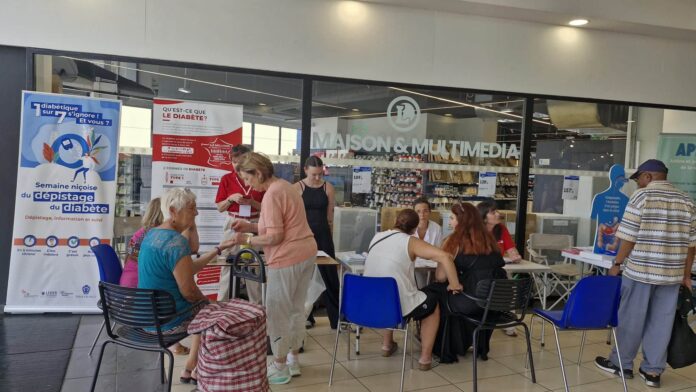
Until June 5, the city of Nice is organizing free screening booths for type 2 diabetes with no appointment necessary. This initiative highlights the importance of getting diagnosed in order to adopt new eating habits or appropriate treatment.
The screening booths
There are three days left to access the screening booths from 9 am to 12 pm. Otherwise, it is possible to visit the Hancy Vaccination Center or the House of Solidarity and Sharing throughout the month of June, depending on opening days.
- Wednesday, June 3: Place Fontaine du Temple
- Thursday, June 4: Marché de la Libération
- Friday, June 5: Marché de l’Ariane
An opportunity to have your blood glucose level checked and to learn more about the disease, its symptoms, and treatments. At each booth, healthcare professionals are present to answer any questions.
According to a nurse present at the Leclerc Saint Roch booth yesterday, there are two types of diabetes. Type 1 appears more in youth while type 2 manifests more often after age 35. “It’s a disease that is invisible, […] that’s why you have to come get screened like today”. Often, the symptoms do not alert people; they may experience sweating, discomfort, tremors, confusion, intense thirst… When diagnosis is delayed, diabetic foot syndrome can also occur: a simple foot wound heals with difficulty and can, in the most severe cases, lead to amputation.
Some patients also have risk factors within their immediate or extended family. The most reliable way to be certain remains a blood test, prescribed by the attending physician. The patient can then regulate their diabetes through diet, oral treatment, or insulin, depending on the case.
On site, some visitors take advantage of their shopping to get checked. This is the case with a man met at the booth, who regularly undergoes this type of screening. Having a history of diabetes in his family, he prefers to stay vigilant. He also praised the initiative: “I think it’s great, a good initiative.“
Lorenzo, 22 years old: “today, I live very well with my diabetes”
Lorenzo is 22 years old and has lived with type 1 diabetes for ten years. He was diagnosed on February 14, 2016, following a rapid deterioration of his health. He remembers drinking excessively, urinating very frequently, losing four kilos in a week, and feeling increasingly weak: “I was vomiting everything I ate, I couldn’t even stand up,” he recalls. His worried parents take him to the hospital. He falls into a coma lasting a day and a half.
Hospitalized for two weeks, he learns to live with this autoimmune disease: “my body attacks my beta cells, so my pancreas no longer produces insulin.” Adolescence made adaptation even more difficult. Between fast food, candy, and outings, Lorenzo sometimes felt “different”: “others could eat without thinking, whereas I always had my big bag with the glucose meter, strips, pen, sugar…“
Today, he uses an insulin pump and a glucose sensor attached to his arm, directly connected to his phone. Technology that makes his daily life easier. “It’s no longer a mental burden. It’s integrated into my life. I’m careful, but I no longer deprive myself.” Ten years after his diagnosis, he says he has found balance: “I manage my diabetes well, and I learn something new every day.“
An early diagnosis remains essential for avoiding complications and beginning appropriate follow-up quickly. Screening initiatives remind us that knowing your health status allows you to live better with the disease on a daily basis. Lorenzo’s journey shows how much a diagnosis, even a shocking one, can become the starting point for true balance.
NicePremium is a free, independent local news outlet.
Help us keep going by supporting our work from €5 per month.


