
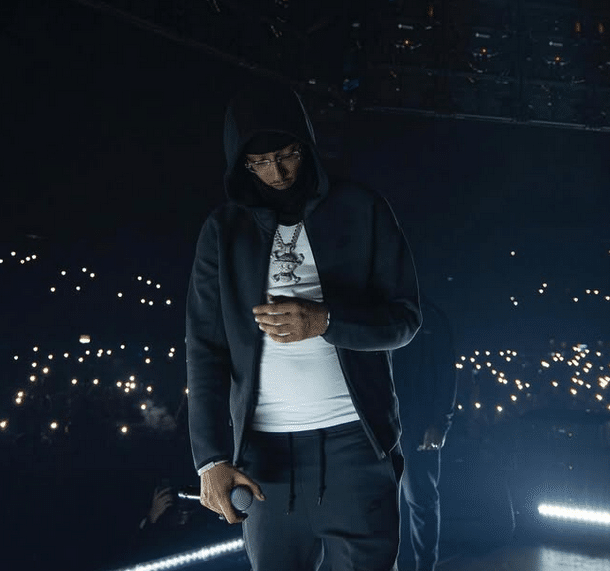
The rapper Freeze Corleone was sentenced on April 27, 2026, in Nice for advocating terrorism. The criminal court issued a 15-month suspended prison sentence, a fine of 50,000 euros, and a residency ban. This decision follows the controversy surrounding the song “Haaland,” accused of referencing the July 14, 2016, attack.
The rapper Freeze Corleone was sentenced in Nice for advocating terrorism. The judgment was rendered on April 27, 2026, by the Nice criminal court. The sentence includes 15 months of suspended prison and a fine of 50,000 euros. A three-year ban from the Alpes-Maritimes complements the decision. Damages of 2,800 euros were awarded to each of the civil parties.
This condemnation of Freeze Corleone in Nice is based on the song Haaland. This track, recorded with Luciano, is at the center of the controversy. An interrupted phrase indirectly refers to the July 14, 2016, attack. This attack in Nice, on the Promenade des Anglais, resulted in 86 deaths and hundreds of injuries. The question posed to the court concerned the interpretation of these lyrics and their impact.
The prosecutor of the Republic of Nice, Damien Martinelli, had requested 18 months of suspended imprisonment. During the hearing, the magistrate stated: “art can and should challenge us.” The prosecutor also mentioned “a nauseating ideological foundation and a desire for provocation in a mercantile logic.”
Why was Freeze Corleone convicted in Nice for advocating terrorism?
The Freeze Corleone case is based on a detailed analysis of the song Haaland. Even without explicit mention of the Promenade des Anglais, the magistrates held that there was an implicit reference to the attack. The silence following an interrupted phrase “in defense I’m Kalidou, you’re Lenglet. Burberry like an English grandfather. I come in rap like a truck bombing full speed on the…” was interpreted as a central element.
The conviction for advocating terrorism relies on this construction. The court considered that the message could be understood as a glamorization of a terrorist act. A reading contested by the defense.
The rapper, whose real name is Issa Lorenzo Diakhaté, did not attend any hearings, maintaining silence throughout the proceedings.
Lawyer Adrien Chartron announced an appeal after the conviction of Freeze Corleone. The defense criticizes a decision “that is more authoritarian, discretionary than lawful.” The argument focuses on the fact that the contentious words are not explicitly pronounced.
Song Haaland and Nice attack: why the controversy?
The song Haaland by Freeze Corleone has become a point of tension. The track circulated widely on platforms. The album La menace fantôme reached 5.2 million streams on Spotify within 24 hours of its release.
In this context, the question of the influence and reception of the piece was raised. The association between music, implicit reference, and the Nice attack fueled public debate. The link to the July 14, 2016, attack was at the heart of judicial discussions.
This controversy around Freeze Corleone and the song Haaland fits into a broader debate. The place of violent or symbolic images in rap is regularly questioned. The decision rendered in Nice rekindles this question.
Reaction of the victims of the Nice attack after the conviction
Seventeen civil parties were constituted in the trial against Freeze Corleone for advocating terrorism. Several families of victims of the Nice attack and associations participated in the hearings.
Hager ben Aouissi declared: “I cannot believe that one can glorify their nightmares.” This association leader added: “terrorism should not be an image of power, it cannot be a figure of speech.”
After the decision rendered on April 27, 2026, in Nice, the associations expressed relief. Marie-Pierre Lazard, lawyer for the civil parties, indicated: “it was an expected and important judgment.”
The consequences of Freeze Corleone’s conviction after the Nice judgment?
The conviction of Freeze Corleone in Nice for advocating terrorism occurs in a context of controversy. An investigation in 2020 for incitement to racial hatred had been closed without follow-up. The Universal Music label then ended the collaboration. Since the inception of the investigation in 2024, the rapper has not performed on stage.
The announced appeal opens a new judicial stage. The Freeze Corleone case could be re-examined. The conviction of the rapper in Nice for advocating terrorism, pronounced on April 27, 2026, is part of a case involving music, justice, and the memory of the July 14, 2016, attack. The Freeze Corleone case, linked to the song “Haaland,” continues to provoke research and debates about the limits of artistic creation.
NicePremium is a free, independent local news outlet.
Help us keep going by supporting our work from €5 per month.


