
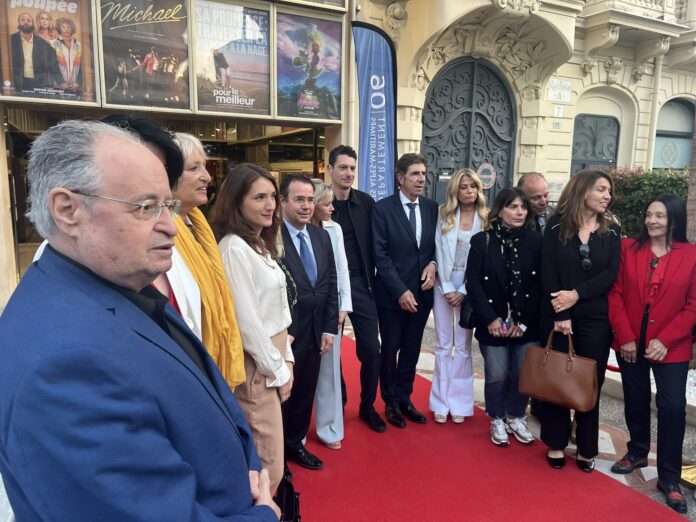
On Thursday, April 23, 2026, the Variétés cinema in Nice buzzed with the excitement of an extraordinary premiere. Two episodes. One murder. A resurrected era. Four heroines: Julie de Bona, Sofia Essaïdi, Nolwenn Leroy, and Constance Gay, with an audience eager for more.
The idea came from Iris Bucher, CEO of Quad Drama Production. Following the successes of Le Bazar de la Charité and Les Combattantes, TF1 asked her for a third installment. She chose the summer of 1936: the advent of the first paid vacations, the working class arriving on the Riviera for the first time, and a severe clash with a bourgeoisie that considered the beach its exclusive domain. “It was a pivotal period, perfect for inserting a detective story à la ‘Agatha Christie,'” she explained. The dramatic twist comes from a little-known historical detail: in January 1936, the French police opened an auxiliary position to women for the first time. An investigating heroine was thus possible, legitimate, inevitable. With writers Marie Désert and Catherine Touzet, and director Fred Garson behind the camera, “Été 36” was born. Fifteen years after her start in production, an emotional Iris Bucher confided that night that this may be the series she is most proud of.
An immense challenge at the heart of Nice. Recreating Nice in 1936 in the middle of 2025 was a feat. Fred Garson did not downplay the scope of the project. “Every accessory had to be period-appropriate, every gesture coherent.” Hundreds of extras, over thirty vintage cars, the Promenade des Anglais blocked for two whole days, traffic jams stretching back to Italy, according to a local restaurateur. The bars of Le Négresco, unchanged since the 30s, served as a natural backdrop. The Hôtel Masséna was transformed into a fictional palace. Visual effects recreated the mythical Palais de la Jetée. On set, coordinating such a vast ensemble was also a challenge: “Many scenes involve interactions between nearly 12 main characters. It’s like choreography. If just one is slightly delayed, the choreography falters,” confided the director. And laughter was not scarce. Iris Bucher remembered: “Antoine Simony, who plays young Gabriel, came out of the water shivering from head to toe. We really pitied him. But while he performed, he was flawless. Incredible.” A team spirit that likely helped attract a stellar cast: Julie de Bona, Sofia Essaïdi, Nolwenn Leroy, Constance Gay, François-Xavier Demaison, Pascal Elbé, Miou-Miou. Cinema and theater names who all said yes to “the breadth of the adventure,” as the director put it.
Nice and its institutions, proud to have said yes
The evening was also one of institutional recognition. Zara Boutayeb, Deputy Mayor of Nice in charge of promoting film and audiovisual productions, represented Éric Ciotti. She paid tribute to all the teams and the cast, describing “a cinema city, a source of inspiration for many creators,” before thanking the studios of la Victorine and the municipal teams for their daily support during the shooting.
The Prefect of the Alpes-Maritimes Laurent Hottiaux proudly recalled that the prefecture’s teams had hosted part of the makeup and support teams on site. He also emphasized that the department is a cinema land, recalling that the Cannes Film Festival, whose next edition opens on May 12, was created in 1939 on the initiative of the Popular Front, with Jean Zay, Minister of National Education, and its first screening took place on September 1, 1939, the day of the invasion of Poland, before being postponed to 1946.
Charles Ange Ginésy, president of the Alpes-Maritimes department, recounted how Iris Bucher convinced him via videoconference to co-finance the production. “She came with all the talent of her conviction,” he smiled. He emphasized the driving role of the department, recalling that since 2006, more than 100 projects have been supported by the departmental fund, relaunched in 2026. “It’s with great pride that the department committed as a major partner to support this production, thus contributing to bringing creation to life and highlighting local talents,” he declared. He also praised the territory in all its diversity: “Between the bright Mediterranean and the snow-capped peaks of Mercantour, our department offers an exceptional setting, a true open-air studio.” He added enthusiastically: “following the World Artificial Intelligence Film Festival, approaching Canneseries, and of course the mythical Cannes Film Festival, I want to reaffirm our determination to support all those who make the Alpes-Maritimes a territory of openness, sharing, and cultural renewal.”
An enchanted audience, total anticipation
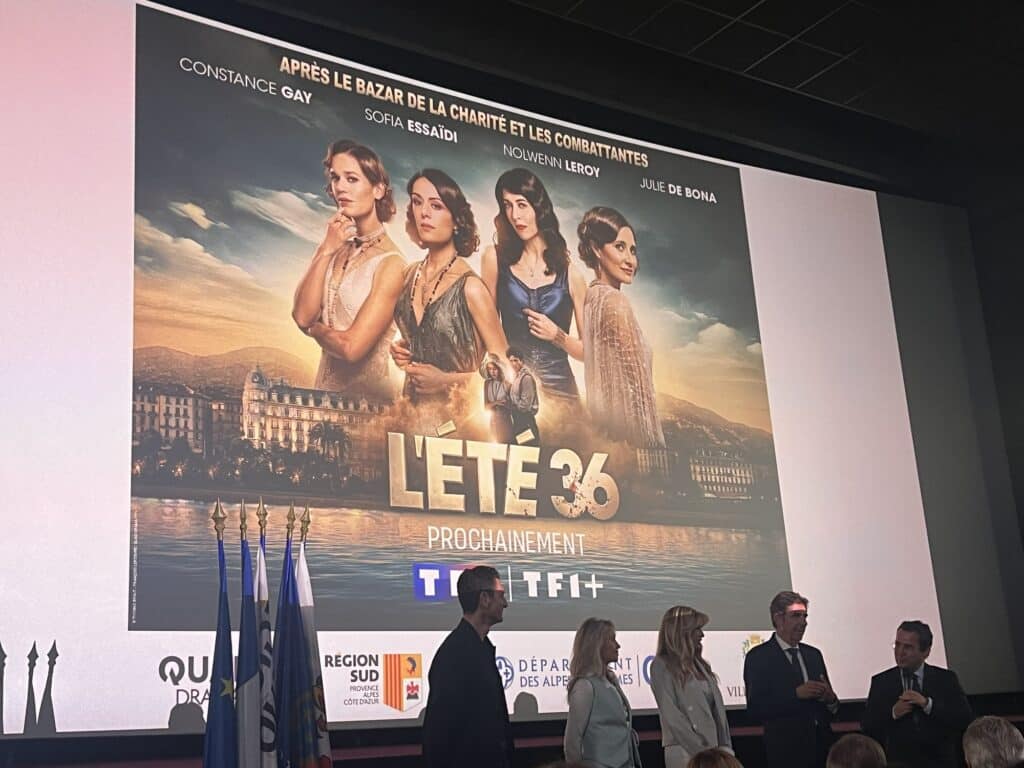
In the theater, the verdict was clear. Philippe, who came from Alpes-de-Haute-Provence as a spectator, hurried to question the producer right after the screening: “How do we find out what happens next? It keeps you in suspense the whole time,” he confided. Karina, another spectator, perfectly summed up the spirit of the series: “It depicts a life that the common person can live, whether rich or poor.” The broadcast date on TF1? Iris Bucher remains enigmatic: “I will not tell you.” One thing’s for sure: Nice will continue to be talked about.
Adama Sanogo
NicePremium is a free, independent local news outlet.
Help us keep going by supporting our work from €5 per month.


