
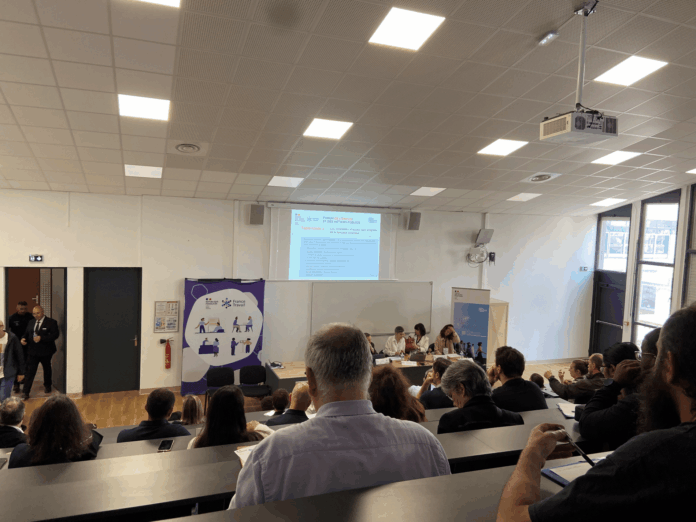
The Carlone campus of the University of Côte d’Azur hosted the Employment and Public Professions Forum in Nice this Tuesday. The event aimed to present the different pathways to public service and to inform students and job seekers about career opportunities within administrations.
Smile, you’re being hired! Throughout the day, students, young graduates, and people in career transition were able to meet representatives from numerous public institutions who came to present their professions and recruitment methods. Among the structures present were state administrations, local authorities, and judicial institutions.
“One Quarter of Employment Opportunities”
The first round table of the day was dedicated to the modalities of access to public service. Several speakers took the floor, including Agathe Ferran, project manager for interministerial attractiveness and mobility at the regional prefecture, and Carole Claudepierre from the local government public service management center of Alpes-Maritimes.
Before delving into recruitment details, the speakers recalled the general organization of the public service in France. It is composed of three branches: the state public service, the local public service, and the hospital public service. The first includes, among others, ministries and administrations like prefectures. The next concerns local authorities, and the third includes public hospitals and medico-social structures. According to figures presented during the round table, the public service currently represents 5.7 million agents in France, or about one in five employees. In the Provence-Alpes-Côte d’Azur region, nearly 430,000 public agents work within these administrations.
For Agathe Ferran, public service constitutes a vast field of professional opportunities: “When thinking about career change or career and excluding public service, you’re ignoring nearly a quarter of employment opportunities,” she explained. The speakers also emphasized that administrations will face a major turnover. By 2030, approximately 20% of public agents are expected to retire, which will lead to a “significant wave of recruitments“.
Not Only Through Competitions!
Contrary to some preconceived notions, competitions are not the only gateway to public service. Several recruitment methods exist. The classic path remains administrative competitions, divided into different categories based on qualification level: A, B, or C. However, it is also possible to join the administration through other mechanisms. Some category C positions can be filled without competition, through direct recruitments organized by ministries. The use of contractual employees is also an increasingly common access route: today, about one in five public agents works under this status.
Apprenticeship and internship programs also represent a favored entry point for students. A national platform (https://www.fonction-publique.gouv.fr/) is available to consult the internship and apprenticeship offers proposed by public administrations.
The diversity of professions is also highlighted during this round table. The public service includes more than a thousand different professions. “There are cooks, drivers, IT specialists, human resources managers, and even mathematicians,” reminded Carole Claudepierre, highlighting that career paths can evolve over time.
Promoting Equal Opportunity
The speakers finally discussed several schemes aimed at promoting equal opportunities. Among them are “Prep Talents,” which support scholarship students or job seekers in preparing for administrative competitions. This program offers tutoring, administrative internships, and financial assistance of up to 5,000 euros per year.
Implemented in 2021 by Emmanuel Macron, this scheme shows promising results. Nearly 7,000 students have already benefited from this support, with a success rate of about 60% in competitions. The goal is to combat self-censorship and enable individuals from various social backgrounds to enter public careers. “The public service must reflect the diversity of society,” stated Agathe Ferran.
NicePremium is a free, independent local news outlet.
Help us keep going by supporting our work from €5 per month.


