
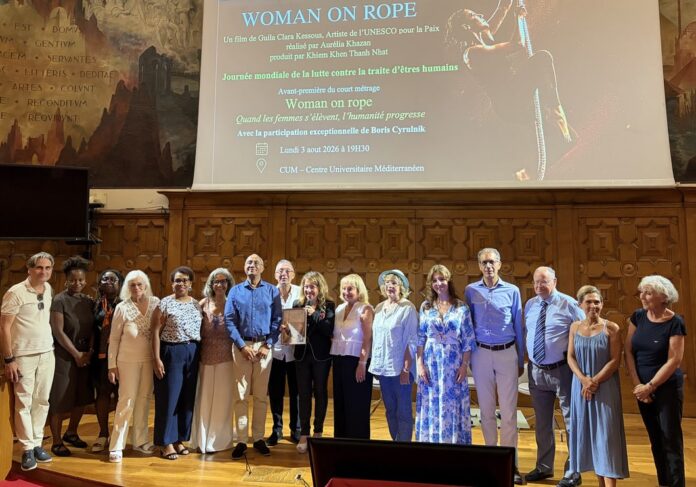
An awareness evening dedicated to the World Day Against Human Trafficking was held at the Mediterranean University Center in Nice. Guests had the opportunity to attend an exchange between figures of commitment and science. The city of Nice is a symbolic place to promote collective mobilization.
In the heart of the Albert Camus hall, minds were mobilized around the issue of the violence of human trafficking. The city of Nice coordinated with Guila Clara Kessous, UNESCO artist for peace and the Coordination Council of Armenian Organizations of the Côte d’Azur (CCOCA) to organize this exchange around “one of the greatest violations of human dignity.” The short film “Woman on Rope” was screened to close the evening.
Trafficking is characterized by the recruitment, transportation, transfer, accommodation or reception of people, under the effect of threat, coercion, deception or abuse of a situation of vulnerability, for purposes of exploitation. This can manifest in different forms, including sexual exploitation, forced labor, forced begging or forced criminality.
“International estimates indicate tens of millions of people victims of modern slavery in the world. No figure will ever be able to fully express the trauma experienced, the freedoms taken away and the difficult paths of reconstruction,” said Guila Clara Kessous.
The choice of the Côte d’Azur city is particularly significant for addressing these forms of violence, but also the path to reconstruction for victims so that they are never condemned to invisibility.
Nice, at the crossroads of cultures
The location of this ceremony is not insignificant. The Mediterranean University Center is renowned for being the guardian of ideas. Amphitheaters and libraries continue to be spaces for exchange, in which thoughts are enriched and ideals of freedom and justice are cultivated. “We are gathered in a deeply symbolic place, in this city of Nice which has embodied, for centuries, dialogue between cultures, openness to the world and encounter between peoples,” declared the UNESCO artist for peace. The Côte d’Azur city continues to be a place of sharing, transmission and understanding of each person’s realities.
Furthermore, Nice remains a strategic crossroads. The Mediterranean is also one of the routes used for human exploitation, at the intersection of Europe, Africa and the Middle East.
“Faced with this reality, the city is taking its part in this fight, by making the strong choice of prevention and direct action, by developing pioneering infrastructure to listen to, protect and support victims,” announced the representative of Éric Ciotti and deputy to the Nice City Hall, Dario Lutchmayah. For example, the Reception Center for Victims offers people facing trauma “free, confidential and personal support,” he added.
Guila Clara Kessous: “refusing indifference and defending human dignity“
“Responsibility does not rest solely with institutions, it also belongs to each of us, civil society. Criminals thrive in silence and indifference,” said Kirkor Ajderhanyan, vice-president of CCOCA.
The intervention of neuropsychiatrist Boris Cyrulnik highlighted the process of reconstruction for victims: “victims of human trafficking have experienced not only trauma but also abandonment, silence and indifference.” He, who is considered the pioneer of resilience, explained that indifference is excessive withdrawal into oneself so as not to suffer with others. “Denial is protective but it prevents finding solutions and for that we must open our eyes and face reality,” he added.
According to the neuropsychiatrist’s work, this ability to bounce back, despite the trials experienced, exists “provided that society knows how to listen, protect and support,” said Guila Clara Kessous. The figures of commitment present insisted on the importance of listening and building a relationship of trust with victims. “For me the turning point is when the person feels they are truly listened to, without being judged,” confided Maria Ramos, president of the Racine du Cap-Vert association in Nice. “Each of us must act, prevent, inform and guide people by supporting and assisting them,” she assured.
To address human trafficking, all the personalities present declared that it was essential to combine justice, social protection, education, culture and international cooperation.
NicePremium is a free, independent local news outlet.
Help us keep going by supporting our work from €5 per month.


