
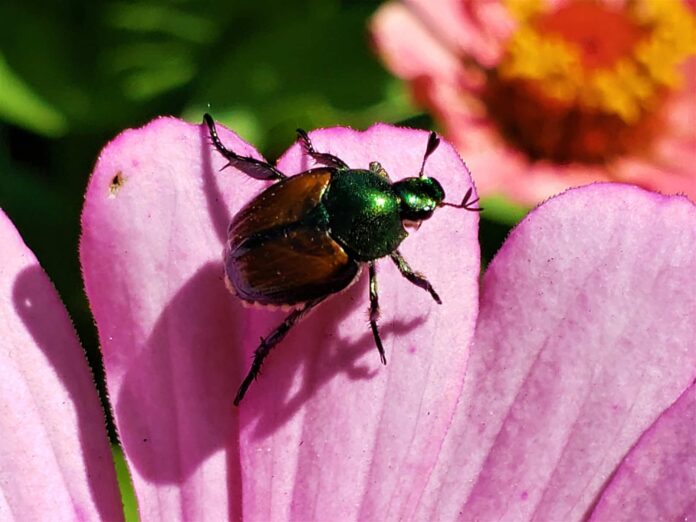
Five new Japanese beetles have been detected in Mougins, bringing the number of specimens identified in the Alpes-Maritimes to seven. Classified as a priority quarantine organism in Europe, this insect represents a threat to crops and green spaces due to its ability to attack more than 300 plant species.
Vigilance is increasing in the Alpes-Maritimes. The prefecture of the Provence-Alpes-Côte d’Azur region announced on Tuesday, July 28, the detection of five new Japanese beetles in Mougins. These captures bring to seven the number of insects identified in the department since surveillance was strengthened following an initial detection in Cannes last June. Specimens had also been discovered in the Bas-Rhin.
The identification of the new insects was confirmed by ANSES’ national reference laboratory. Following this confirmation, the Regional Directorate of Food, Agriculture and Forests (DRAAF) strengthened its system. Additional traps have been installed and intensive surveys are underway. This surveillance will be maintained in the coming weeks in order to “precisely assess the phytosanitary situation and quickly detect any developments.”
An insect capable of threatening more than 300 plant species
The Japanese beetle (Popillia japonica) is not just any beetle. Originally from Asia, this insect is classified as a priority quarantine organism by European regulations. Such a classification is explained by the potential consequences for agriculture and green spaces.
The danger of the Japanese beetle lies in its particularly extensive diet. More than 300 plant species can be attacked. Vines, fruit trees, small fruits, corn, lawns as well as many ornamental plants are among the most exposed vegetation. A proliferation of the species could cause significant damage to crops, gardens and certain natural areas.
Already established in Italy since 2014 and in Switzerland since 2017, the Japanese beetle was detected for the first time in France in 2025. Since then, authorities have been increasing controls to prevent its permanent establishment in the country.
The risk is not solely due to damage caused to plants. The insect’s dispersal capacity also represents a source of concern. Nicknamed a “hitchhiker,” the Japanese beetle travels easily in vehicles, goods, luggage, plants, or various objects. This ability facilitates rapid spread over long distances.
To limit this expansion, DRAAF has been deploying since 2021 a network of enhanced surveillance along the main road, rail and airport routes linking the region to Italy. Traps are also installed near sectors considered sensitive, particularly logistics platforms, campsites, golf courses and certain natural areas. The new detections recorded in Mougins led to the immediate reinforcement of this system.
Authorities are also calling on residents to participate in this surveillance. The Japanese beetle can be confused with the summer chafer, but certain criteria allow it to be identified. The insect is smaller than a one-cent euro coin and displays well-visible tufts of white bristles on the sides of the abdomen. Anyone who believes they have observed a specimen is invited to take a photograph and send an email to the DRAAF Provence-Alpes-Côte d’Azur mentioning “Popillia Report” as well as the precise location of the observation. The goal remains to quickly identify any new presence in order to prevent the permanent establishment of this pest in the Alpes-Maritimes.
NicePremium is a free, independent local news outlet.
Help us keep going by supporting our work from €5 per month.


