
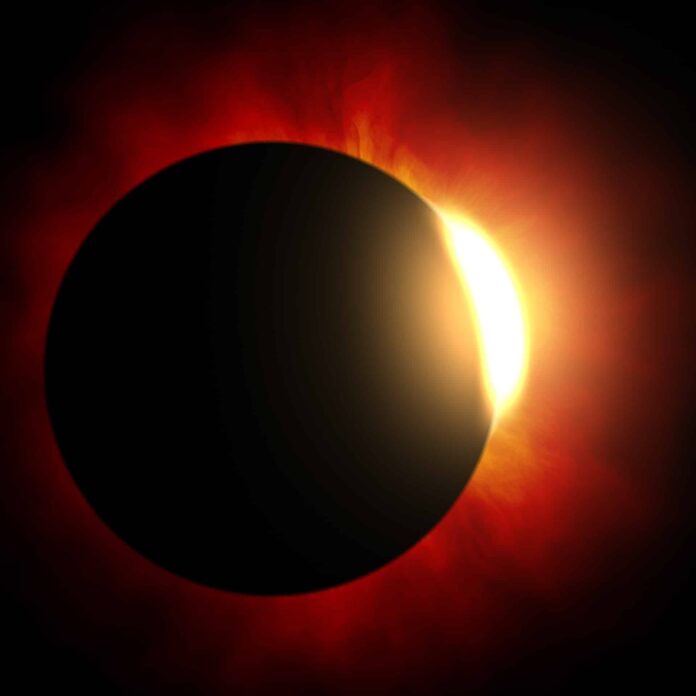
The partial solar eclipse on Wednesday, August 12, 2026 will be visible from the entire French Riviera. In Nice, nearly 95% of the Sun will be obscured around 8:24 PM. Here are the places to prioritize to try to observe the phenomenon until its maximum.
The French Riviera is preparing to observe a partial solar eclipse this Wednesday, August 12, 2026. The phenomenon will begin around 7:30 PM on the coast. In Nice, the maximum is expected at 8:24 PM, with approximately 95.1% of the Sun obscured. In the Alpes-Maritimes, the obscuration will reach between 95 and 97% depending on the area.
A particular difficulty arises for observers. At the time of maximum, the Sun will be very close to the horizon. The choice of location will therefore be decisive. A relief, trees, or buildings can quickly mask the celestial body.
From Nice to Valberg, the places to prioritize
The main criterion will be to have a clear horizon towards the West or West-Northwest. On the coast, beaches and seafront areas offering sufficient openness will allow you to follow the eclipse.
In Nice, the Promenade des Anglais is an interesting area in zones open towards the west. Some high points of Mont Boron can also be suitable, provided there is sufficient clearance. The Castle Hill will also be exceptionally accessible until 9 PM. The Bellanda Tower offers a particularly open view over the Bay of Angels.
In Cannes, waterfront areas oriented towards West-Northwest are to be prioritized. The Croix des Gardes can also offer suitable observation points. In Antibes, the ramparts, certain areas of Cap d’Antibes, and the heights of Garoupe are recommended when the horizon remains clear.
Around Èze, the Fort de la Revère area can be suitable from locations with an opening towards West-Northwest.
In the Grasse Region and the Prealpine foothills, several areas are also identified. Col de Vence, Gourdon, Saint-Vallier-de-Thiey, Col du Ferrier, Gréolières, Gréolières-les-Neiges, and Coursegoules have points that can offer good openness. Ridges and plateaus should be prioritized when relief does not obscure the horizon.
In the Upper and Middle Country, high points in the Tinée, Cians, and Var valleys can also be interesting. Passes, ridges, and accessible plateaus should be selected when the West-Northwest direction remains sufficiently clear.
At Valberg, an official observation is planned at the summit of the Eguilles starting at 7 PM, weather permitting. Scientific mediators from the Dome will accompany the public.
The highest location will not necessarily be the best. With a sun very low on the horizon, a few degrees of relief can be enough to make the celestial body disappear before the maximum of the eclipse.
Special glasses essential
Observation will also require appropriate protection. Even when nearly 95% of the Sun is obscured, the remaining radiation can cause serious damage to the retina.
Regular sunglasses are not sufficient. Special eclipse glasses must comply with the ISO 12312-2 standard. The same precautions apply to observations with binoculars, a telescope, or a camera. These devices should never be pointed at the Sun without a solar filter specially designed for this use.
Installing early enough will also allow you to verify that the horizon remains clear in the right direction. On the coast, the gaze should be directed towards West-Northwest.
Weather will finally be another factor to monitor. Thunderstorms expected on the reliefs in the afternoon could generate cloud veils to the coast by evening. These clouds could disturb observations at the time of maximum.
Photographing the eclipse safely
If conditions are good and you wish to capture the solar eclipse, a few precautions remain necessary. A smartphone or camera should not be pointed directly at the Sun without appropriate protection. A solar filter specially designed for astronomical photography must be placed in front of the lens. Without a filter, the bright light can damage the sensor and make images overexposed. For observation with a smartphone, it is also better to avoid looking directly at the Sun through the screen when the device is pointed at the celestial body. The simplest thing to do is to prepare the framing in advance and use equipment with appropriate solar protection.
So see you this Wednesday, August 12 around 8:24 PM to try to glimpse the solar eclipse from the Alpes-Maritimes, provided you have a clear horizon and appropriate protection.
NicePremium is a free, independent local news outlet.
Help us keep going by supporting our work from €5 per month.


