
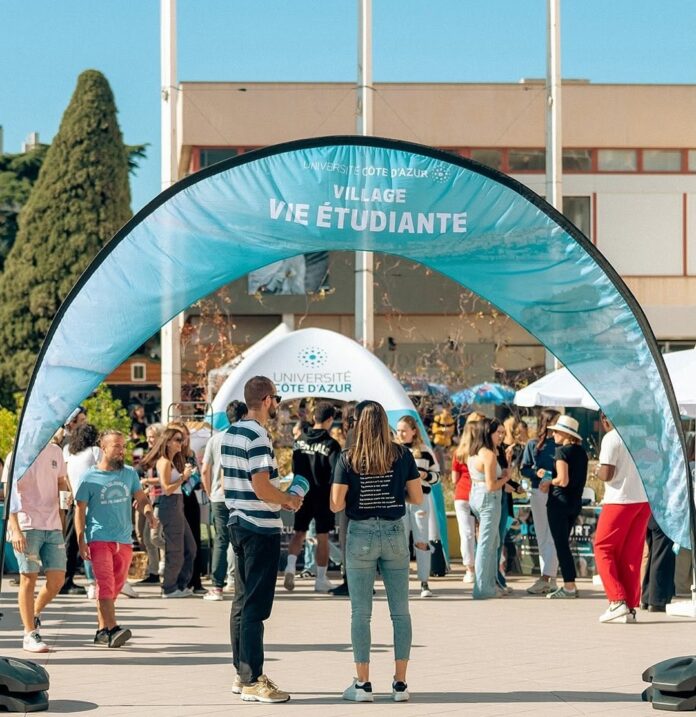
As the new university year has just started, housing remains one of the main points of tension in Nice. Today, more than one young person in two would be in a situation of inadequate housing. Between testimonies and figures from the Federation of Associations and Student Corporations of 06, the question arises: has Nice become an unaffordable city for its students?
Septembers follow one another but the situation is deteriorating year after year on the Côte d’Azur. According to the 2026 Back-to-School Cost Indicator, produced by FACE06, a non-scholarship European student, living alone and without assistance, must spend 4,018.99 euros to cover their back-to-school expenses. A figure up 3.02% compared to 2025. For an international student, the bill even climbs to 7,704.05 euros.
In addition to this is an essential monthly budget estimated at 1,207.12 euros. It obviously includes rent, food and transport, but also multimedia subscriptions and packages, entertainment, cleaning products and menstrual expenses.
Finding housing, a budget in itself
Housing remains the first factor putting pressure on the budgets of students on the Côte d’Azur. A 25 m² T1 now reaches 700 euros per month on average, an increase of 15.89% in one year. Nice is the second most expensive student city in France for housing, just behind the Paris region, according to the UNEF ranking.
And since difficulties never come alone, add 325 euros in agency fees and a security deposit, which generally equals one additional month of rent.
According to FACE06, the leading youth organization in the Alpes-Maritimes, “more than one student in two is still in a situation of inadequate housing.” Beyond price, “this inadequate housing is also characterized by access difficulties, sanitation conditions, living space as well as security issues,” clarifies the federation.
“ Life is much more expensive in Nice “
For Léa, 19, in a D1 preparatory program, the housing search was quick, but far from simple nonetheless. “I was accepted very quickly to my prep school, so as soon as I found out, I immediately started looking. After three weeks, I had already found and filed my application,” she says.
A former student from Angers, she immediately measures the difference in cost of living between the two cities: “The biggest difference is really the prices. Even in terms of housing, it was easier to find in Angers. But yes, life is much more expensive in Nice, especially for groceries or going out in the city.” A financial shock she does not, however, have to face alone, with her parents helping to pay her rent.
The same speed was noted for Laura, 18, preparing for a Bachelor’s degree in Law: “It took me about a week, because I planned ahead, as early as February.” She had even anticipated the level of prices for her searches: “My rent matches the budget I had planned, I knew that rents were not cheap.” Like Léa, she does not directly finance her housing, an aid that allows her to avoid certain sacrifices.
But then, where is this surge in prices coming from?
When asked about the reasons for this surge in prices, FACE06 points to a combination of structural factors: “The lack of available housing creates strong tension in the private rental market, with demand far exceeding supply. To this is added an insufficient number of housing units in university residences managed by the Crous, which does not allow for meeting all of students’ needs.“
Private residences, often presented as an alternative, are also seeing “their rents in constant increase,” explains the student organization.
Inequalities that are intensifying
While some are financially supported by their families, the reality is much harsher for other profiles, particularly international students. In 2026, their registration fees reach 2,902 euros for bachelor’s degrees and 3,950 euros for master’s degrees, compared to 178 and 254 euros for nationals. Since July 1, 2026, non-EU students without scholarships are also excluded from personal housing assistance. A measure denounced by FACE06, which calls for its withdrawal as well as access to need-based grants upon arrival in France.
The cost of a residence permit has also doubled in one year, rising from 75 to 150 euros. When asked about the most vulnerable profiles, the federation is categorical: “International students are particularly exposed to difficulties, with more complex administrative procedures and measures that further weaken their situation.”
A testimony perfectly illustrates this accumulation of fees: “Not yet having a social security number, the “Pass Zou! Studies” registration system refused to grant me the reduced rate of 45 euros, testifies a student before continuing: I was forced to choose the full rate of 90 euros.” A work-study student in turn describes a delicate budget balance: “I pay an apartment at 750 euros a month plus 60 euros for electricity, with a train subscription at 90 euros a year. All these expenses with a work-study salary of about 800 euros.“
The one-euro meal, “ a major advance “
Certain measures nevertheless provide some relief. Since May 4, 2026, the generalization of the one-euro meal in university restaurants brings the monthly budget down to 20 euros, compared to 66 euros previously.
An advance welcomed by FACE06, which points out, however, the question of “white zones“. Some students far from campuses simply do not have access to this solidarity offer.
Solidarity programs to cushion the shock
Faced with this growing precariousness, the Federation of Associations and Student Corporations of 06 is multiplying concrete initiatives. The AGORAé solidarity grocery store, open for 15 years in Nice, allows financially struggling students to access essential products at about 15% of their usual price. The Solidarity Restaurant for its part offers free meals on Tuesday and Thursday evenings.
The APPARTÉ Plan offers social housing units ranging from 16 to 45 m², at a solidarity rate of approximately 7 euros per m². “To benefit from it, the student must be enrolled in a higher education institution and not be on a work-study program. Advancement in their academic path is an additional advantage: academic honors or success, high-level sports practice, artistic background, particular commitment…,” details FACE06.
Finally, the Guide to Social Aid for Azurean Students (GASEA) lists all existing aid, so that each student can easily identify which ones they are entitled to throughout their academic career.
NicePremium is a free, independent local news outlet.
Help us keep going by supporting our work from €5 per month.


