
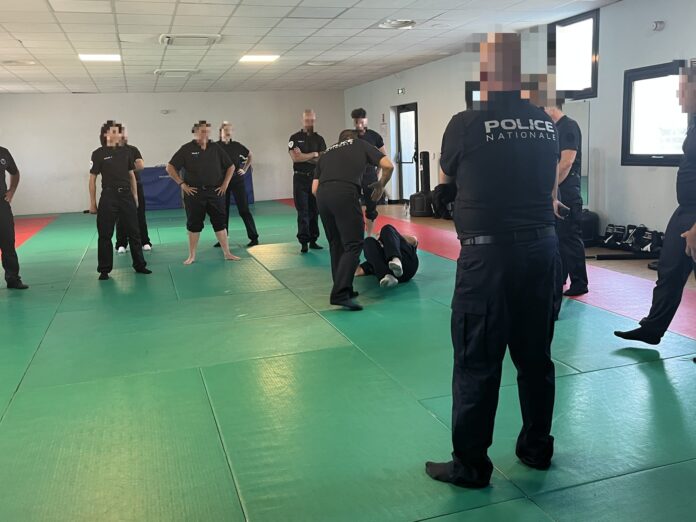
At the Saint Augustin police station, about ten national police reservists were finishing their fourth and final week of training. Training that now includes intermediate force weapons training and takes place particularly in a context where the police are short-staffed and seeking to strengthen their proximity with the population.
At 2:30 p.m., in the gymnasium of the Saint‑Augustin police station, about ten reservists begin their session of the day: baton handling, ground defense techniques, tackles. Divided into pairs, they carry out exercises in short sessions, punctuated by two-minute breaks.
Several training areas are on the program such as reflex workshops, where reservists undergo simulated baton attacks, notably the move called “from top to bottom”, to learn to protect themselves before counterattacking.
“The goal is for them to consider this weapon as a protective weapon, not as a handicap,” explains Major Stéphan. Because the natural reflex of beginners goes the other way “ they tend to want to strike, whereas originally, you protect yourself, and only then do you control the individual. ” On blows to the face, he insists: “ that’s the last resort.”
Second area, on the ground. Lying down, tackled, sometimes surprised by an “ assailant “ who has just knocked them down, the reservists learn to break free and regain the initiative, unarmed and then with baton in hand. “ The goal of every police officer is to go home tonight,” the major reminds them.
At the end of the training, a practical evaluation, three assailants, one of whom is armed with a fake knife, determines who will be certified.
As for remuneration, the first two weeks are unpaid; from the third week onwards, reservists are paid.

A reserve expected to triple by 2030
“ The operational reserve is a force that has a lot of future in the national police,” explains Frédéric Pizzini, director of the inter-departmental national police of the Alpes Maritimes. The finding is national: the police currently has approximately 12,000 reservists, which the Interior Ministry wants to increase to 40,000 by 2030.
As for the department, the DIPN currently has 330 reservists, including 150 civilians, the others being former retired police officers.
“ The objective is to allow people to respond to their desire for civic engagement,” the director emphasizes, who also sees this as a way to “ supplement operations “ on public roads, at borders or in investigation. “ If we have one more reservist, we can set up an additional police rescue crew and therefore better meet the expectations of the population. “

In the field, reservists support crews for police rescue, prevention and cross-border control, although they cannot yet participate in law enforcement. A non-negligible issue also appears to be the integration of these reservists with respect to active personnel, who are more reluctant about their training.
Training completed with intermediate force weapons training
The program lasts four weeks with two at the police academy (law, legal framework), with a final certification exam for individual weapons, then two focused on intervention techniques.
And with a new doctrine published in early 2026, reservists can now be certified for intermediate force weapons, a first which the Alpes Maritimes were the first to take on.
“ We already struggle to train all active officers,” acknowledges Frédéric Pizzini, who mentions the cost of this additional training. “ We decided to overcome these difficulties and include reservists. “
A decision also made for the safety of the reservists themselves, armed as soon as they are deployed. “ Until now, a reservist sent to the public road had no intermediate option if he had to use force,” explains the director. Equipping them with pepper spray or a baton is preferable to forcing them to use their firearm. “
Laurence Constantin, from temp work to police reserve
Among the reservists is Laurence Constantin, an administrative assistant in a temporary staffing agency in the construction sector. An engagement triggered after serving as a juror at an assizes court. She now balances professional life, family life and reservist training. “ I feel like I’m being useful, she confides. I won’t change the world, but at my level, I can be closer to the population. “
This experience also prompted her to take the municipal police exam on May 12th. “ Municipal and national police complement each other. “
NicePremium is a free, independent local news outlet.
Help us keep going by supporting our work from €5 per month.


