
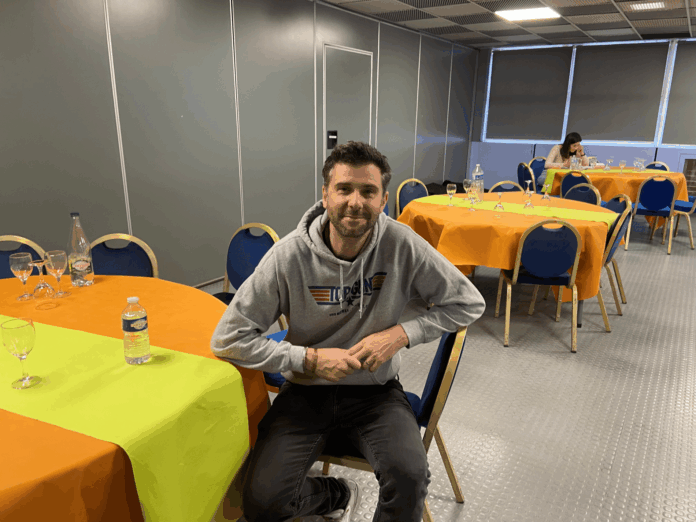
Present at the Play Azur Festival in Nice last weekend, on April 25 and 26, voice actor Donald Reignoux met his fans during conferences and signing sessions. Between signing posters, the French voice of the famous Titeuf gave us a few minutes to discuss his profession, still relatively unknown to the general public.
In the aisles of the festival in Nice, at the Palais des Expositions, Donald Reignoux continued meeting with visitors. As soon as his conference ended, the actor took the time to sign a few posters and chat with fans before giving us a short interview. This was an opportunity to discuss a discreet profession, yet one present in the daily lives of millions of viewers.
Dubbing is still a fairly unknown profession. What surprises people the most when they discover what you do?
Donald Reignoux: “At conventions, the audience is already on board. People know why they’re coming and are generally familiar with my work. With the general public, it’s different: it’s really hit or miss. Either people have no idea who I am, and it completely goes over their heads, or they’ve seen me on social media or in videos and immediately connect me with a character. When the connection happens, it often brings back strong memories. People associate my face with a role and it triggers a kind of Proustian madeleine. As a result, the interactions are immediately very positive. It’s not necessarily about being a total fan but more about someone thinking, ‘Oh yes, it’s that voice!’ and it reminds them of a moment from their childhood or a series they love.”
Do you ever get recognized on the street?
Yes, every day… but it depends on where I go. If I go to Yves Rocher, I am relatively unnoticed. If I go to Micromania, it’s much more complicated! It all depends on the environment. People who frequent certain places are naturally more receptive to pop culture and dubbing. But overall, it remains a fairly anonymous profession. And that’s rather pleasant. I have the best of both worlds: I can meet the public when I want to, at festivals for example, and remain relatively discreet in my everyday life.”
What made you want to go into dubbing?
Nothing at all. I stumbled into it completely by accident. I’ve been doing this job for over thirty years and, initially, there was no intention of a career. A friend of my mother worked in this field and was looking for children for a dubbing project in the early 1990s. I went there once, somewhat by chance. And then it simply developed through word of mouth. There was a demand for children’s voices at that time, and I continued like that without really planning it.”
Is it more difficult to dub a comedic or dramatic character?
Both have their challenges. Making people laugh is very complicated, but conveying dramatic emotion is just as challenging. They simply require different skills and evoke different sensations in performance. Personally, I really enjoy both. But if I had to choose… I would still pick comedy. It suits me more and allows for a lot of fun with the characters.”
You lend your voice to Titeuf, among others. What makes this character so unique to dub?
First of all, there’s his voice, his cheekiness, his energy. He’s a very lively character, a bit rebellious, a little rascal who often says what shouldn’t be said. All this makes dubbing very fun. Characters like him are very colorful. They allow you to go beyond the lines, to play with interpretation, and to push the energy quite far. That’s what makes the work truly enjoyable.”
Do you identify with this character?
No, not particularly. But I love playing him. You don’t need to identify with a character to be genuine. However, you have to play it sincerely. If you don’t believe in it, it doesn’t work. With Titeuf, I have a lot of fun because he’s a character that allows for a lot of freedom in performance.”
How do you find the voice of a character like Titeuf?
For him, I had a pretty immediate idea when I saw the character. I almost envisioned only that voice. But often, it comes down to instinct. For example, in certain series, I have to find several different voices within the same scene. There, I observe the characters: their appearance, how they move, their attitude… and I look for a reference point. It’s not a job that takes weeks. It requires immediacy. You test, you adjust, and when it clicks, you know it right away.”
NicePremium is a free, independent local news outlet.
Help us keep going by supporting our work from €5 per month.


