
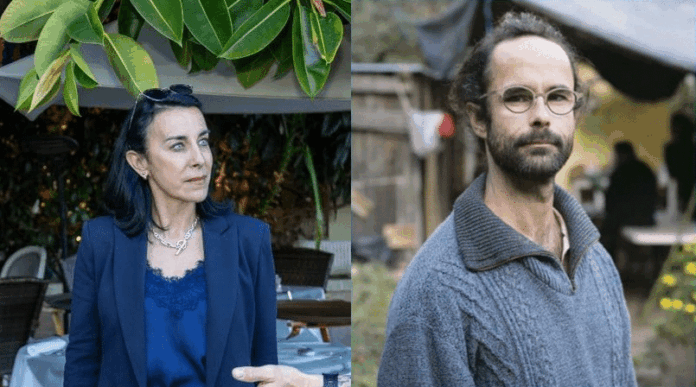
Alexandra Masson’s election to the head of CARF triggered a confrontation with Cédric Herrou. Between public statements, citizen mobilization and associative reactions, several days of tension marked the Roya valley.
The events unfolded over several days, in a tense political climate in Menton and in the Roya valley. Before the election to the presidency of the Riviera French Agglomeration Community (CARF), around forty people had gathered outside the intercommunal headquarters. Among them, Cédric Herrou, co-director of Emmaüs Roya. The mobilization aimed to contest the arrival of the far right at the head of the structure.
The farmer had hoped to encourage other candidacies. An attempt had emerged with David Brouste. The mayor had presented himself against Alexandra Masson. The vote, however, confirmed the expected balance. Alexandra Masson had been elected with 39 votes out of 48. Six mayors had cast blank votes.
Following this election, the new president had spoken publicly. The tone was direct. The statement explicitly targeted Cédric Herrou: “he is an extremely sectarian, dangerous man, with out-of-touch and often defamatory statements. I invite him to leave the valley, and he shouldn’t worry: the residents of Roya will be well represented by the mayors of the municipalities. We have much to do, but especially without him.”
This position immediately sparked a reaction. From his agricultural operation, Cédric Herrou had published a video on social media. The message evoked a situation deemed concerning: “an elected official of the Republic (…) freshly appointed to the presidency of the Carf who orders me to leave my home (…) that’s crazy!”
In this intervention, the farmer had been careful to clarify the nature of the conflict. The personal dimension had been set aside in favor of a political disagreement. One sentence summarized this position: “you are indifferent to me (…) what I fight against are your ideas.”
In his message, Cédric Herrou also recalled his local roots. Antifascism was described as a “family tradition.” Daily farm life had been mentioned, between crops and livestock. One assertion came back insistently: “I cannot leave.”
A political sequence and chain reactions
Beyond this exchange, Alexandra Masson’s election had fueled broader political interpretations. The new president had emphasized the support of mayors not affiliated with the National Rally. A strategy appeared in her remarks: “many mayors who are not members of the RN voted for me. Many of them share my ideas and know that their voters expect what we propose, notably in the National Assembly. That’s why many of them wanted to work with me, and that’s important.”
For his part, Cédric Herrou had offered a different analysis: “we can see the mechanism very clearly: it’s the right joining the far right. We are seeing the beginnings of 2027, with a shift of the so-called republican right towards the RN.”
In the hours and days that followed, several organizations had reacted. The association All Citizens denounced a personal attack and recalled the right to freedom of expression. In a statement, it challenged any political legitimacy to decide who could live in the valley.
The text had also emphasized a sensitive context. Cédric Herrou had already been targeted by threats. Some organizations felt that the remarks made could be interpreted as a dangerous signal.
The civic gathering Viva! had also expressed support. The criticism had focused on the political priorities of the new presidency. The question of the role of a local elected official had been raised, between territorial management and ideological confrontation.
On the side of Emmaüs Roya, support had been total. Members of the community had defended Cédric Herrou’s commitment. The text had emphasized the actions carried out over several years in the valley, on welcoming and collective work.
CGT Spectacle 06 had also taken a stand. The statement had mentioned remarks incompatible with a calm democratic debate. The need to preserve a plurality of opinions had been recalled.
Meanwhile, mobilization had continued on the ground. A demonstration called “The Spring of Migrations” had been announced in Breil-sur-Roya. The event was fully booked. The demands focused on equality of rights and criticism of migration policies.
This sequence had revealed an entrenched political fracture in the territory. Two visions are opposed. On one side, an institutional approach led by the new CARF presidency. On the other, a grassroots dynamic anchored in the valley.
NicePremium is a free, independent local news outlet.
Help us keep going by supporting our work from €5 per month.


