
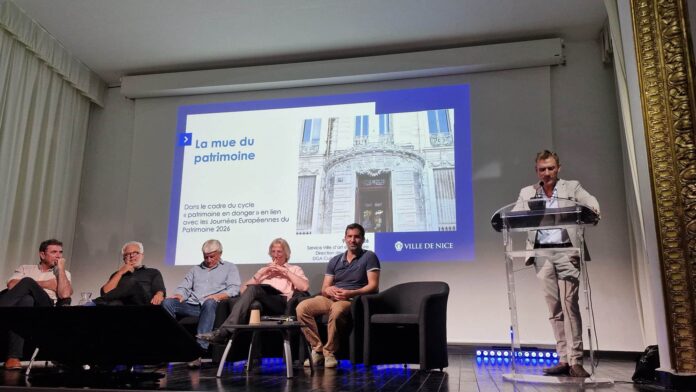
The Artistique hosted the final meeting of the roundtable discussion cycle organized by the city of Nice. The theme was “Renovation and transformation of built heritage: ‘The heritage metamorphosis'”. A subject that corresponds to issues that remain relevant in our city.
The roundtable discussion cycle was organized in preparation for the European Heritage Days 2026, which will have the theme “heritage in danger“. These meetings aimed to highlight heritage workers. They also aimed, according to the city of Nice, “to raise awareness among a wide audience of threats that may affect fragile heritage and to promote conservation initiatives.”
For the final roundtable, five professionals were present:
- Luc Albouy, head of the Territorial Service of Architecture and Heritage of the Alpes-Maritimes, Architect of French Buildings
- Pierre Verdet, Madelénat Architecture agency
- Jean-Paul Gomis, architect
- Didier Grimaldi, Observatory Nice Côte d’Azur
- Dominique Brossard, head of the Sponsorship and Heritage Promotion Department, Côte d’Azur University
Between conservation and evolution: the challenge of heritage transformation
The central debate in heritage management rests on the subtle boundary between the strict conservation of a place and its necessary evolution to adapt to new roles.
Two major visions confront or complement each other: on one hand, pure “crystallization“, as with the Eileen Gray Villa where the aim is to faithfully restore the original reference state and its gardens; on the other, change of use for monuments that, like this same villa which evolved from a private residence to a site open to visitors, were not originally designed to accommodate the public.
According to one of the speakers, wanting to freeze a monument at all costs can sometimes be a contradiction, because heritage must accept changes and adapt to modifications in uses. The objective during work is often to erase the clumsy interventions of the past to recover the original identity and respect the spirit of places, like the Saorge Convent which today welcomes artists in residence to maintain life in the premises without betraying the initial functions.
Economic, ecological challenges and the transmission of know-how
Today, the concept of heritage has expanded considerably and fully embraces a sustainable development approach. Jean-Paul Gomis recalls that conserving and reusing a building rather than demolishing it allows for avoiding high CO₂ consumption.
This point of view is supported by traditional architecture, such as that of Old Nice, whose house arrangement (air currents, shaded areas, lower temperatures, N.B.) naturally offers alternatives to modern insulation problems.
Beyond ecology, heritage generates strong economic and social impact on territories by promoting attractiveness and job creation. However, professionals face the difficulty of finding financing and resources. It is also a human challenge: Luc Albouy emphasizes the importance of understanding techniques, gestures and old materials, while Dominique Brossard discusses the complexity of recruiting specialized craftspeople, such as stonemasons, sometimes forcing the sourcing of labor and materials from very far away.
Collective responsibility, associative preservation and threats to heritage
The preservation of monuments and urban landscape is not solely a public mission; it falls under a plural responsibility, often carried by citizen engagement. During the exchanges, a representative of the “Protect Heritage” association, the organization behind the rescue of the garden and Villa Paradiso, reminded that the danger remains very real.
She notably pointed out that certain private owners become true obstacles to heritage preservation, citing the example of difficulties surrounding the Villa Beau Site. The vigilance of associations also focuses on public projects, such as the criticism leveled against the new events building at the port (the OcéaNice conference center, N.B.), compared by its industrial silhouette to an “Amazon warehouse” by some elected officials.
Faced with these blockages and contested architectural choices, the question remains open as to the precise moment when public authorities must intervene, a regulatory and protective role that falls directly to the State.
The closing of this roundtable discussion cycle recalls how much the preservation of Nice’s heritage remains a collective and demanding challenge. Between transmission of know-how, adaptation of uses and citizen vigilance, the protection of old buildings requires constant mobilization. Through these exchanges, the city of Nice reaffirms its determination to defend a legacy that shapes the identity and memory of the territory.
NicePremium is a free, independent local news outlet.
Help us keep going by supporting our work from €5 per month.


