
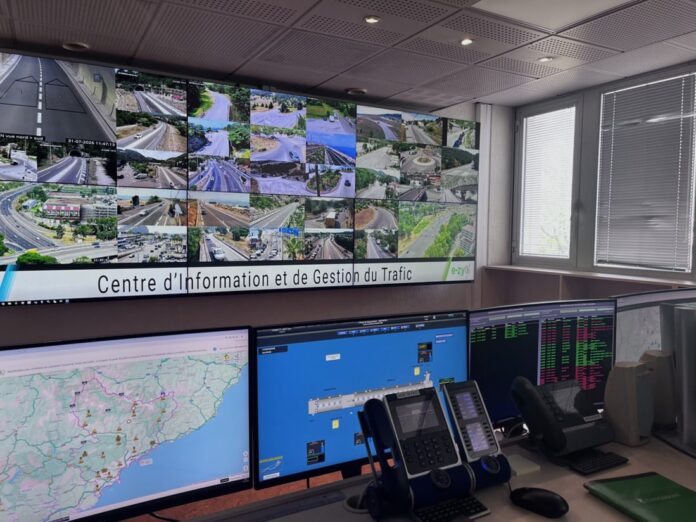
The Information and Traffic Management Centre of Alpes-Maritimes celebrated its twentieth anniversary during a visit organized at the Department Building. As a busy weekend approaches, the authorities presented the central role of CIGT, its continuously mobilized teams and the technological developments that support the monitoring and management of the road network.
As the influx of holidaymakers onto the roads looms, a visit to the first departmental Information and Traffic Management Centre (CIGT) was organized on Friday, July 31, 2026. Launched on July 1, 2006, the CIGT is designed to monitor, anticipate and manage traffic flows in real time.
Many people had the opportunity to observe behind the scenes of the nerve center of the road network at the Department Building. The Vice-president of the Alpes-Maritimes department, Patrick Cesari was present as representative of Charles Ange Ginésy: “We wanted to build an operational and modern tool, capable of concretely improving traffic conditions, strengthening safety, informing users and coordinating interventions across a territory.”
The centre stands out for its ability to reinvent itself to preserve road efficiency and user safety.
Unfaltering vigilance
Out of the spotlight, the CIGT permanently supervises roads winding through the Alpes-Maritimes. Mobilized 7 days a week and 24 hours a day, fifteen agents, a room supervisor, a section dedicated to traffic police and regulatory documentation, a service manager and an assistant IT officer responsible for technical matters make up the CIGT. “They are the ones who, day after day, night after night, ensure surveillance, process information, alert, coordinate, anticipate and support decisions,” declared Patrick Cesari.
Among the fifteen agents, seven people are controllers who ensure permanent coverage, with a system of three teams rotating every eight hours. “Because an accident, falling rocks, a broken-down vehicle in a tunnel or a closed road don’t choose the hour, the day or the season,” explained the Vice-president of the department.
Some periods are more difficult than others on the roads. “We always have teams available during busy periods like this weekend,” assured Marc Javal, the deputy general director in charge of technical services at the Alpes-Maritimes department. Faced with this massive influx, teams can be reinforced with the addition of a second controller to support the first, in order to better respond to users in difficulty.
This vigilance is accompanied by constant liaison with emergency services, law enforcement and road operation center operators. Thus, the service centralizes, informs and coordinates the various operators. Furthermore, Patrick Cesari recalled that “on the ground, it is the road teams that secure, mark off, repair, clear, often in difficult conditions.”
This visit was an opportunity for the authorities to acknowledge and highlight the agents working daily to safeguard the proper functioning of roads and user safety.
Constant technological progress
The vice-president of the department provided some figures. Seven million euros have been invested to deploy and connect field equipment, including 120 road cameras. “If we identify an additional bottleneck point, we are able to add cameras,” assured Marc Javal.
In the operational room, the walls are equipped with numerous screens. Innovation holds an important place. Recent modern supervision tools and automatic incident detection are used, such as incident detection in tunnels.
The CIGT is developing new technologies, notably through artificial intelligence, to better anticipate risks and optimize road traffic management. “Tomorrow’s roads will be based on intelligent traffic management and automated road inspection,” declared Patrick Cesari. Artificial intelligence is associated with experiments, notably embedded solutions, capable of analyzing images, assessing road conditions and helping to prioritize maintenance operations. Innovation is a lever serving safety, efficiency, the environment and the daily work of our agents.” The CIGT is an example of a service merging technology and human touch.
NicePremium is a free, independent local news outlet.
Help us keep going by supporting our work from €5 per month.


