
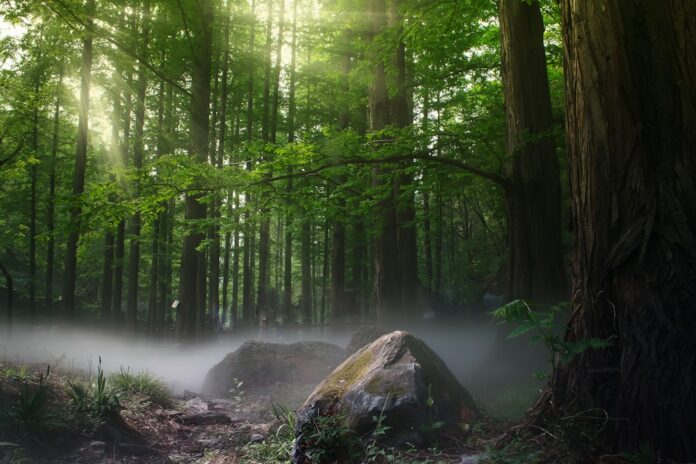
Born in Japan in the 1980s, the practice of shinrin-yoku — literally “forest bathing” — is experiencing unprecedented enthusiasm on the Côte d’Azur this spring 2026. Between the fragrant hills of the Nice hinterland and the pine forests bordering the coast, conditions are ideal for immersing yourself in this natural therapy that is proving its worth far beyond Japan’s borders.
What exactly is shinrin-yoku?
Forest bathing is not a simple hike. It is a slow and conscious sensory immersion in a forest environment, guided by trained facilitators. You walk slowly, you stop, you breathe deeply, you touch tree bark, you listen to the wind in the leaves. The objective is not athletic: it is therapeutic.
Introduced by the Japanese Ministry of Forest and Agriculture in 1982 as a public health tool, shinrin-yoku has since been validated by numerous scientific studies. Research conducted by Professor Qing Li, a global figure in forest therapy, has demonstrated that two hours spent in the forest are enough to significantly reduce cortisol levels — the stress hormone — and to strengthen NK (Natural Killer) cells, pillars of our immune system.
Why is the Nice region an ideal setting?
The Côte d’Azur benefits from an exceptional natural asset: the diversity and richness of its forest spaces. Within less than an hour of Nice, several ecosystems invite this contemplative practice.
Turini Forest: a biodiversity sanctuary
Perched at over 1,000 meters altitude in the Mercantour, Turini Forest offers a striking setting of Scots pines, firs, and larches. The air is filled with phytoncides, those volatile organic compounds released by trees, recognized for their antibacterial and anxiolytic properties. In June 2026, several certified guides offer morning sessions that begin at dawn, when the forest is still wrapped in coolness.
The Garrigue of the Estérel: a unique Mediterranean immersion
For an experience closer to the coast, the Estérel massifs and their maritime pine forests constitute an enchanting alternative. The resinous smell of pine mingled with the scents of rosemary and wild thyme acts as a true balm for the nervous system. Forest bathing workshops are organized there on weekends, accessible to beginners and experienced practitioners alike.
Proven benefits for body and mind
Beyond immediate relaxation, the effects of shinrin-yoku on health are documented and multiple:
- Stress and anxiety reduction: a drop in cortisol is measurable within 20 minutes of forest immersion.
- Sleep improvement: exposure to natural light filtered through foliage regulates melatonin production.
- Immune strengthening: phytoncides stimulate NK cell activity, the body’s natural defenses.
- Blood pressure reduction: Japanese studies have measured an average 6% decrease in systolic pressure after a session.
- Improved concentration and creativity: digital disconnection combined with sensory immersion promotes a lasting state of mindfulness.
These benefits are not ephemeral. Research published in 2025 in the Journal of Environmental Psychology confirms that positive effects on mood and the immune system can persist up to 30 days after a two-day forest session.
How to practice forest bathing on the Côte d’Azur?
Get accompanied by a certified guide
While forest walks are accessible to all, shinrin-yoku in its therapeutic dimension benefits from being practiced with a trained facilitator. These professionals — often from the world of coaching, naturopathy, or psychology — offer sequences of sensory exercises, guided meditation times, and forest entry and exit rituals that amplify the effects of the practice.
Several practitioners certified by the Association for Nature and Forest Therapy (ANFT) now practice in the Alpes-Maritimes. Local wellness platforms reference their offerings, with individual sessions starting at 60 euros and one-day retreats around 120 euros.
Essentials for a successful first session
No need for sophisticated equipment to get started. Here are some practical tips:
- Opt for comfortable and natural clothing, ideally cotton or linen, to enhance sensory connection.
- Turn off your phone or leave it in your car. Digital disconnection is a sine qua non condition of immersion.
- Bring a notebook to note your sensory observations or draw what you perceive.
- Choose a morning hour: early in the morning, the forest is more lively, smells more intense, and light softer.
- Respect a slow pace: 1 to 2 kilometers in two hours is a good reference. The goal is not to go far, but to go deep.
A trend that will endure
The rise of shinrin-yoku on the Côte d’Azur is not a passing fad. It reflects a deep desire to slow down in a hyperconnected world and to rediscover simple sensory anchors. In a territory where the sun, sea, and mountains coexist within reach, it would be almost paradoxical not to take advantage of these riches to care for yourself differently.
Luxury spas and hotels in the region have clearly understood this: several five-star establishments in Nice and Cannes are now integrating forest bathing experiences into their wellness programs, combining morning forest immersion and spa treatments in the afternoon. A subtle alliance between wild nature and Mediterranean refinement, true to the spirit of the Côte d’Azur.
Conclusion: embrace slowness
In a busy summer 2026 ahead, treating yourself to a morning of forest bathing in the Nice highlands could well be the most radical — and least expensive — wellness act of your season. No need to travel to Japan to find your therapeutic forest: it awaits you, just a few turns above the Promenade des Anglais.
Ready to immerse yourself? Find out from the tourist offices of the Alpes-Maritimes or nature guide associations in the region to find the session that suits you.
NicePremium is a free, independent local news outlet.
Help us keep going by supporting our work from €5 per month.


