
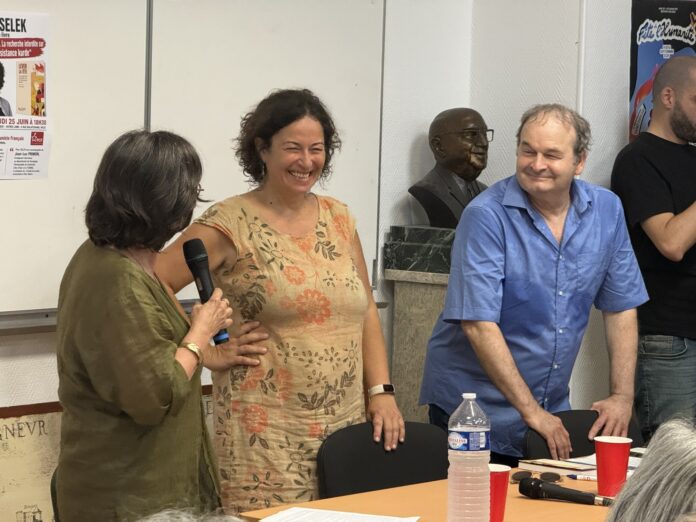
The Turkish sociologist presented her new work on her “forbidden inquiry” at a conference. Supported by her university colleagues and students, Pinar Selek reminded everyone that her long trial was still not over.
Dozens of activists and students gathered in the offices of the PCF 06 yesterday evening, at 6 rue Balatchano. In a room named after the resistance fighter Virgile Barel, Turkish sociologist Pinar Selek held a conference on the occasion of the release of her book Raising Your Head. Forbidden Research on Kurdish Resistance, published by Paris Cité University. She retraces her turbulent journey since her arrest in Istanbul in 1998 for investigating Kurdish culture, while the eighth hearing of her fifth trial is scheduled to take place on September 18 in Turkey.
In her work, the sociologist recounts from memory and with few notes—all of which were confiscated from her—the survey on the socio-cultural practices of the Kurdish population that she conducted between 1995 and 1998 and which ended tragically. Throughout, Pinar Selek protected the participants “at the cost of torture,” indicated posters displayed on the wall.
Accompanied by Jean-Luc Primon, teacher-researcher in the sociology-demography department at Côte d’Azur University and at the Research Unit on Migrations and Societies (URMIS), and Sylvane Faure, teacher-researcher in social psychology, Pinar Selek took the floor in a packed room to share her experience. After acknowledging “the unwavering support of the PCF for Kurdish resistance,” the researchers denounced the “judicial harassment of Kurds by the Turkish government for over 25 years,” as well as that which their colleague claims to have been subjected to for 28 years.
A testimony filled with hope
Before an audience filled with activists and her own students, the sociologist took the floor to speak about herself through the Kurds. “When I was younger, I didn’t know about Kurds; they were spoken of as something from before Jesus Christ,” she explains. But from 1989 onwards, the Kurds entered the period of the famous “raising your head”: they become visible, assert themselves more in Turkish public space, but especially demand their singularity for a few years. A resistance that they “paid very dearly for,” affirms Pinar Selek.
She was then 18 years old and began to take an interest in this part of the Turkish population. A common thread guides the sociologist in the making: the question of the “sociocultural resources of Kurdish resistance.” To answer this, she becomes interested in the sociology of the Kurdistan Workers’ Party, the PKK. Violent repression was carried out by the Turkish government against the Kurds until 1993, resulting in tens of thousands of deaths.
Between 1995 and 1998, Pinar Selek carried out an immersion in a Kurdish village, wanting to understand “the sociocultural bases of their organization.” She was questioned in 1998 for investigating the Kurds and supposedly establishing ties.
A unique journey
On July 11, 1998, Pinar Selek was arrested by Turkish plainclothes police officers. Two days earlier, an attack had struck the Istanbul bazaar. The Turkish government blamed the PKK and accused the sociologist of having collaborated in it based on falsified evidence, before an expert determined that the explosion was actually due to a gas leak.
The successive prosecutions by the Turkish government forced Pinar Selek to leave her native country for fear of reprisals. The sociologist obtained academic asylum in France. She obtained official refugee status in 2013, then French nationality in 2017. On trial for 28 years, her Turkish legal odyssey is filled with acquittals and annulments of those same acquittals by Turkish institutions and justice.
Her trial for terrorism has been postponed once again to April 2026. To date, the same trial has been ongoing since 2023, based on an “empty accusation file.” The Istanbul Court of Assizes requires her physical presence at the next hearing scheduled for September 18.
NicePremium is a free, independent local news outlet.
Help us keep going by supporting our work from €5 per month.


