
A culinary identity firmly rooted in its territory
There are cuisines that transcend time without losing their identity. Nice cuisine belongs to this category. Shaped by the Mediterranean, the hills and the hinterland, it is based on popular recipes, seasonal products and gestures passed down from generation to generation.
In Nice, local gastronomy is not limited to a few specialties intended for visitors. It constitutes a true cultural heritage, still present in markets, local shops, families and establishments that continue to respect its recipes.
The “Cuisine Nissarde” label, created in 1995 and then taken up by the Metropolitan Tourism Office, pursues precisely this objective: to defend and promote authentic homemade Nice cuisine. It is awarded to restaurants and establishments that commit to respecting defined recipes, products and preparation methods.
Markets, at the starting point of local cuisine
Nice cuisine often begins long before cooking begins. It is built throughout the seasons by observing what arrives on the stalls.
At the heart of Old Nice, the Cours Saleya market remains one of the most emblematic places in the city. Beneath its colorful canopies, you will find fruits, vegetables, fish and various products notably from the Nice hinterland. The flower market and food stalls are open Tuesday to Sunday, while Monday is traditionally dedicated to flea markets.
In the Libération district, the market installed around Avenue Malausséna and Place du Général-de-Gaulle maintains an atmosphere more oriented towards the daily life of Nice residents. It completes this gourmet geography in which markets remain places of supply, but also of meeting and transmission.
Trumpet courgettes, courgette flowers, sun-ripened tomatoes, eggplants, peppers, chard, basil, purple artichokes, broad beans and spring onions make up, depending on the season, the vegetable repertoire of many local recipes.
Seasonality as a founding principle
In Nice cuisine, seasonality is not a recent trend. It is part of its history.
This cuisine developed from locally available products, sometimes modest, that had to be used without waste. Vegetables thus occupy an essential place in small stuffed vegetables, ratatouille, courgette flower fritters, chard pie and Niçoise salad.
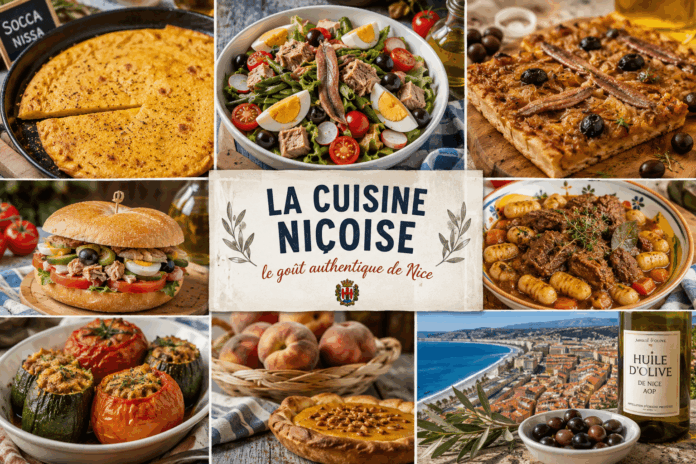
Olive oil also plays a central role. Nice Olive Oil benefits from a protected designation of origin and comes mainly from the cailletier variety, adapted to the coastal terrain and the reliefs of the Alpes-Maritimes. The PDO “Nice Olive” also protects table olives and olive paste produced in the recognized geographical area.
Socca, a simplicity that resists trends
Made from chickpea flour, water, olive oil and salt, socca remains one of the most accessible symbols of local cuisine.
Thin, crispy at the edges and softer in the center, it is enjoyed very hot, generally seasoned with a little pepper. Its strength lies precisely in its simplicity: it requires neither sophisticated presentation nor excessive transformation.
In Old Nice, certain establishments still perpetuate its wood-fired cooking. At Thérésa, an institution established in Nice since 1925, socca is notably prepared in an old wood-fired oven and offered on Rue Droite as well as at the Cours Saleya market.
Pissaladière, between patience and balance
Another emblematic specialty, pissaladière combines bread dough with slowly cooked onions, anchovies and black olives.
Its name is linked to “pissalat”, an old preparation based on salted fish that was formerly used to make it. Today, the recipe is based mainly on the quality of the dough, the slow cooking of the onions and the balance between their sweetness, the salty taste of the anchovies and that of the olives.
As is often the case in Nice cuisine, the result depends less on the number of ingredients than on the time and attention devoted to each of them.
Niçoise salad, a recipe regularly mistreated
Few dishes spark as much discussion as Niçoise salad. Its international distribution has given rise to numerous versions, sometimes very far from the local recipe.
The version presented by the City of Nice is based on raw vegetables and notably includes tomatoes, spring onions, radishes, green pepper, broad beans or young artichokes depending on the season, hard-boiled eggs, black olives, anchovies and tuna. The whole is seasoned mainly with olive oil.
Potatoes, rice, cooked green beans and mayonnaise are not part of it. Traditional Niçoise salad is therefore not based on an accumulation of ingredients, but on the freshness and balance of the products used.
Pan bagnat, a portable Niçoise salad
Pan bagnat takes the spirit and a large part of the ingredients of Niçoise salad in a small round bread specially adapted for this preparation.
Its name comes from Nissart and evokes bread “moistened” or “bathed” in ripe tomato and olive oil. The bread is opened, cleared of part of its crumb, then possibly rubbed with garlic before being soaked in tomato and oil.
It is then filled with raw vegetables, hard-boiled egg, black olives, tuna and/or anchovies, then lightly pressed so that the flavors permeate the bread. Easy to transport, it remains one of the natural companions of beach lunches, picnics and summer outings.
Daube and gnocchi, another face of Nice cuisine
Local gastronomy is not limited to summer recipes and raw vegetables. It also includes slowly simmered dishes, inherited from family cooking where nothing had to be wasted.
Beef daube is one of the best-known examples. Prepared slowly with wine, aromatics and, depending on the recipes, elements such as olives or orange zest, it takes time before fully revealing its flavors.
It traditionally accompanies pasta or Nice gnocchi. The recipe published by the City of Nice indeed indicates that these can be served with a daube sauce. The remaining meat can also be used in the filling of Nice ravioli, another illustration of this cuisine attentive to the complete use of products.
Transmit rather than transform
The vitality of Nice cuisine does not necessarily depend on its reinvention. It is based above all on its ability to be transmitted without being frozen.
Establishments labeled “Cuisine Nissarde” participate in this transmission by maintaining traditional recipes on their menus. The Atelier Cuisine Niçoise, located at the Palais du Sénat, near the Cours Saleya, also offers the public courses devoted to the history, products and preparation of local specialties.
This approach does not prohibit creativity. On the contrary, it makes it possible to clearly distinguish a traditional recipe from a contemporary interpretation. A socca can inspire a chef, just as a Niçoise salad can be revisited, provided that the new creation is not presented as the original recipe.
Rediscovering the Nice table in summer
For residents and visitors alike, summer remains a privileged time to find Nice cuisine in its simplest form: a product bought at the market, a slice of still-warm socca, a shared pissaladière or a pan bagnat taken to the sea.
It is also possible to consult the updated list of restaurants, snacks, takeaway shops and caterers bearing the “Cuisine Nissarde” label. This selection is a useful reference for finding establishments committed to respecting local culinary heritage.
Nice cuisine ultimately does not need to follow all trends to remain contemporary. Its future depends mainly on the quality of the products, respect for recipes, the work of craftspeople and the willingness to continue transmitting this living heritage.
NicePremium is a free, independent local news outlet.
Help us keep going by supporting our work from €5 per month.


