
The Regional Audit Office examined the management of reconstructions carried out after storms Alex and Aline. The regional authority noted delays related to judicial procedures, financing, and technical constraints. The former president of the Nice Côte d’Azur Metropolis, Christian Estrosi, defends himself by placing these decisions in the exceptional context of disasters.
The audit of accounts and management of the Nice Côte d’Azur Metropolis is part of a joint investigation by the Court of Auditors and the Regional Audit Office of Provence-Alpes-Côte d’Azur. This investigation focuses on how the public sector handled the consequences of storms Alex in 2020 and Aline in 2023. It examines the organization put in place to conduct reconstruction, the terms of public funding commitments, the resilient reconstruction strategy, and the conditions for carrying out operations in the disaster-stricken valleys.
The chamber recalls that the Metropolis, the first metropolis created in France in 2011, groups together 51 municipalities and has 568,596 inhabitants. Its territory represents one-third of the department’s area. The jurisdiction emphasizes that this territory “very exposed to hazards and climate change” was struck by two storms that “had lasting impacts on the infrastructure and economic and social life of the Tinée and Vésubie valleys.”
A territory permanently marked by storms
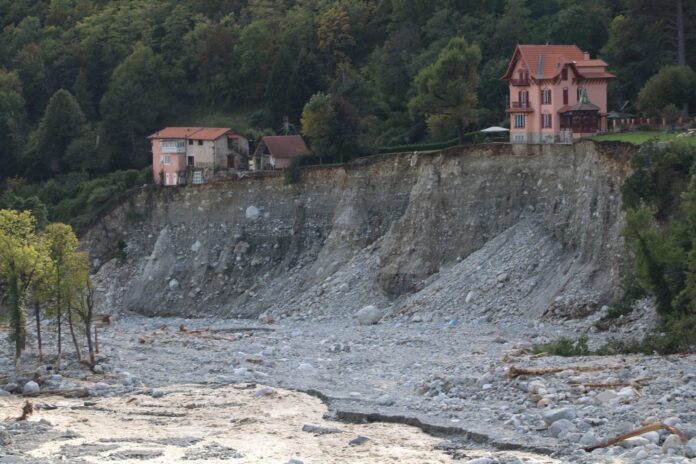
The report returns to the scale of the damage. The chamber indicates that “more than 270 buildings and houses were swept away or became uninhabitable.” Water, sewerage, energy, and telecommunications networks were severely affected. Road access was cut off over long stretches, with “50 km of roads completely destroyed” according to the latest assessments.
The violence of storm Alex is documented by Météo-France records, taken up in a report: “513 mm in Saint-Martin-Vésubie” in 24 hours. The prefect of Alpes-Maritimes had described the episode as a “meteorological bomb.” The Jean Jaurès Foundation spoke of “the greatest civilian destruction since World War II in France.”
In a letter addressed to the President of the CRC PACA, Xavier Lefort, the former president of the Nice Côte d’Azur Metropolis, Christian Estrosi describes “watercourses previously familiar transformed into destructive torrents” and “entire sections of mountain collapsed.” The former official highlights the erosion of fluvio-glacial terraces “10,000 years” old, carved out over more than twenty meters, which he considers a “particularly eloquent” marker of the phenomenon’s scale. The metropolitan official of that time also emphasizes that hydrological analyses converge on a return period of between “600 and 1,000 years.”
Significant funding but only partially disbursed
To meet the emergency, the Metropolis mobilized European, state, regional, and departmental financing. Allocated subsidies reached 150 million euros, but only 98 million were actually disbursed. The chamber specifies that “at the end of 2024, subsidies paid by the State represented 65% of the subsidies set by prefectural orders.”
In his response, the former mayor of Nice recalls that “no single funding source allows for covering 100% of a financing need.” Christian Estrosi clarifies that the remaining cost to the Metropolis reached “138,417,074 euros” at the end of 2025, for total equipment spending estimated at “239,223,014 euros.” The former president acknowledges that this situation had direct consequences on other structuring projects, notably tram lines 4 and 5. The metropolitan official of that time also explains that the complexity of financing mechanisms forced the Metropolis to pre-finance a significant number of operations, assuming “significant financial risk” to avoid delaying the restoration of safety in the territories.
A dedicated management agency, governance still fragile
The Metropolis had created an autonomous management agency to oversee reconstructions. After examining the case, the CRC noted irregular functioning, marked by sparse council meetings and recruitment difficulties.
In his defense, the former president of the Metropolis emphasizes “objective recruitment constraints,” linked to the project contract regime, the health context, and the remoteness of worksites. The former official assures that the local authority “made no cuts to human resources” and that all metropolitan services were mobilized “without interruption.” The previous metropolitan official justifies the use of existing framework agreements by “absolute urgency” and the need to ensure continuity of public service. Regarding contractual irregularities, the former mayor states that the Metropolis reacted “immediately” by consulting the General Inspection of Services, the prosecutor, and by initiating recovery actions.
Worksites halted following judicial referrals
Of the 126 operations undertaken since 2020, sixteen had not yet begun at the time of the audit. The chamber indicates that “these delays are partly linked to judicial referrals” relating to disputed invoices. It specifies that “these referrals led to the halt of part of the subsidies as well as the halt of several worksites.”
In his response, the former official explains that the anomalies identified in January 2023 were “confined to the Tinée and Vésubie valleys.” The former president emphasizes that ongoing expert assessments will provide “contradictory analyses essential” to defending the Metropolis’s interests.
RTE, cited in the report, reports “the destruction of 70% of reconstruction structures carried out at the Roquebillière substation“ after storm Aline.
Toward more resilient reconstruction in the face of climate change
The chamber highlights the efforts undertaken for more resilient reconstruction. The Metropolis relies on hydrological studies, reconstruction committees, and GEMAPI competence (Management of aquatic environments and flood prevention, Editor’s note) to adapt structures to climate risks.
In his response, Christian Estrosi broadens the discussion by recalling that the Alps are “on the front lines of climate change.” The former official cites examples in Switzerland, Oisans, Haute-Savoie, and Savoy to show that the phenomena observed in the Tinée and Vésubie valleys are part of a broader dynamic. He believes that the repetition of episodes requires a “considerably wider latitude of action” for managing sediments and materials being carried along. The former president concludes by affirming that any analysis of metropolitan management must be “assessed in light of this exceptional reality,” marked by successive disasters, a major health crisis, and a lasting transformation of climate risk.
NicePremium is a free, independent local news outlet.
Help us keep going by supporting our work from €5 per month.


