
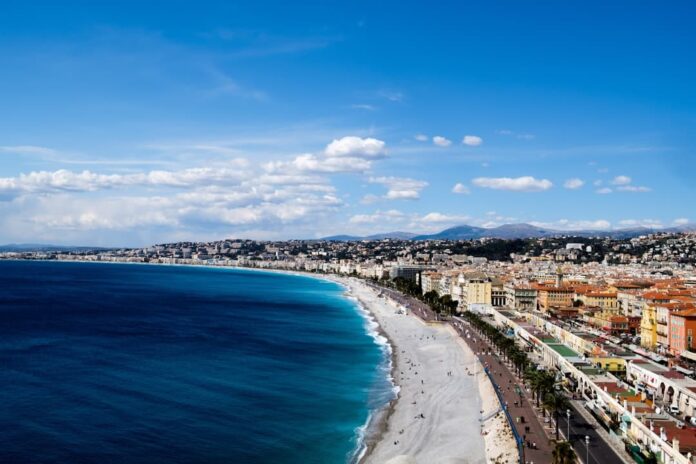
There is something imperious in the light of Nice that compels the imagination to unfold. For centuries, the Côte d’Azur has attracted the liveliest minds of Europe, those who seek in Mediterranean brilliance a clarity conducive to creation. Even today, Nice continues to nurture a vibrant literary scene, discreet but deeply rooted in the city’s identity.
A City-Novel: Nice in Literary Imagination
Few French cities have accumulated as many literary layers as Nice. The Phocaean city that became the County of Savoy, attached to France in 1860, carries within it an identity ambiguity that fascinates novelists. It is at once French and Italian, popular and refined, seaside and baroque. This complexity is reflected in the way writers invoke it — not as a mere backdrop, but as a true character.
The promenades along the seafront, the winding alleyways of Old Nice, the markets of Cours Saleya or the heights of the castle overlooking the Bay of Angels: every corner of the city seems to carry a story to tell. The geography of Nice itself becomes a natural dramaturgy, between the sea and the mountains, between the shadow of arcades and the blinding luminosity of ochre facades.
The Legacy of Travelers and Creative Exiles
The literary tradition of Nice is inseparable from that of great European intellectual migrations. In the nineteenth century, philosophers, poets and novelists came to stay on the Côte d’Azur to escape northern winters, but also to find in the Mediterranean climate a serenity favorable to intellectual work. This long tradition of welcome forged a culture of nomadic creation, where inspiration comes as much from the place as from the inner exile it enables.
This movement has never really stopped. Today, authors from diverse backgrounds choose to settle on the Côte d’Azur coast, attracted by this same promise of light and distance. Nice remains a city where one can still write in a café without being recognized, blend into the anonymity of the morning market, while enjoying a rich and stimulating cultural life.
The Mediterranean as a Universal Literary Motif
Beyond Nice itself, it is the entire Mediterranean that acts as a powerful literary metaphor. The inland sea, its plural mythologies, its cultures layered since Antiquity: it offers writers a symbolic foundation of incomparable richness. Authors who gravitate around the Côte d’Azur often draw from this collective imagination to give their narratives a dimension that transcends the regional framework.
The Local Literary Scene: Between Transmission and Renewal
Nice has a discreet but real literary cultural fabric. Independent bookstores play an essential role in the circulation of ideas and the promotion of local authors. They are these spaces of gentle resistance where demanding literature finds its audience, where encounters between readers and writers take the form of authentic dialogue, far from the media circus of major metropolises.
Municipal libraries also participate in this effort of valorization, regularly organizing reading cycles, writing workshops or tributes to literary figures who have marked the region. Transmission is conceived there as a fundamental cultural gesture, in a city where collective memory is often fragmented by tourist flows and rapid urban transformations.
Writing as an Act of Urban Resistance
In a city where mass tourism tends to smooth out identities and folklorize local cultures, literary writing represents a form of resistance. Contemporary Nice authors — whether born here or having chosen to live here — often bear in their texts a particular attention to the margins, to working-class neighborhoods, to populations that do not appear in tourist office brochures. This literature of everyday Côte d’Azur life is precious precisely because it says what images do not show.
Museums, Exhibitions and Literature: Natural Bridges
In Nice, art and literature have never evolved in isolation. The great museums of the city — dedicated to artists whose work profoundly marked the twentieth century — are also places of reflection on language and representation. Many writers have found in the contemplation of a painting or sculpture the impulse for a text, the resolution of a narrative enigma.
This permeability between the arts is one of the most seductive characteristics of cultural life on the Côte d’Azur. Exhibition catalogs sometimes become genuine literary works, with curators inviting authors to propose texts that dialogue with the exhibited works. This increasingly widespread practice testifies to a desire to break down disciplinary barriers and offer visitors a total aesthetic experience.
Cinema as an Extension of Novelistic Imagination
The Côte d’Azur is also a land of cinema, and cinema maintains a constant dialogue with literature. Many films shot on the Nice coast are adaptations of novels, or invoke an imagination directly derived from the Mediterranean novelistic tradition. This circularity between the arts reinforces the idea that Nice is not merely a place of creation, but a true cultural ecosystem where forms nourish each other mutually.
How to Immerse Yourself in Literary Nice?
For those wishing to explore Nice from a literary angle, several approaches are possible:
- Stroll through Old Nice while thinking of writers who walked these same streets, stopping in neighborhood bookstores that dot the area.
- Frequent the city’s media libraries, which often offer specialized collections on regional history and culture.
- Participate in writing workshops organized by various local cultural associations, ideal for amateurs as well as established authors.
- Explore the museums with a literary gaze, seeking in permanent collections works that inspired or accompanied the creation of a text.
- Read authors of the region, whether born here or who chose Nice as their land of election, to grasp what the city says about itself through their words.
A City Still Being Written
What is remarkable about Nice is that the city does not belong to the literary past. It does not merely commemorate geniuses who passed through it. It continues to write itself, page by page, by the pen of those who live it today. The light has not changed. The sea is still there, imposing and soothing. And somewhere, in an apartment in Cimiez or a terrace on Place Garibaldi, a writer searches for words while gazing at the Bay of Angels.
Perhaps this is the true literary wealth of Nice: not a museum frozen in the glory of its illustrious guests, but a living workshop, buzzing with languages and stories, that has not finished surprising us.
NicePremium is a free, independent local news outlet.
Help us keep going by supporting our work from €5 per month.


