
Just days before the municipal elections, the battle of figures has begun in Nice, and it promises to be as political as it is technical.
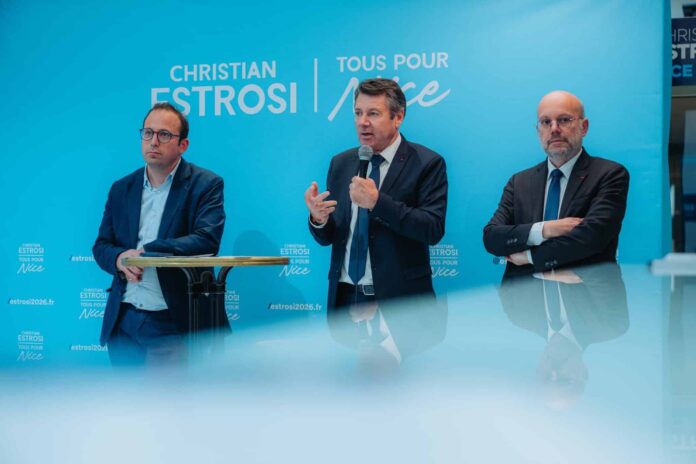
It was from his campaign headquarters that Christian Estrosi held a press conference yesterday devoted to the city’s public finances. Surrounded by his supporters and Maître Léa Lacour, future deputy in charge of Finance, the mayor presented a detailed argument in favor of Nice’s budgetary “soundness”.
The day after this statement, Christian Estrosi wanted to regain control of the budgetary terrain. Facing opposition criticism, he asserts that the city’s financial situation is “healthy” and “under control”, with figures and independent audits to back him up.
From the outset, he reiterated his conception of public management: “finances are an essential responsibility. This budget is not my money. It is not that of the majority. It is the money of the people of Nice. Public money. Its proper management is imperative. And I take great pride in it.”
Returning to the investments undertaken since 2008, tramway, school and sports facilities, network modernization, he describes them as “useful investments”: “they are productive. They strengthen Nice’s appeal. And in the long run, they pay off.”
He also stands by the choices made during the health crisis and storms: “I preferred to temporarily worsen our ratios and finances to save what mattered (…) Yes, we spent money. And I don’t regret it. I’m even proud to have done so. A local authority is meant to protect during difficult times. Not to hoard while residents suffer.”
According to him, Nice has now entered “a third phase, a phase of solid recovery.” The outgoing mayor cites several external assessments: “the Michel Klopfer firm gives us 17 out of 20. LocalNova gives us 18 out of 20 (…) The Montaigne Institute in turn confirms the soundness of our accounts. They all say the same thing: our financial situation is good and everything is under control.”
Debt, taxation, opposition: the battle of figures
Maître Léa Lacour, tax lawyer and future deputy in charge of Finance, detailed the main indicators. The debt repayment capacity stood at 6.8 years at the end of 2024: “who can boast today of having the means to repay all their debt in less than seven years?”
Debt has fallen by 41 million euros despite the spike linked to Covid, while operating expenses increased on average by 1.6% per year between 2019 and 2024.
Another element highlighted by her running mate: savings representing 15% of actual operating expenses. “That means one simple thing: our income far exceeds our current expenses.”
On taxation, Léa Lacour asserts that the municipal property tax rate (35.30% in 2026) places Nice “among major cities with the lowest levels in its category. She adds: people in Nice now pay fewer local taxes than in 2008 or 2018.”
The tone hardened regarding Éric Ciotti’s proposals, who promises a return to 2023 tax rates. Christian Estrosi contests the figures: “It’s not 40 million, but 90 million (…) Finding 90 million means more than 2,000 jobs. You can’t cut 50 or 90 million without damaging municipal public services.”
He questions the possible consequences: “which services will be affected? Nurseries? Teaching assistants? Nursing homes? Municipal police? Museums? Libraries?”
In conclusion, the mayor made five commitments for the next term: continued control of expenses, continuous reduction in debt, annual independent audit made public, chairmanship of the finance committee entrusted to the opposition, and finally, tax reduction “through growth (…) people wanted to make Nice residents believe the city was on the brink of bankruptcy. A lie!“
In a campaign where every percentage becomes an electoral argument, municipal finances have become the heart of Nice’s political debate, and no doubt one of the main issues—transparency?
NicePremium is a free, independent local news outlet.
Help us keep going by supporting our work from €5 per month.


