
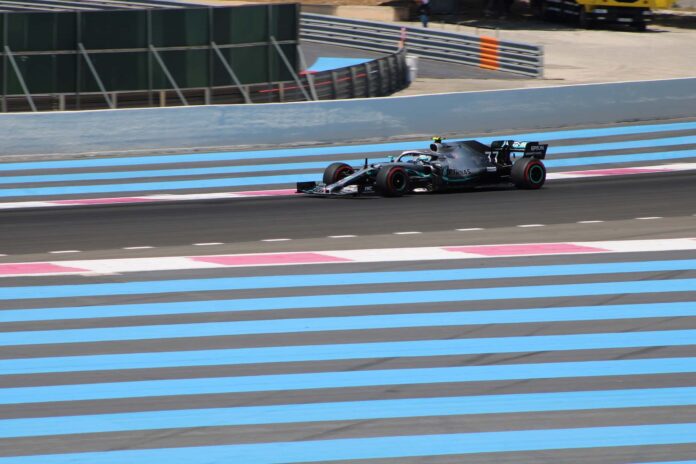
The regional audit office report describes a French Grand Prix at Le Castellet heavily financed by public money and undermined by a deficit-ridden model. The magistrates point to irregular procedures, high compensation, and opaque governance leaving a debt of 35.7 million euros.
The return of the Formula 1 French Grand Prix to the Paul-Ricard circuit at Le Castellet between 2018 and 2022 was supposed to establish the discipline permanently in the Var region. The Provence-Alpes-Côte d’Azur regional audit chamber now describes a trajectory marked by structural deficit and governance deemed deficient. The public interest grouping French Grand Prix-Le Castellet, active from 2017 to 2023, emerged with a debt of 35.7 million euros. The magistrates count 102.9 million euros of public money committed for four editions “without economic returns being verified.”
The report details an economic model dominated by royalties paid to the group holding the commercial rights to Formula 1. More than 75 million euros were devoted to these payments over the entire period. Contracts stipulated that this company would capture the bulk of commercial revenues, notably television rights and associated income. The GIP found itself dependent on ticket sales, its only direct source of revenue. Attendance remained high despite access difficulties to the site, but ticket sales were insufficient to absorb costs. The Covid period further reduced the model’s capacity to stabilize.
Nearly half of the GIP’s resources were financed by taxpayers. Member local authorities have already injected over twenty million euros. The Var departmental council, the Toulon-Provence-Mediterranean Metropolis, and the South-Sainte-Baume agglomeration community are among the main contributors. The liquidation of the GIP, finalized in March 2024, leaves these territorial actors in disagreement over debt sharing.
Irregular procedures, Nice study, and opaque governance
The regional audit chamber does not limit itself to financial imbalance. The magistrates mention “governance failures” and a form of opacity in the GIP’s management. Around a dozen public contracts were awarded without competitive bidding. The auditors cite media space purchases for 430,000 euros and consulting services for 1.23 million euros between 2017 and 2022. These expenses add to the royalties paid to the British group and reinforce the unsustainable nature of the model described by the CRC.
One decision attracts particular attention: a contract for 550,000 dollars signed in 2022 for a study on “the feasibility of a Grand Prix in Nice.” Half of this amount was paid to the Formula One Management group. This contract was concluded without the board of directors’ knowledge and outside the GIP’s statutory purpose, focused on the French Grand Prix’s return to Le Castellet. The chamber emphasizes this point and characterizes this initiative as an expense “outside statutory purpose.”
In his response, Christian Estrosi clarified that this sum had been paid in 2025 by the Nice-Côte d’Azur Metropolis, a structure he chaired when he was mayor of the Côte d’Azur capital. The official also recalled not having held executive functions within the GIP. The CRC nonetheless underlines the strategic role of the presidency in validating certain orientations.
The GIP’s governance is also criticized for its lack of transparency toward administrators. Member local authorities did not always have complete information on financial commitments. This opacity fuels today’s tensions surrounding debt sharing.
High compensation, significant expenses, and ongoing judicial investigation
The regional audit chamber devotes part of its report to the GIP’s recruitment and compensation policy. The payroll increased from 1.1 million euros in 2018 to 2.8 million euros in 2022. The magistrates mention a “generous recruitment and compensation policy.” The chief executive recruited in 2020 received 338,000 euros per year. Expenses related to this position are also examined: 25,700 euros in hotel costs in 2021 and home-work commute expenses paid for despite these trips not being provided for in the contract.
Other material advantages are noted. A manager had a corporate credit card, a benefit not in line with the bylaws. The report mentions “conveniences granted to managers who did not appear particularly vigilant about economizing means.”
On the judicial front, the Marseille prosecutor’s office is pursuing an investigation opened in 2023 for favoritism and embezzlement. Jean-Louis Masson, president of the Var departmental council, recalls having made a report to the prosecutor in 2023. “I will therefore also produce your final report and consider that your organization is also entitled to do so,” the official writes to the CRC.
Reduced economic returns and debate on F1’s future in France
The question of economic returns occupies a central place in the report. Project promoters were betting on 120 million euros in gains. The CRC evaluates this actual amount at 75 million euros. The magistrates estimate that “economic returns were substantially overestimated” and describe the model as “unsustainable.” Xavier Lefort recalls the context: “Everyone knew it would be deficient and require public money.”
In his response, Christian Estrosi nonetheless defended the Grand Prix’s impact on the territory. The official argues that “the Grand Prix did contribute to the territory’s prominence and tourist appeal.” The region’s delegated president considered Le Castellet a relevant site for a possible Formula 1 return, provided “clear financial commitment from the State” is obtained.
NicePremium is a free, independent local news outlet.
Help us keep going by supporting our work from €5 per month.


