
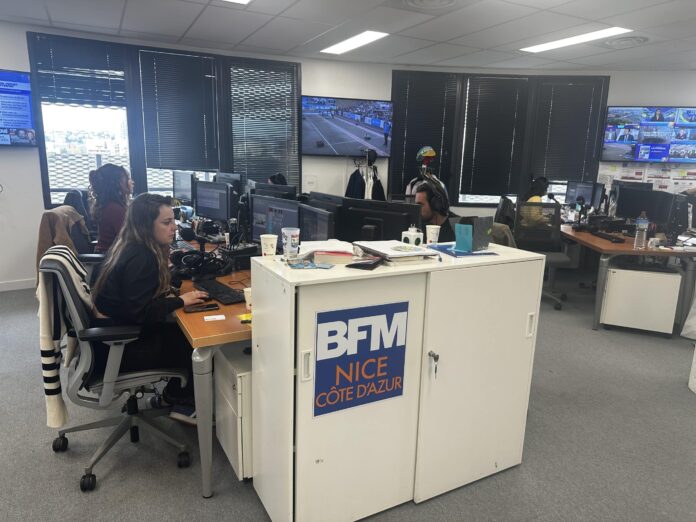
On Wednesday, June 24, the owner group CMA Média announced its intention to sell 9 of its local channels BFM as part of a cost optimization plan aimed at achieving 20 million euros in savings. A decision that quickly triggered a strike call from unions.
In response to the group’s decision to close the 9 local BFM channels, the reaction from unions was swift. The SNJ and CGT RMC BFM notably called for a strike starting Wednesday at 5 p.m. through Thursday at 9 p.m. No news broadcasts will be aired. In their statement, the unions denounce a management that claims to be protective of local journalistic anchor while simultaneously divesting itself of its 9 channels.
The unions point to the threat that no buyer will come forward, as the economic models of local channels are often criticized as having little viability, which management itself implicitly acknowledges. 125 employees find themselves waiting for a decision that won’t come for several months.
A strong contrast is condemned in the statement: the recruitment of presenters “at exorbitant salaries“ and the distribution of “generous loyalty bonuses“ while local channel employees have seen their resources shrink for months.
A BFM journalist explained the situation to us. According to her, there have been rumors of closures of BFM local channels since December 2025 due to an unstable economic situation. She described the market as “complicated” because the channel relies largely on advertising and aid from institutions (Regional government, city hall, etc.).
She added that she and her colleagues had long thought there would be a merger with BFM Toulon and BFM Marseille to create a regional entity. Another hypothesis was to focus on web formats rather than television.
The journalist stated: “We’re talking about the end of BFM Nice and the local BFMs which are the only private local channels in the French audiovisual landscape”. She shared her concern and that of all the teams because they were composed of professions specific to television and news.
A “voluntary departure plan”
As part of this “cost optimization” initiative, CMA Media will immediately open a voluntary departure plan within its RMC BFM audiovisual division, with the number of positions affected remaining undefined and subject to negotiations. This leaves employees with deep concern as the fall season approaches.
In Paris, the departure plan will certainly free up some positions, but their number will remain very limited given the scale of closures announced across all network local channels. Ultimately, several hundred people across all affected cities risk ending up without a solution and probably without employment. However, the “voluntary departure plan” won’t work for everyone since many cannot or do not want to leave Nice. Employees who have been established in Nice for a long time, with family life and recent financial commitments, find themselves facing an almost impossible mobility situation.
The BFM journalist also clarified that the decision was made even though some local channels were doing better financially than others and some had made considerable investments (for example: a new studio for Marseille). Regarding Nice, the journalist emphasized the significant number of stories to cover, mentioning the recent coverage of municipal elections and special editions for the carnival earlier in the year: “We have upcoming events including the ten-year anniversary of the Nice attack”.
She concluded by saying: “We were very proud of the work we did over five years [. . .] we gave our best [. . .] that’s why we’re all the more disappointed and feel let down by management despite all the enthusiasm and energy we put in”. The employee explained that many had left Paris to settle permanently on the Côte d’Azur, and now face the closure of their channel. And “even if there were a buyer, we don’t know who it could be, who could invest in a local channel in such a complicated economic situation”.
The budget restrictions announced by CMA Media thus triggered a strong union reaction and significant concern among employees about their professional future. A situation that highlights the economic difficulties of local televisions in the face of profitability demands from the audiovisual division. As negotiations begin, it remains to be seen how the private regional news offering will evolve in the French audiovisual landscape.
Charlotte Nguyen Van and Juliana Bauchiero
NicePremium is a free, independent local news outlet.
Help us keep going by supporting our work from €5 per month.


