
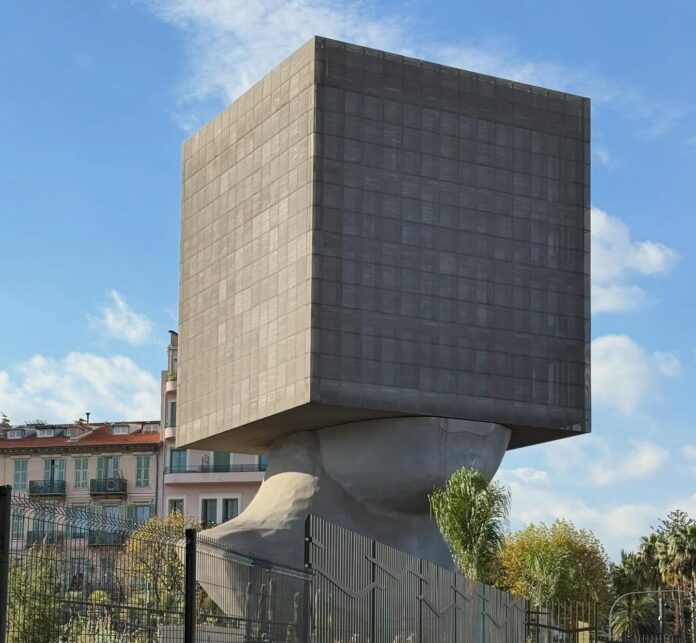
In the heart of the green corridor, facing one of the most recognizable monuments in the Nice landscape, Éric Ciotti presented a proposal included in his cultural program. We gathered reactions from residents to understand what this initiative could change for Nice residents.
A symbol of the city center, a visual landmark for Nice residents and visitors alike, the Tête Carrée could enter a new chapter in its history? A proposal that fits into the municipal debate and directly touches on local heritage.
In front of the Tête Carrée, a work by artist Sacha Sosno, Éric Ciotti detailed a proposal from his cultural program for Nice. The stated objective is to allow residents to access the inside of the building and develop an exhibition space there.
Currently occupied by municipal offices and closed to the public, the structure could become a cultural venue accessible to Nice residents. The idea would be to organize temporary exhibitions, highlighting local artists and creations from the region, in order to strengthen the city’s cultural anchoring.
His running mate, Nathalie Kestemont-Gasperi, points out that this reflection stems from a simple observation: “many Nice residents pass by this monument every day without being able to discover its interior”. The project would therefore aim to bring this emblematic building closer to residents, while respecting its technical constraints.
In the same vein, Éric Ciotti indicated on his X account that “the Tête Carrée must become a living space serving Nice residents”. He also announced that “Auguste Verola would be in charge of culture in the event of electoral victory”.
Field reactions in the heart of Nice
On the Promenade des Arts, the opinions gathered reflect the diversity of local views. Some residents, like David, 75, a retiree, believe that “the Tête Carrée is an integral part of the Nice landscape” and that it “naturally fits into the architectural identity of the city center”. For them, the building already fulfills its role and contributes to the balance of the neighborhood.
Others, however, are in favor of opening it up. Bianca, 28, a waitress, sees this initiative as “an opportunity to further boost Nice’s cultural life”. She mentions the interest in hosting modern and contemporary art exhibitions, and imagines a venue capable of showcasing local talent while attracting a wider audience, including foreign visitors discovering Nice.
Jean-Jacques, 80, a retiree, for his part insists on the heritage dimension of the monument. For him, the essential thing is to “allow Nice residents to enter this unique building and enjoy the view of the city and the Mediterranean”. A passionate collector of vintage cars, he even imagines other possible uses, such as “a themed space” or “a place dedicated to the history of the Tête Carrée and its creator, Sacha Sosno”. According to him, any reflection must above all serve “Nice residents and local heritage”.
In the heart of the city center, between the sea and the hills, the Tête Carrée remains a powerful symbol of Nice. Its future could now depend on the political choices to come, in a debate that directly touches the cultural identity of the Azure Coast capital.

NicePremium is a free, independent local news outlet.
Help us keep going by supporting our work from €5 per month.


