
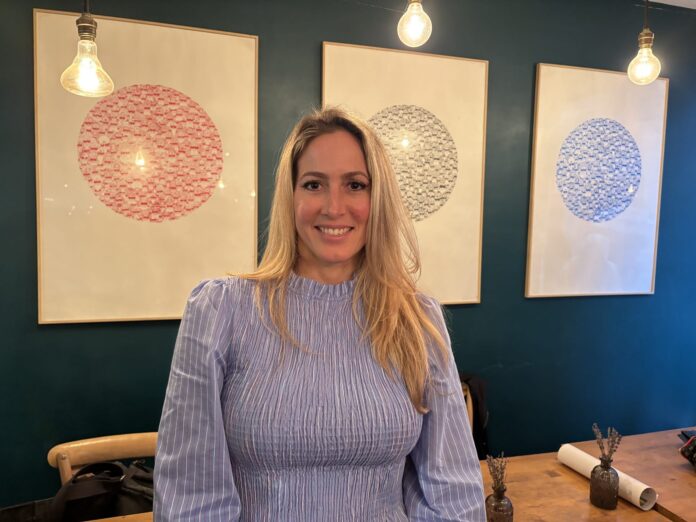
On the eve of the first round of municipal elections, the editorial team of Nice Premium is proposing a series of identical interviews with the list leaders who have agreed to our request. The objective is to help you better understand the positions taken by the various candidates in the municipal election in Nice.
Three lists did not respond despite several follow-ups: All for Nice (Christian Estrosi), for scheduling reasons; The Reconquest of Nice (Cédric Vella), which did not honor its appointment; and The Best is Yet to Come (Eric Ciotti), which ignored our requests.
The four other lists, namely Nice Popular Front (Mireille Damiano), Nice Direct Democracy (Céline Forjonnel), Workers’ Struggle – The Workers’ Camp (Estelle Jaquet) and United for Nice (Juliette Chesnel-Le Roux), have answered ten general questions and sent a message to Nice voters.
It is now the turn of Céline Forjonnel to answer our questions:
If you are elected, what would be your top priority for Nice during the first 100 days of your term?
“ Our guiding principle is to reinstate the local referendum for decisions on significant budgets, on major city projects, during the first 100 days and beyond.
We will conduct an audit with the population, with neighborhood committees too, to find out what really needs to be done, because our list actually wants to listen to the citizen.
We will also carry out a financial audit to see which parts of the budget could potentially be reduced, and based on that, see what we could propose, for example, possibly property tax cuts, as some candidates suggest. I don’t want to rush ahead before seeing the city’s financial situation.
What will your strategy be regarding public safety?
We believe in reinstating community policing, trained in ethics and first aid. Some may already be, but that would allow for concrete results, especially in neighborhoods with higher crime rates.
What concrete measures will you propose to address the housing crisis in Nice?
We need to build approximately 2,500 homes, which is enormous. Some candidates propose raising buildings. We instead propose participatory housing types and restoration of municipal heritage. Many apartments owned by the city are empty today and could be reused.
Participatory housing involves buildings where people live by providing services to each other, or with shared common spaces, common workshops, things like that. Many people who own properties on the hills, with fairly large plots of land, where the building coefficient is already maxed out, might have room to put what we call tiny houses. These are lightweight structures where you can make energy savings in particular. This would help people who really need housing and can’t find any.
It could be a win-win situation for homeowners and tenants, since homeowners would receive rent for the occupation of part of their land, and people would find comfortable, decent homes, perhaps a bit more in the countryside.
What mobility policy will you implement to reduce traffic congestion and improve daily transportation?
We need to encourage people as much as possible to use the tram, perhaps by making transportation free, especially for students and the elderly, to free up space.
The same applies to parking in Nice, which is quite congested. We should make them free for two hours and on weekends, in addition to resident parking subscriptions. We could also reduce the price of public parking, which is quite expensive in Nice. I don’t know why, in Monaco, they can have such low parking prices, and here in Nice, we have such high prices. That’s something to look into.
How will you support local downtown commerce?
We had thought perhaps of implementing tax reductions for merchants, depending on the rent they pay, if they rent a business property, for example. This would possibly allow savings on commercial space rental for two years.
The person collecting the income would need to be able to deduct the lost income from their taxes. For example, if a space were to cost 1,000 euros, perhaps merchants could actually pay only 700 euros, and 300 euros would be deducted from taxes for the landlord.
How will you guarantee fair access to sports, culture, and public facilities in all neighborhoods of the city?
Access to culture in Nice is again reduced since they destroyed Nice’s theater. We need to restore many things. Perhaps through schools: there needs to be more activities to introduce all the possibilities that Nice’s culture offers.
We also plan to open citizenship centers, neighborhood centers, where we take into account the needs of residents. And if it turns out that this is among their main concerns, we will work with artists who will also be integral parts of these centers.
We can also consider opening small stadiums — basketball, football… — and theaters too. But all of this always depends on the audit we do at the beginning, based on the budget. We don’t want to put the city into debt.
What is your vision for protecting and developing the Nice coastline in the face of climate change?
As for climate change, I think it’s still difficult to anticipate that kind of event. I’m not sure we can really do it, but in that case, we would hire experts specialized in the subject to see what we can implement.
How will you finance your program without increasing municipal debt or local taxes?
First, we need to see where we can make savings. Today, we know that at the public money level, some expenses are not really controlled. For example, on public construction projects, large profit margins are often taken by companies.
We must manage the budget closely, in a healthy and transparent way: that’s what we want. As I manage my wallet, I would manage the city if I had to. I know expenses are enormous. When you spend 750,000 euros redoing the Nikaïa bathrooms, couldn’t we have done it much more cheaply, for example? There’s a huge amount of money being spent, and it’s not necessarily useful. That would allow for reductions in other areas.
What role will you give to local democracy and citizen participation in your decision-making process?
It’s the main priority, the flagship of our program, what we want to implement so that citizens feel concerned again.
We would aim to significantly reduce abstention in Nice in various elections over the next six years. With digital tools today, it’s easy. When you look at the Swiss system, for example, whenever decisions need to be made, they submit them to the population. We could imagine an application where all resolutions dealt with in city council would be voted on by the population, with a yes or no. True democracy is taking the majority vote.
How do you plan to combat abstention and strengthen electoral participation in Nice?
In reality, the citizen has the impression of being concerned about what’s happening, but is not involved. If we give them decision-making power back, they will feel more involved and think: “yes, it’s worth something for me to vote.” We imagine we can significantly reduce abstention rates with this kind of functioning.
What message would you like to send to the people of Nice?
We really want to give the city back to Nice residents. Today, I think it’s really important to change the local democracy system to actually get real results. We are a non-partisan list, because I think many people realize that left-right, today, doesn’t really make sense anymore. We aspire to something else. “
NicePremium is a free, independent local news outlet.
Help us keep going by supporting our work from €5 per month.


