
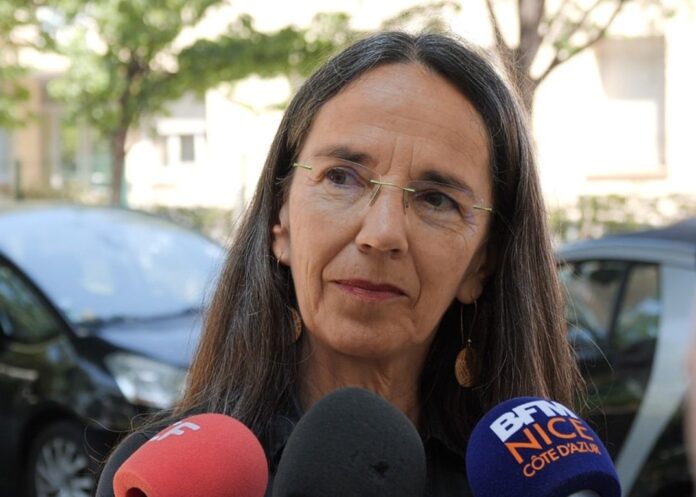
On the eve of the first round of municipal elections, the editorial team of Nice Premium is offering you a series of identical interviews with the leading candidates who responded favorably to our request. The objective is to help you better understand the positions of the different candidates in the municipal election in Nice.
Three lists did not follow up despite several reminders: Everyone for Nice (Christian Estrosi), for scheduling reasons; For the Reconquest of Nice (Cédric Vella), which did not keep its appointment; and The Best Is Yet to Come (Eric Ciotti), which ignored our requests.
The four other lists, namely Nice Popular Front (Mireille Damiano), Nice Direct Democracy (Céline Forjonnel), Workers’ Struggle – The Workers’ Camp (Estelle Jaquet) and United for Nice (Juliette Chesnel-Le Roux), answered ten general questions and sent a message to Nice voters.
To close this series of interviews, the floor goes to Juliette Chesnel-Le Roux:
If you are elected, what would be your absolute priority for Nice during the first 100 days of your term?
The first thing we will implement is to organize free public transport for those under 26, so that this is in place from the start of the school year. At the start of the school year, there will be free public transport for those under 26, whether they are students, middle school students, high school students or young workers.
What will be your strategy regarding safety in public spaces? What concrete measures will you propose to address the housing crisis in Nice?
Safety in Nice means the presence of police in the city. That is, a presence of municipal police in all neighborhoods, not in a car or behind a desk, but present on the ground. We will also implement mediators: we will start with 50 mediators in priority neighborhoods, to be as close as possible to residents and prevent crime.
What concrete measures will you propose to address the housing crisis in Nice?
The concrete measure we will implement cannot be done alone: we must do it with the prefect. This is rent control. This system, already implemented in Paris and other cities in France, allows us to contain the excessive inflation of rents and bring overly abusive rents down to reasonable levels.
What mobility policy will you implement to reduce traffic congestion and improve daily transportation?
The mobility policy is first of all free public transport during the term for all Nice residents. We will also launch the construction of line 5, which is a priority for this term, because it will serve many densely populated neighborhoods currently in a situation of territorial discrimination. These residents are stuck in traffic jams, and even buses can be blocked there in the morning when coming from neighborhoods around the Paillon. Finally, whenever there are road works, we will deploy secure bicycle lanes.
How will you support local commerce in the city center?
Local commerce should not be limited to the city center: it must be present in all neighborhoods. Otherwise, residents are forced to travel, for example to do their shopping on Avenue Jean-Médecin, and some neighborhoods become mere bedroom communities. We therefore want to allow businesses to arrive in all neighborhoods. To do this, we propose to create a commercial property company, which will allow us to pre-empt available commercial spaces and make them available to entrepreneurs and merchants wishing to launch a project, with a moderate rent at the start.
How will you guarantee equitable access to sports, culture, and public facilities in all city neighborhoods?
Access to sports and culture for all is a real issue. Today, at the time of school enrollment, in sports clubs or artistic learning centers like drawing, music or dance, there are often only spaces available very early in the morning, and many families cannot get any. We will therefore work to deploy sports and culture practice venues in all neighborhoods.
AnimaNice currently has quite restricted hours. There need to be activities in the evening, so that adults can practice their activities in the evening, and daytime or afternoons are more reserved for young people. AnimaNice is a good tool, and we need to deploy others elsewhere.
We also need to do significant work on after-school programs, that is, cultural, sports and scientific culture activities, during the hours when children are at school but do not have supervised activities. Running and playing in the yard is of course important, but when it lasts two hours, it can become a time of tension in school yards. That’s what teachers and supervisors tell us.
It is therefore important to put after-school programs in all schools. Today, in Nice, there is no real generalized after-school program: there are occasional facilitators, but no system present in all schools.
What will be your vision for protecting and developing Nice’s coastline in the face of climate change?
This is a very important issue that has often been neglected, because it was considered that the sea was a static backdrop far from homes. However, we are a city built on numerous waterways that flow into the sea. When there are storms or tempests, we can clearly see the water rising and rising into basements, damaging homes. And then there is the threat of a one-meter rise in sea levels by the end of the century, which means that part of the Old Town could be underwater.
We must take these issues into account and respect the Risk Prevention Plans (PPR, N.D.L.R) : flood risk prevention plans, rockfall risk prevention plans, since we also have this problem of rockfalls, often on the railway line. We must not contest these measures, as Mayor Christian Estrosi did, who had challenged the latest rockfall risk prevention plan, because it classified certain areas as red zones, making them therefore unbuildable.
This is an important issue. The unchecked construction in the Var plain, notably in the Nice Meridia area, is an example of this. We saw it with the Arenas building, which subsided by 15 centimeters and is today a construction site where we don’t yet know how it will end. This shows that we must take precautions when building, and that we don’t build anywhere, particularly not in the major floodplain of a river like the Var. The mouth of the Var is a place that can be very dangerous, with storms related to low-pressure systems. Construction must therefore be taken seriously: we cannot simply say that an area is flat and decide to build there. This is why we will stop construction in certain areas. Zones authorized for construction will be clearly defined, and we will stop encroaching on the Var plain.
How will you finance your program without increasing municipal debt or local taxes?
We are not promising to lower local taxes, because major projects must be funded. For example, we need to complete the treatment plant, which is a very important issue. We also want to add filtering systems, particularly for pharmaceutical pollutants, which today are not taken into account in this new treatment plant. This is a serious issue for biodiversity. We also need to finance the work for tram line 5, which will represent between 300 and 500 million euros. This is a priority for us.
There is obviously an issue of good management. During the last three terms, we have seen a disastrous management of public funds, notably with the Castellet circuit affair, revealed by the press. The investigation and the Court of Audit report, also revealed by the press, confirm what we feared: poor management. In this specific case, it represents 15 million euros. Storm Alex cost us 11 million euros. And because of this poor management, we lost state support in the Storm Alex-related project. The state indicated that as long as the situation was not clarified, it would not finance its share.
There are also projects started and then cancelled because public procurement procedures were poorly conducted, like the Vauban parking garage. We have a whole series of files of this type that cost millions of euros each year. Investment can be financed by debt when it is useful, but operations must be based on rigorous management of public finances. This is why we are not committing to lowering taxes, at least not immediately.
The only small room for maneuver concerns the tourism tax. We can increase it slightly, because we are not at the ceiling: the ceiling is €4.90 and we are currently at €4.80, or a possible increase of about 2%. Our proposal is to transfer all expenses related to major events to the Metropolitan Tourism Office, since it is the one that can collect the tourism tax. This would allow us to use this resource to finance tourism events, such as the Nice Jazz Festival, Ironman Nice or Nice Carnival. This would represent approximately 10 million euros.
We will also increase the price of bus and tram tickets for tourists, since transportation will become free for Nice residents. Today, the ticket costs €1.70; it would increase to €2.30 for tourists, which is still in line with the average for major French cities.
What place will you give to local democracy and citizen participation in your decision-making process?
We don’t want to rely solely on neighborhood committees, which often feel too dependent on the town hall. We will implement regular participatory budgets, with genuine prior consultation, as is already done in several cities, notably in Grenoble. And with a significant budget, not just a symbolic one.
We will also implement open data on the town hall’s website. The site must be clear and accessible. Today, if you’re looking for a municipal resolution, you almost have to know in advance how the administration works to find it.
The objective is therefore to publish municipal decisions in open data, but also to consult residents beforehand. This is not about communication, as Christian Estrosi did, who announced his decisions in the press before each municipal council meeting. Instead, we want to say: here are the decisions we propose to vote on, then we engage with citizens and the concerned neighborhood committees before the final decision.
How do you plan to combat abstention and strengthen electoral participation in Nice?
Abstention is linked to several factors, but mainly to disinterest in politics, often linked to the spectacle that politics presents. For my part, I have tried to generate interest by speaking about substantive issues, while some of my opponents have given a spectacle that I find pitiful. For us, talking to residents daily, listening to them and presenting concrete projects, is already a first step.
We must also better educate citizens on how political life works: what a mayor can do, what depends on the state, and how the two work together. This will be a real civic education project in schools. For example, asking elected officials who sit on school boards to speak in classrooms, to explain what a municipal council is, or invite students to visit the town hall or attend a municipal council meeting.
Even though the city is not responsible for middle and high schools, middle and high school students are probably the most receptive audience for this type of initiative.
What message do you wish to address to the people of Nice?
The message I wish to address to the women and men of Nice is that I want, as a candidate for mayor, to return the city of Nice to its inhabitants. Make Nice a more livable city, more affordable for purchasing power, safer with more police presence and mediation, and more caring, with attention paid to all neighborhoods. And I also tell them to seize the opportunity to vote, to give their voice to someone who cares about residents, and not just about their own personal prestige.
NicePremium is a free, independent local news outlet.
Help us keep going by supporting our work from €5 per month.


