
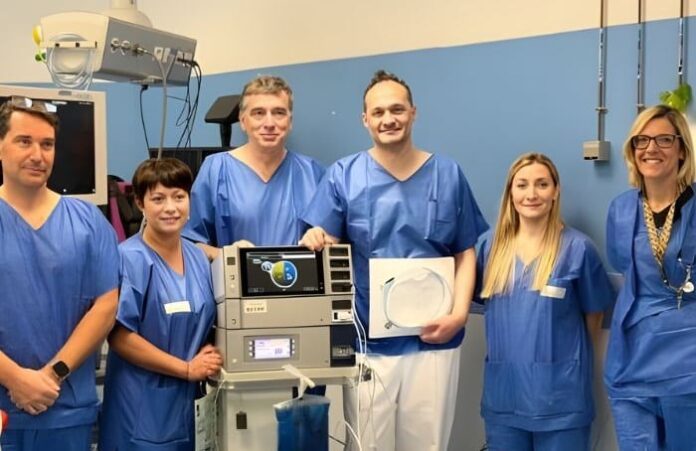
An intervention carried out in April 2026 marks a milestone in the treatment of obesity. The University Hospital Center of Nice implemented a procedure never before used in France. This approach is based on a minimally invasive technique without resorting to surgery or medication.
In April 2026, the University Hospital Center of Nice performed an intervention presented as a national first in the treatment of obesity. This initiative is part of the search for new solutions to support patients with this condition.
The procedure was conducted through digestive endoscopy. This method allows intervention without opening the abdomen. The act is based on a technique called fundic gastric mucosal ablation, abbreviated fGMA. The principle relies on targeted action on the stomach’s fundic mucosa.
The technique involves destroying a specific part of this mucosa using an argon coagulation system. This device acts directly on the production of ghrelin, a hormone involved in the sensation of hunger. The reduction of this hormone aims to limit appetite over time.
The intervention was carried out under general anesthesia. It took place within the DIGI-TUNED unit. The concerned patient had grade 2 obesity with a body mass index of 35.5 kg/m². The procedure was performed as a day case, with the patient going home the same day.
A technique associated with an already used practice
The fundic gastric mucosal ablation was not used alone. The medical team combined it with endoscopic gastric plication, an intervention already performed at the hospital. This association is a work axis for improving the achieved results.
Currently, plication results in an average weight loss of about 15%. Adding fGMA could exceed 25%. These data need to be confirmed by further studies.
To date, only one international publication mentions this technique. This study was conducted by an Italian team and published in the journal Endoscopy. In this context, its implementation at the Nice University Hospital marks a step for its development in France.
The procedure was validated in a multidisciplinary consultation meeting. This step defines the indications and frames the patient’s journey. The intervention is part of the Specialized Obesity Center’s initiative, coordinated by Dr. Véronique Nègre and Professor Nicolas Chevallier.
A structured medical and technical framework
The intervention benefited from specific technical support. ERBE Medical provided assistance during its execution. The French Society of Digestive Endoscopy also participated in this national first.
The collaboration included Professor Marc Barthet, president of this learned society. This framework ensured the safe introduction of the technique in a hospital environment.
The Nice University Hospital highlights several elements related to this approach. The technique requires no surgery. No medication is required. The intervention remains minimally invasive, and recovery is quick.
These characteristics may represent an alternative for certain patients. The process, however, remains supervised by a multidisciplinary team. The selection of candidates is based on specific medical criteria.
A strategy oriented towards medical innovation
This intervention is part of a broader strategy. The Nice University Hospital seeks to develop solutions tailored to the needs of patients with obesity. Diversifying techniques is a leverage to improve care.
The medical and paramedical teams were mobilized for this intervention. Their involvement allowed for this national first. The institution also emphasizes the role of scientific and technical partners. For the Nice University Hospital, “this national first illustrates our ambition: to offer Maralpin patients innovative, less invasive, and increasingly effective solutions in a rigorous and secure medical setting.”
This approach aims to provide access to recent techniques in a structured context. Patient follow-up remains at the heart of the initiative. Coordination among different actors is a central element.
The implementation of fGMA opens new perspectives. Evaluations will be necessary to measure long-term effects. Results will need to be analyzed on a larger patient population.
The Nice University Hospital reaffirms, through this initiative, its commitment to developing new practices. The goal remains to adapt treatments to patient profiles while maintaining a secure framework.
This national first marks a step. It could contribute to evolving therapeutic strategies in the coming years.
NicePremium is a free, independent local news outlet.
Help us keep going by supporting our work from €5 per month.


