
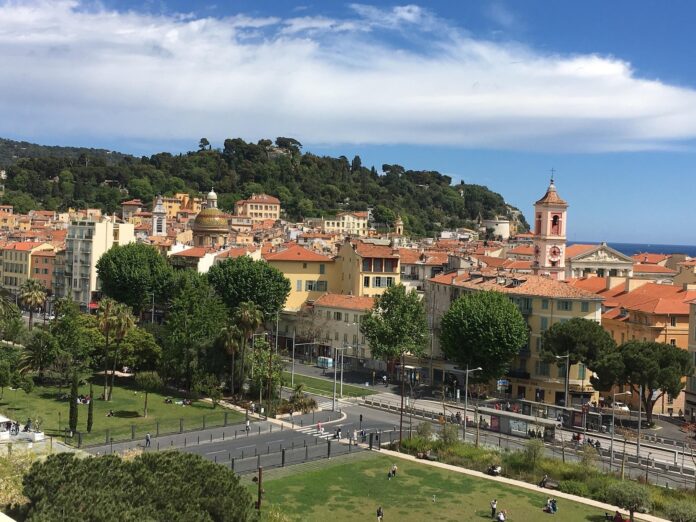
Facing almost 300 professionals gathered for the launch of the summer season 2026, Éric Ciotti detailed his orientations for tourism. The return of business tourism, new facilities, tax reduction, and preparation for the Winter Olympics 2030 form a strategy presented as a major economic lever.
In a context of local political transition, the launch of the 2026 tourist season in Nice provided Éric Ciotti with a platform to lay the foundations of a new strategy. In front of an audience comprising hotel, restaurant, and cultural sector players, the mayor emphasized the central role of the sector in the local economy. “Tourism, naturally, continues and will always remain the primary driver of our economic activity.”
The figures presented confirm this weight. The metropolitan area records €2.7 billion in economic benefits and nearly 22,000 direct jobs. The attendance reaches 15.2 million visitors, with a 3% increase. In this context, the municipality displays a desire for consolidation and adaptation. “Nothing will be spared to continue making our territory a land of welcome, a land of excellence.”
The stated goal rests on an international ambition. The city must “continue to establish itself with this image of an international capital.” This direction involves several axes, the first of which concerns business tourism.
The return of business tourism at the core of the strategy
The disappearance of the Acropolis convention center left a structural void. “Nice experienced a structural weakness by almost eliminating its conference offerings.” The municipality aims to address this situation with a new offering. An infrastructure “of very high quality” is envisioned to strengthen off-season activity.
Three locations are being studied: the site of the current ephemeral palace OcéaNice, the theater of Verdure sector in the Albert-Ier garden, and the Sulzer parking lot. Proximity to the city center and coastline is a decisive criterion.
The project previously proposed at MIN fleurs was ultimately not selected. “I think this location is not the most suitable for a convention center.” The site could accommodate other functions. The mentioned prospect concerns< an establishment of major company headquarters as a continuation of the Grand Arénas. “The configuration, with the airport nearby, the train station, and the highway, lends itself to this. It could rejuvenate this economically moribund Var plain.”
This revival of business tourism aims to smooth out attendance. The objective is to “increase occupancy rates during the off-season.” The strategy takes inspiration from models based on regular international events.
Culture, taxation, and administrative simplification
The second identified lever concerns the cultural offering. There is a reflection on the creation of events with widespread reach. “We need to reinvent, create events with national and international reach.” The current programming is deemed insufficient to attract significant flows to museums. “I want us to reinvent cultural events with national and even international reach (…) Because it has been a long time (…) since we hosted a major flagship exhibition capable of attracting hundreds of thousands of people…”
The strategy also relies on the role of the private sector. “Beyond the power in organizing events, I deeply believe the essential lies in the private offering.” Hotels, restaurants, and shops are presented as critical players in attractiveness.
Following this logic, a “fiscal counter-shock as of April 24 distributed between the city and the metropolis” is announced. The amount reaches €55 million. The measure includes “a 20% decrease in property tax, a 10% decrease in the residence tax on secondary homes, as well as a reduction in the waste collection tax.”
Simplification of rules accompanies this orientation. Procedures related to building permits, opening authorizations, or public space occupancy will need to be accelerated. “The goal is to assist those who create, those who invest, and those who are the primary wealth creators.” The local authority intends to play a “facilitator role” in order to “create fertile ground for initiatives to thrive.”
A context marked by the Winter Olympics 2030
Nice Côte d’Azur Airport represents another pillar of this strategy. The infrastructure, recently expanded with the extension of Terminal 2, is presented as “an extraordinary asset” with 130 international destinations. This connectivity represents a lever in the perspective of the Winter Olympics 2030. Hosting this event is described as a “priority subject.” “We are not far from reaching a win-win agreement.”
The question of cruises remains controlled. The adopted position aims to be balanced and aligns with the framework set by the prefectoral order limiting flows.
In the short term, indicators are trending upward. The occupancy rate reaches 69% in April. The period from April to June shows 58%. The month of May reaches 61%, an increase of 2% compared to 2025. The month of June stands at 51%, a level comparable to the previous year.
The 2026 season relies on around forty events. Festivals and sports competitions contribute to this dynamic. “We have an occupancy rate of 69% in April, 58% for the period between April and June, 61% in May (…) and 51% in June.”
The municipality seeks to consolidate a key sector for the local economy while changing certain tools and priorities.
NicePremium is a free, independent local news outlet.
Help us keep going by supporting our work from €5 per month.


