
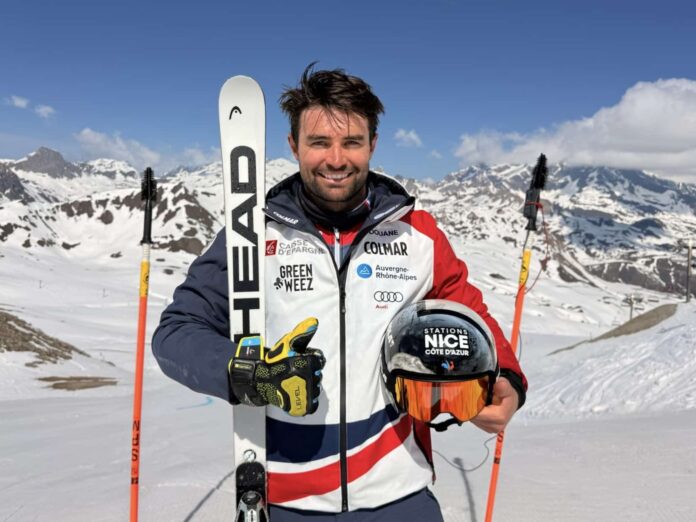
After a contrasting winter, Matthieu Bailet looks back on his 2025-2026 season. From his Super-G comeback to the Olympic episode and prospects for 2027, the athlete from Nice opened up the day after a rebuilding season from which he drew many lessons.
Start of season and overall assessment
We spoke at the beginning of winter. You explained that you wanted more and weren’t yet at the desired level. Now that the season is over, what’s your perspective on your winter?
“The way I see this season is a year in two parts, marked by a very positive Super-G. After our conversation (at the end of the American tour – Editor’s note), I wanted more and, honestly, I got more, not long after, with great races and great results. I come a hair’s breadth away from my first World Cup victory (a mistake two gates from the finish in Livigno – Editor’s note). There was good skiing, pleasure, beautiful emotions, but also frustration, as any professional athlete can experience. In downhill, it was more complicated, with less performance and high bib numbers. I struggled to put it all together. With high bib numbers, it was really not simple, especially because of external conditions. At Beaver Creek, the weather wasn’t conducive to high bib numbers. Bormio didn’t take place in December as usual, even though it’s a race where high bib numbers can often perform well. Several external factors accumulated. This creates frustration, but also shows there’s still work to do. The goal is to go next year and achieve what I managed to achieve this year in Super-G.”
You mention Livigno, where victory came down to nothing. Did that race change the rest of your winter?
Yes. It was very frustrating, but it’s exactly the kind of day I want to face: big skiing, performance, speed, intensity. Up front, you’re competing with the world’s best skiers. Sometimes it goes the right way, sometimes the wrong way. This time it went the wrong way, but with very good intentions and the right approach. Next time, I want to use this off-track two gates from the finish, when I was still ahead at the last intermediate splits, to make it to the end.”
The final step
You had some good training sessions. What was missing to translate those performances into racing?
It’s a sign of the positive side of this season. I won my first official training session (in downhill at Courchevel in March – Editor’s note). We know training remains training, but it has significance. Perhaps there was a slight lack of precision in equipment setup to be able to express myself best in all conditions. Some conditions suited me very well, others much less. Then there’s the mental aspect. It takes a little time to regain all the confidence you can have when you’re at the highest level after coming out of my most difficult season of my career last year. You come back quite quickly to 80-90%, but the last percentages, the final step, take time. That’s what I was missing. And that’s what we want to work on.”
Super-G seems to have suited you. Will this discipline take precedence over downhill for the rest of your career?
Downhill remains the premier discipline. Super-G has always been more natural for me. Since there’s no training and it’s a single run, you have to leave more room for instinct. Last season, the psychological difficulties had troubled me in this discipline. Today, I’m rediscovering the pleasure, the commitment, the adrenaline. That shows right away in Super-G. In downhill, you need more precision. I’m convinced that won’t take long to move in the same direction.”
The non-Olympic selection
The Olympics marked your winter. How did you experience that period?
It’s perhaps the most difficult moment of this season. For me, it’s important to put it in context. Until then, the French team had always had between ten and eleven places. This season, I learn, the day before my last race before the Olympics, there will only be seven (eight ultimately with the withdrawal of a quota from the Norwegian team in favor of France – Editor’s note). The quota calculations changed. We weren’t informed by our management. It hurts, it surprises you. At the start of the season, we’re given precise criteria. When you meet those criteria and everything changes, it’s not easy. I had to digest it and build on it. I think that showed in my last race, with a top 15 that has real significance. That gives me even more desire to reach the next Olympics.”
Do you think there was a failure somewhere?
It’s complicated to say. Some people are responsible for calculating and anticipating these things. As an athlete, we ask our management to handle the logistics and administration. For a selection for a major event, you need to arrive with the most precise idea possible. Even if it’s hard to hear in advance, it’s better to know. You never expect it to come like that. Elite sport is hard, strict. When a change comes at the last moment, it’s never simple. But that’s part of life. It’s an experience like any other.”
How did you manage to bounce back after that disappointment?
I had to take time. It creates a void in the middle of the season. But I was able to return home, to my usual resort at Auron. I reconnected with my club and committee coaches. We set up a framework around speed training, Super-G and downhill that allowed me to express myself at my best. That did me a lot of good.”
Preparation and 2030 Olympic objective
How do you see your path to the 2030 Olympics now?
It’s still a bit early to talk about that. I’m exactly the day after my last skiing day (last Friday – Editor’s note) of this season. The 2030 Olympics are an important objective, but there’s planning season after season, with the World Cup circuit and two world championships before. We have the opportunity to take a complete break in May. We’ll resume everything that’s physical preparation progressively in June with a big intensity block in July. Skiing will resume progressively in August before we head to the Southern Hemisphere for our most important training camp on skis, normally in Chile. And then comes the trickiest phase, October-November, where we switch a bit between fine-tuning physical details and continuing to progress on skis until our departure for North America, normally around November 10th.”
You mentioned a need for renewal around you. Where do you stand?
The direction is very good. I would have hoped for changes within the French team. I had expressed a need for freshness, for renewal, to break out a bit from the routines, from the speeches we already know without having targeted criticism of any specific person. It’s more a need for fresh air. Having also discussed it with my group colleagues, it was still a general trend. Unfortunately, the context doesn’t allow it to my great regret. That’s also part of the obstacles of an elite athlete. Either I sit around complaining, or I get my act together to find my own solutions and that’s exactly what I intend to do. (…) There are always solutions, but they require funding. In skiing, we’re not rolling in money. You need to find the right balance. Build, be smart, see what we can improve. I’m already opening up on the mental side. On the skiing side, it’s more complicated because it requires more logistics and therefore higher costs.”“
NicePremium is a free, independent local news outlet.
Help us keep going by supporting our work from €5 per month.


