
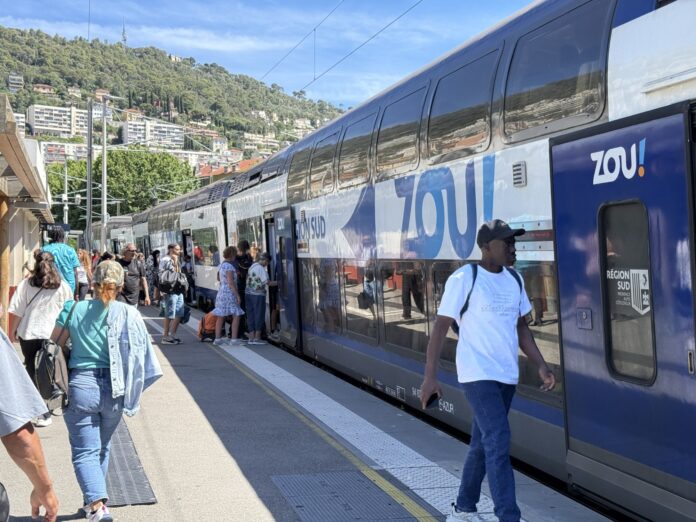
In line with national forecasts indicating severely disrupted regional traffic, the proportion of railway workers on strike on Wednesday, June 10 reached peaks in the Alpes-Maritimes department. The strike will not be continued in the coming days.
The call for a day of mobilization launched by four unions representing SNCF railway workers found a strong response in the Alpes-Maritimes. Railway traffic there has been considerably slowed since the beginning of the day due to the social movement, with only 10% of transport capacity in effect on Wednesday, June 10.
A joint statement took place this morning near Nice-Ville train station (Thiers), where a general assembly of strikers gathered in large numbers. Jean Castex, CEO of the SNCF group, is to meet with these same unions in Paris on June 23. Rail worker federations will meet tomorrow, Thursday, June 11 in Paris to request to be received more quickly by the group.
Facing SNCF which “wants to trim existing benefits”, the unions know they have proven “power to disrupt”. The Sud Rail union states that this is for now merely a “warning shot”, and does not rule out extending such a movement if the group fails to hear their demands. Discussions with the Rail Workers Union Federation are to be held tomorrow, Thursday, June 11, pending negotiations at SNCF and Sud Azur. At both the group level and locally, the discourse is currently identical. For the unions, the immediate opening of wage negotiations could constitute an initial emergency measure that would resolve the conflict.
24 trains out of 200 in service on the TER Sud Azur network
Today it was “75% of strikers across all trades” who exercised their right to strike according to Jordan Mandelli, departmental secretary of the Sud Rail union and conductor based in Nice for the TER Sud Azur, SNCF Voyageurs company dedicated to the Nice hub. Just on this Nice hub, the TER network was severely disrupted today: 24 trains were running today out of approximately 200 normally in service, representing only 10% of transport capacity in service. 23 of the 24 trains in circulation had modified routes: “The Ventimiglia-Grasse line became Ventimiglia-Cannes for the day” explains the Sud Rail union representative in the Alpes-Maritimes.
The most affected line is undoubtedly the Breil-Tende line, on which no trains were running today. It was entirely replaced by buses. “When only about twenty trains are running for the day, the entire network is blocked”, explains Jordan Mandelli.
3/4 of Sud Azur workers on strike
This striking figure is explained by a strike rate approaching 95% among controllers and 90% among rolling stock drivers, according to Sud Rail union data. This same rate approaches 75% among rolling stock maintenance workers. Furthermore, very little SNCF personnel are available at stations on the network.
A success for the Sud Azur representative, who is pleased to have managed “to mobilize so many […] We organized a gathering this morning where we were very numerous. It gives hope that the fight is just beginning”, he confides.
Reduction in rest time and increase in working time
The unions explain this strike by three major findings: increased work-related suffering (13 suicides since the start of the year, in a context of SNCF subsidiary and privatization, editor’s note), growing job insecurity for railway workers, and questioning of SNCF’s historical working time organization, notably in its subsidiaries.
For the Sud Rail union, this last aspect is sacred. Yet recently the social framework of SNCF group subsidiaries has been modified here and there: “the number of working days increases with the elimination of 5 or 10 RTT days, rest time between two working days is reduced by one or two hours, decentralized shift starts are multiplying” (a conductor based in Nice can be called to start his shift in Cannes for example, editor’s note).
And this without offering means to get there, since “the collective agreement provides that a worker can travel within a 45-minute radius of their place of residence” to take their job. All of these measures are not without consequences on passenger safety.

“It’s going to take me more than three hours to get home”
At Nice-Riquier station, stranded passengers sigh at the sight of the few lines displayed on the departure board. The impact of the social movement on these travelers is no less significant. Caroline, 32, works at Nice’s Pasteur Hospital. Both on the way there and back, her journey was not spared from the slowdowns on the rail network: “I go from Antibes to Nice-Riquier to go to work every day. From home, I have 1 hour and 30 minutes of travel in total. Now it’s going to take me more than three hours to get home. My train leaves at 4:55 p.m., I arrived here at 3:30 p.m., so I’ll wait almost 1 hour and 30 minutes. This morning too, there was a three-quarter hour delay on my train”.
Others ended up favoring telework, while updating the SNCF application until the last minute: “this morning, I had to wake up earlier than usual to monitor the SNCF application and verify which trains were canceled or maintained. I had to reorganize myself urgently. I’m lucky to have very understanding bosses who, given the situation, immediately granted me permission to work from home today”, explains Thibaut, 24, working in Monaco and residing in Nice.
Competitor Transdev particularly affected
Present on the Marseille-Toulon-Nice line since 2025, the competitor Transdev is particularly affected by the job insecurity. Its employees would benefit from minimum social benefits and are at the initiative of the housing allowance request appearing in the tract from the unions to railway workers on June 4, 2026, according to the Sud Rail union. “Many of them are in situations of great precarity, even distress”, confides Jordan Mandelli. Transdev employees have been on strike for four days, as announced in late November 2025.
NicePremium is a free, independent local news outlet.
Help us keep going by supporting our work from €5 per month.


