
The Mediterranean Vegetable Garden Facing the Water Challenge
Every summer on the Côte d’Azur, the same ritual is imposed on amateur gardeners and vegetable garden enthusiasts alike: daily watering, often tedious, sometimes ineffective, always water-hungry. In a context where summers on the Riviera are becoming increasingly hot and droughts increasingly frequent, the question of intelligent irrigation has never been more pressing. Yet the answer may lie in an object thousands of years old, discreet, artisanal and remarkably effective: the oya.
This terracotta jar buried directly in the soil of your garden is seducing a new generation of gardeners concerned about their water footprint. And on the Riviera, where water is a precious resource and watering restrictions an increasingly present reality, it stands out as a solution of both common sense and good taste.
What exactly is an oya?
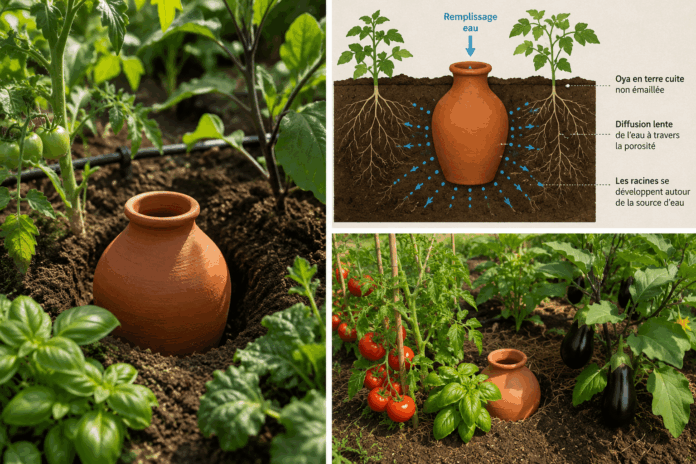
The oya — also found spelled olla in its Hispanic version — is an unglazed terracotta jar that is buried in the soil, in the immediate vicinity of the plants you wish to irrigate. Only the neck remains visible above the surface, allowing the jar to be filled regularly with water. The principle is based on a natural and fascinating property of terracotta: its porosity.
The wall of the oya allows water to diffuse very slowly, continuously, directly into the surrounding soil. The roots of the plants, attracted by this constant source of moisture, naturally develop around the container. Irrigation thus takes place in depth, where it is truly useful, without surface evaporation and without waste. This is what is called root diffusion irrigation.
An ancestral technique brought back into fashion
If the oya seems to be a recent discovery in French gardens, it is in fact one of humanity’s oldest irrigation techniques. Traces of its use date back more than 4,000 years in China, India and the Middle East. Ancient Mediterranean civilizations already used it to cultivate in arid conditions, making it a particularly coherent tool with the spirit and climate of our region.
Today, sustainable garden designers and organic farmers are rediscovering its virtues. Artisanal manufacturing workshops are flourishing throughout France and Europe, and oyas can now be found in many specialized garden centers or on online craft commerce platforms.
Making your own oya: a creative project for summer
One of the charms of the oya lies in its simplicity of design. It is entirely possible to make it yourself, and the experience proves both satisfying and educational. You will need natural, unglazed terracotta — this point is crucial. Glaze would waterproof the wall and eliminate the diffusion effect.
The essential steps
The most accessible method consists of assembling two terracotta pots of identical size, opening against opening, by sealing their junction with special ceramic cement or water-resistant glue. The drainage hole of one of the pots — the one that will be oriented downward — is then sealed, and the opening of the second is kept as the filling neck. A small stone or cork stopper placed on the opening prevents water from evaporating at the surface and insects from entering.
Sizes vary according to needs: a small one-liter oya is suitable for a few plants of cherry tomatoes or aromatic herbs, while a five to ten liter model can irrigate a larger vegetable garden area. In a Nice garden exposed to the intense sun of July and August, the oyas generally need to be refilled every two to four days depending on the heat.
The oya in your Mediterranean vegetable garden: which plants benefit from it?
The Côte d’Azur offers ideal conditions for vegetable gardening: exceptional sunshine, often limestone soil, mild temperatures from spring onwards. But these same conditions require particularly attentive water management. The oya is particularly well suited here to water-hungry crops that struggle in intense heat.
The big winners of oya irrigation
Tomatoes, peppers and eggplants top the list. These Mediterranean solanums par excellence benefit from regular, deep water supply, which limits water shocks responsible for fruit cracking. Zucchini and cucumbers, whose rapid growth requires constant hydration, are also excellent candidates.
On the side of less conventional plants, the tetragone — this particularly hardy Mediterranean spinach — also thrives very well with oya irrigation. Undemanding, vigorous, productive even in full heat, it represents a remarkable vegetable alternative for Riviera vegetable gardens seeking to diversify their crops while limiting water needs.
Aromatic herbs such as basil or cilantro, more fragile in the face of heat waves, also appreciate the constant freshness that this foot-irrigation system provides.
Water savings and concrete benefits
Studies conducted on oya irrigation show a reduction in water consumption of 50 to 70% compared to conventional surface watering. A considerable figure at a time when municipalities on the Côte d’Azur are intensifying their awareness campaigns on the reasonable use of water during the summer period.
Beyond water savings, the benefits are multiple. Roots, developed in depth around the jar, make plants more resistant to heat waves. The absence of surface moisture limits the proliferation of weeds and reduces the risk of fungal diseases such as mildew, a well-known scourge of vegetable gardeners. Finally, this system frees the gardener from the daily constraint of watering, ideal for peacefully enjoying an extended weekend or vacation.
The oya as a decorative object
In the spirit of Mediterranean decoration that permeates Nice interiors and exteriors, the oya also has undeniable aesthetic appeal. Artisanal models, often handcrafted, blend harmoniously into a garden with ochre and Sienna tones. Some ceramicists offer versions decorated with geometric or floral patterns, transforming this gardening tool into a true outdoor design object.
Displayed on a terrace or lined along a garrigue wall, unearthed oyas can also serve as original planters for potted plants, gradually diffusing water into a porous sub-pot. An elegant way to combine functionality and aesthetics, in the tradition of Mediterranean craftsmanship.
Conclusion: adopt the oya this summer
Facing the climate challenges that are reshaping how we garden on the Côte d’Azur, the oya stands out as both an ancestral and profoundly contemporary answer. Economic, ecological, easy to make or purchase, it sustainably transforms the relationship between the gardener and his vegetable garden. This summer, why not try making your first oyas? Your garden — and your water bill — will thank you.
Find more advice for a sustainable and inspiring Mediterranean garden on nicepremium.fr, in the Home-Garden section.
NicePremium is a free, independent local news outlet.
Help us keep going by supporting our work from €5 per month.


