
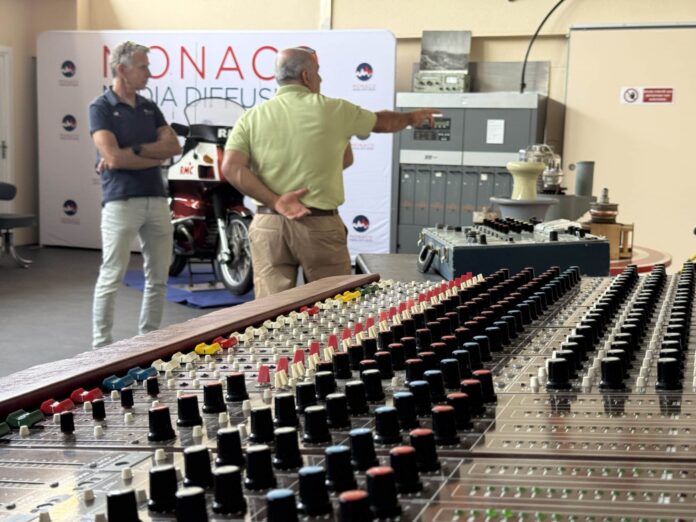
To ensure a good understanding of how radio transmissions work, the teams at Monaco Média Diffusion share their expertise over three days in Peille.
How does a radio broadcast physically reach its listeners? On the occasion of the Radio Festival, Monaco Média Diffusion (Monégasque broadcaster for radio and television on the Côte d’Azur, editor’s note), is reopening the doors of its two transmission centers to reveal the behind-the-scenes of radio broadcasting for the third consecutive year.
From June 4 to 6, 2026, its two centers located at the Col de la Madone sites in Peille (Alpes-Maritimes) and Roumoules (Alpes-de-Haute-Provence) welcome the public between 9 a.m. and 5 p.m., offering guided tours of the site every 30 minutes going right up to the base of the antennas. Participants will discover the technical installations that enable content broadcasting on the airwaves. A way to celebrate the essential role of radio broadcasting, its professions, and its history. Founded in 1994, Monaco Média Diffusion is the Monégasque company operating the audiovisual frequencies of the Principality of Monaco.
Making the invisible visible
Perched in the middle of the clouds, the Lucien Allavena transmission center is located at the end of a long, difficult-to-access road. It offers breathtaking views of Monaco and the Alpes-Maritimes. A true work base, its spacious facilities and supervision center make it the group’s most important site. But the technical heritage it contains is often closed to the public. So the objective of opening it is to “make the Nice, Menton, and Monégasque basin aware of what radio is and how it works. The aim is to explain what happens behind the car radio, since today radio listening is often limited to car journeys,” explains Thierry Poyet, managing administrator of Monaco Média Diffusion.
Specific technical demonstrations, long-distance communication… The infrastructure of the Peille site intrigues visitors: modern and vintage mixing consoles, digital and tube transistors, an ephemeral studio where Radio TopSide broadcasts live, not to mention its antennas that touch the clouds: “the tallest masts are nearly 300 meters high,” Thierry Poyet tells us.

At the last edition, over 200 visitors came to the broadcaster’s two sites. This year, organizers hope to also count on the presence of around a hundred people. “Last year, people came from Monaco and told me they had never been here, that they didn’t know how it worked,” Thierry Poyet regrets. This physical and geographical isolation, though necessary, contributes to the invisibility of the profession: “even though it’s not that far in kilometers, Monaco is not that close. Our center is not easy to access, because a radio center, by definition, must be high.” The success of previous editions is also explained by the growing interest in the profession.
Simplifying the behind-the-scenes professions to better recruit
“For three years, we’ve been opening our doors to explain our profession. The goal is also to pass knowledge on, and perhaps awaken vocations. Many young people are interested in this profession, particularly those with geeky profiles (sic). We hope to introduce them to our profession,” says Guillaume Asso, team leader of the transmission center.
“Last year, someone who wanted to pursue a career in this sector joined us as a student after the Radio Festival. He’s a radio enthusiast and already knew us. So we hired him to train him in this professional activity. The goal of these days is therefore to bring people in and to make our professions more accessible,” says Thierry Poyet with a smile. At the Peille site, the teams present all seem driven by the same passion for radio and desire to share: “people in the profession are passionate. They are true radio lovers,” adds Thierry. They certainly seem to be on the same wavelength.
Transmission as a legacy
The administrator of the Peille transmission center is also motivated to highlight historical equipment to attract a targeted audience: “this place is historic. It is steeped in the history of Radio Monte-Carlo (RMC), a radio that developed in the post-war era.” Old transistors, resistance equipment – such as suitcases containing transmitters parachuted into the Bay of Antibes in 1941 – are displayed as remnants of a glorious past.

The event attracts history enthusiasts, radio fans, or simply the curious. And even athletes out cycling along the Col de la Madone. Yves, 43, a cyclist, “was passing by” during his morning ride: “I had heard about the event, so I stopped on purpose to visit the site and have a coffee before leaving.”
Thierry Poyet: “we’re counting on the Grand Prix weekend to increase the number of visits”
Continuing from the National Radio Festival on June 4 and 5, Monaco Média Diffusion has decided to extend its opening to the public until Saturday, June 6. An extra day, generously offered by the teams present on site. A move that hopes to capture the flow of visitors on the sidelines of the Monaco F1 Grand Prix, which takes place over the weekend. Thierry Poyet then says: “we’re counting on this weekend to increase the number of visits. During the Monaco Grand Prix, come here to cool off and relax, to discover something different, understand our activity and our profession!”
Practical Information:
Radio Festival continues this Saturday, June 6, 2026. Lucien Allavena Transmission Center. 5547 Route de la Madone, 06440 Peille. Guided tours every half hour between 9 a.m. and 5 p.m. Free admission.
NicePremium is a free, independent local news outlet.
Help us keep going by supporting our work from €5 per month.


