
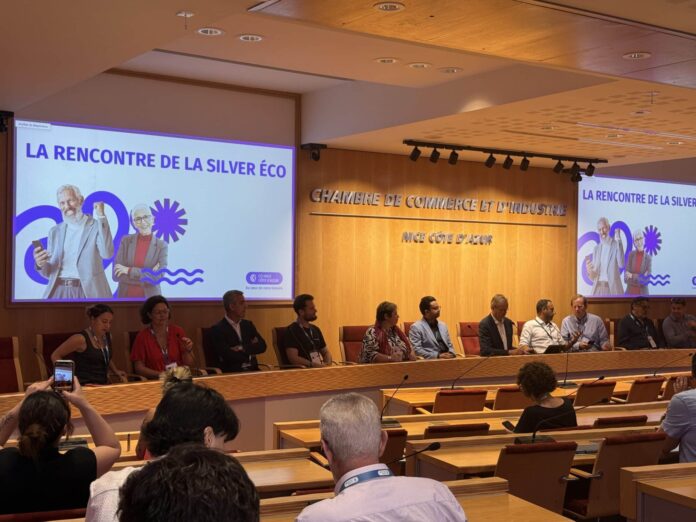
A new meeting of the seniors economy brought together its stakeholders around the use of proposed solutions. The economic dynamism of the sector is considerable in the Alpes-Maritimes, given the demographic specificities of the territory. Data and AI are at the heart of the debate.
A targeted event, local, increasingly regular on the Côte d’Azur. The Chamber of Commerce and Industry (CCI) of Nice Côte d’Azur organized a new meeting between stakeholders in the seniors economy at its Nice headquarters on Tuesday, June 2. The objective of this edition was to bring together regional stakeholders to address the challenges of population aging. Each year, the event is supported by a network of powerful institutional stakeholders: the CCI Nice Côte d’Azur, the Metropolis Nice Côte d’Azur, the South Region, and the House of AI.
The CCI Nice Côte d’Azur therefore invited businesses, healthcare professionals, researchers and public stakeholders to exchange on a specific challenge this year: “accelerating the deployment and adoption of solutions adapted to population aging”. On the agenda were presentations of innovative solutions for “active and intergenerational aging”, as well as targeted discussions around the use of solutions proposed to seniors. Issues that many find local answers to.
Alpes-Maritimes, a “privileged experimentation ground”
AliveNow, SouVia, Somanity… The meeting allowed for the presentation of around fifteen innovative solutions (custom exoskeletons, assistance robots, e-health applications…) developed by local businesses. The current challenge for these stakeholders is to facilitate the use of the proposed solutions: by enabling access, facilitating understanding and adoption of developed solutions.
More seniors. That was the finding that Côte d’Azur businesses quickly made. So most of those represented in the “Exhibitors’ Village” were created in the South region, and particularly in the Alpes-Maritimes. This is the case with Deep IoTech, a company developing connected health devices, based in the business hub of Sophia-Antipolis. Or the Charly’s Family association, which offers to recreate social connections through solidarity carpooling services and organizes activities for seniors. Without a doubt, the Côte d’Azur territory constitutes, due to its demographic particularities, a genuine “privileged experimentation ground” for these stakeholders, according to the CCI. And for good reason.
One in five French people is over 65 years old in 2025. In the Provence-Alpes-Côte d’Azur region, this population segment represents a quarter of residents counted in January 2026. A rate higher than in the rest of France, which creates a demographic fabric more than conducive for sector stakeholders. This attractive prospect for silver economy start-ups has moreover allowed some to establish themselves permanently in Nice and its surroundings. In recent years, these have infused the economic fabric of the Alpes-Maritimes in order to meet growing demand at regional and global scales.
15%, that is the share of seniors in the world population in 2025 (or 1.2 billion people). That same year, the SilverEco market report quantified a global market of 4,200 billion dollars dedicated to products and services for people over 60. Composed of five major sectors (health, housing, mobility, financial services, leisure), this market represented in 2025 nearly 900 billion dollars for Europe and the United Kingdom. By 2030, the silver economy could generate revenue of 130 billion euros for France alone, according to a report from the Terre des Seniors community website.
A meeting under the sign of data and AI
Prevention and “telecare” at home, connected beds, sensors… The question of data security and the role played by AI is a central issue in the seniors economy sector. For Mohamed Taghouti, engineer responsible for the Eternity Healthcare Services project at Deep IoTech, “data is the fuel of AI, it allows us to refine it, and to centralize the data in a single device”. The purpose of certain applications being to create, ultimately, digital twins, but also to provide “an important dashboard for the State”, according to the engineer.
The question of data, framework, and sovereignty is therefore central – especially when it comes to medical data. But while acceptability and consent regarding this data sharing does not currently seem to pose a problem for all seniors, some question how their data will be used. Carole Zisa-Garat, founder of Telegrafik (a platform aimed at preventing and supporting the loss of autonomy in seniors, editors’ note), states: “More than 85% of our clients forget the device installed in their homes”. Enough to reassure, or to reconsider communication about the consent given initially.
NicePremium is a free, independent local news outlet.
Help us keep going by supporting our work from €5 per month.


