
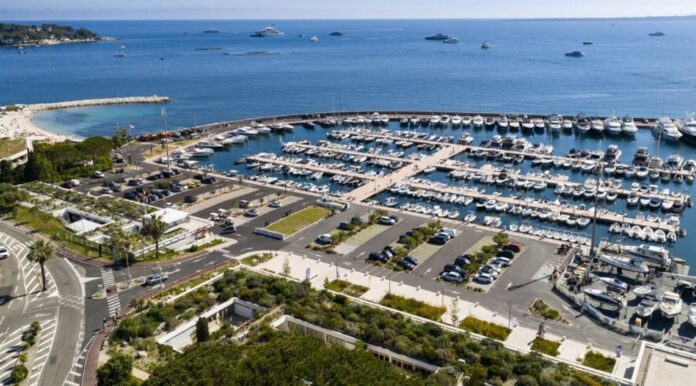
Gallice port has inaugurated a transformation that combines climate adaptation, Mediterranean architecture and enhanced vegetation. The site becomes a port-garden open to the bay, designed for the daily use of boaters and visitors.
Gallice port in Antibes has completed a transformation program launched between 2017 and 2026. Inaugurated at the end of May 2026, the site has been modernized, designed to link maritime space, Mediterranean architecture and plant presence with a clear objective: “combining green with blue” to create a landscape port open to Golfe Juan bay. The entire development has adopted a “blue, white, green” identity, combining water quality, clear architecture and enhanced vegetation.
The project was a continuation of the plan imagined in the 1960s by Guillaume Gillet. The port has retained its horizontality, its white lines and its integration into the landscape, while entering a new phase of climate adaptation. The quays were raised by 40 cm to anticipate rising sea levels. The slopes were inverted to collect polluted runoff water, previously directed towards the basin. Technical networks were redone, an LED lighting plan installed and a wastewater suction system for ships deployed. Pedestrian and accessible pathways were made continuous to facilitate movement.
A port-garden structured by vegetation and enhanced bioclimatic architecture
Vegetation now occupies a central place. The parking lots have regained permeable and shaded surfaces. Roof terraces have become planted spaces capable of naturally regulating the thermal properties of buildings. The place now resembles a “dry garden” composed of Mediterranean species adapted to water stress, installed in “draining substrate” and protected by mineral mulch. This approach limits watering and promotes deep rooting.
The patios of the north building have been redesigned for collective use. Unsuitable trees have been replaced with slender species such as Napoleon Pine, Monterey Pine or Horsetail Tree. The understory now receives flowering trees and a herbaceous ground cover layer. Concrete benches and pedestrian crossings facilitate movement between spaces.
The rehabilitation of buildings reinforces the principles of bioclimatic Mediterranean architecture. Roof overhangs provide protection from the sun. Patios ensure ventilation and natural light. Bio-based materials structure the interiors: wood fiber insulation, European larch joinery, linoleum flooring made of linseed oil, cork powder and jute canvas. Opening transoms allowed hot air to be purged.
The roof terrace of the north building has become a viewpoint over Golfe Juan. The requalification of Boulevard Edouard Baudoin has restored distant views towards the Îles de Lérins. The landscape project completed Guillaume Gillet’s initial intention, whose original plan combined white architecture, horizontality and integration into the site.
The signage has been completely redesigned with a coherent graphic language, based on functional and stylized typography, legible pictograms and white supports integrated into the port environment. Entrances, mooring space numbers, directional signs and business identification have adopted this same visual syntax.
With 436 mooring berths, 756 linear meters of quays and 3.8 hectares of water surface, Gallice port has entered a new phase. The project brought together client representatives, project managers, building contractors, landscape architects, engineering firms and institutional partners, including Région Sud and Banque des Territoires. The stated objective remained clear: to create a port-garden where boaters, visitors and professionals meet in a peaceful setting, open to the sea and to contemporary uses of the coastline.
NicePremium is a free, independent local news outlet.
Help us keep going by supporting our work from €5 per month.


