
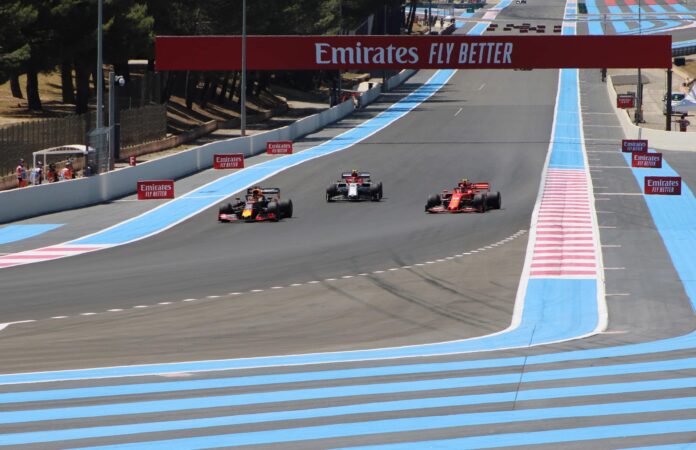
At the metropolitan council meeting on Monday, June 22, Éric Ciotti presented the conclusions of the Regional Audit Office’s report on the four editions of the French Grand Prix organized at Le Castellet between 2018 and 2022. The president of the Nice Côte d’Azur Metropolis denounced a financial commitment that he deemed devoid of metropolitan interest and refused to allow local taxpayers to bear the consequences of a deficit-ridden economic model.
The Formula 1 French Grand Prix organized at the Paul-Ricard circuit at Le Castellet left a deficit of 35.6 million euros for the four editions held between 2018 and 2022. This amount appeared in the audit conducted by the Regional Audit Office and presented on June 22 at the metropolitan council meeting.
Éric Ciotti described this document as a “particularly severe” report. The president of the Nice Côte d’Azur Metropolis contested the very principle of the local authority’s financial participation in an event organized over one hundred kilometers away from metropolitan territory: “this matter is extremely serious. I often allowed myself to intervene, even while not being a member of the metropolis, on the incoherence and inconsistency that it seemed to me the Nice Côte d’Azur metropolis should not have financed a Grand Prix that has no metropolitan interest.”
The president of the Metropolis also expressed his surprise at the validation of this public funding: “that the equality control authority allowed such aid to pass at the time, aid that seems to me contrary to all principles of common sense. Where is the metropolitan interest when a Formula 1 Grand Prix is held in the western part of the Var department, more than one hundred kilometers from our metropolis? And without there naturally being the slightest foreseeable benefit.”
An economic model weakened from the start
According to the conclusions of the Regional Audit Office, the Public Interest Group (GIP) responsible for organizing the French Grand Prix found itself in an unfavorable position from the relaunch of the event at Le Castellet.
The holder of Formula 1 commercial rights, Formula One Management (FOM), received the bulk of revenues generated by the event. Broadcasting rights, worldwide advertising, and the commercialization of 5,000 paddock passes went to them. The group also required the payment of a fee for the installation of refreshment stands on the site.
At the same time, the GIP had to bear significant costs, in particular for the annual provision of the Paul-Ricard circuit. Between 2018 and 2022, Formula One Management received nearly 76.5 million euros in fees.
Attendance reached 65,132 tickets sold as early as 2018. However, these revenues proved insufficient to balance the accounts. The health crisis subsequently reduced ticket revenues, which fell to 3.6 million euros in 2021.
The Regional Audit Office also noted dysfunctions in the presentation of accounts to the GIP’s administrators. The magistrates found that budgets had been presented in a poorly legible manner and observed a tendency to artificially limit projected deficits. Charges had been regularly underestimated while expected revenues had been overestimated.
The opposition recalled its warnings
During the debates, Juliette Chesnel-Le Roux recalled that the environmentalist group had denounced the financial excesses of the French Grand Prix for several years. The opposition metropolitan councilor described this funding as “absurd” and emphasized that several warnings had been sent to the public prosecutor.
While a criminal investigation was underway, the Regional Audit Office identified several irregularities, notably in the awarding of around ten contracts. For the environmentalist elected official, the report’s conclusions confirmed the concerns expressed since the project’s launch.
Éric Ciotti indicated that the Nice Côte d’Azur Metropolis still had to pay 1.2 million euros to settle this matter. The head of the local authority affirmed his opposition to any additional burden on metropolitan taxpayers. “I want to say that we will contest with the greatest determination the principle that the residents of our metropolis should be called upon to cover without question the financial consequences of an inconsistency, of a model whose structural weaknesses and governance failures the regional audit office demonstrates today, and perhaps, since a judicial proceeding is open, faults of another nature. I refuse for metropolitan taxpayers to become the adjustment variable.“
It remains to be seen who will pay the bill…
NicePremium is a free, independent local news outlet.
Help us keep going by supporting our work from €5 per month.


