
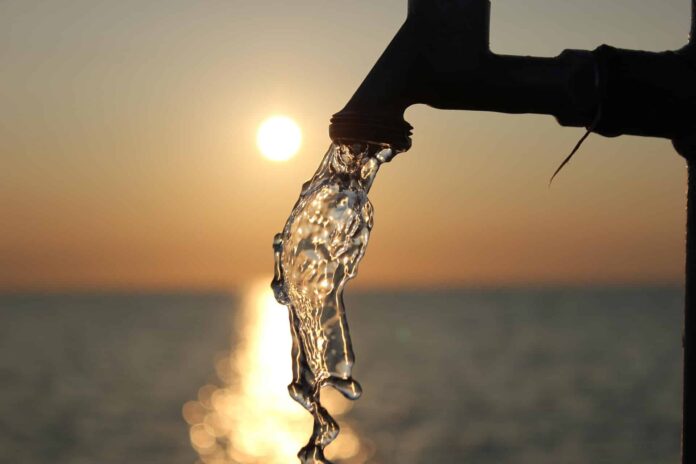
Facing a decline in water resources, usage restrictions will be applied from Saturday, July 11 in 30 municipalities in the Alpes-Maritimes. Twenty-five municipalities are placed on drought alert and five others on enhanced alert. The measures concern in particular watering, vehicle washing and pool filling.
The situation of water resources continues to deteriorate in the Alpes-Maritimes. After a spring marked by a precipitation deficit and high temperatures, water usage restrictions will come into effect from Saturday, July 11 in several sectors of the department.
Twenty-five municipalities are placed on drought alert. The measures concern the sectors of lower Siagne, Brague and Paillons. Notably affected are Cannes, Le Cannet, Mandelieu-la-Napoule, Vallauris, Mougins, Antibes, Biot, Contes, Drap, Lucéram and Peille.
In these municipalities, car washing at home is prohibited. The filling of private swimming pools is no longer permitted. Watering of green spaces, flower beds, vegetable gardens and golf courses is prohibited between 8 am and 8 pm.
Five municipalities in the Cagne watershed move to enhanced alert: Vence, Saint-Paul-de-Vence, Saint-Jeannet, La Gaude and Cagnes-sur-Mer. For the latter, uses supplied by drinking water coming entirely from the Loup basin are not subject to these specific restrictions.
In these municipalities, car washing at home, filling of private swimming pools as well as watering of green spaces and flower beds are prohibited day and night. Golf courses must reduce watering volumes by 60%, with watering only permitted at night. Beach showers must also be closed.
Special measures also apply to agricultural, industrial and craft activities in order to limit water resource extraction.
A drought fueled by lack of rain and high temperatures
The other municipalities in the department remain on drought watch, a level in effect since June 1. No mandatory restrictions are imposed at this stage. However, residents are invited to limit their water consumption in order to preserve the resource.
Hydrological indicators confirm a progressive deterioration of the situation. Since September 2025, the rainfall deficit has reached nearly 15.5% at the departmental level, with some sectors showing up to 20% less precipitation. Deficits reached 87% in April, then 10% in May and 15% in June. In certain coastal areas, the lack of rain observed in June varies between 40 and 80%.
High temperatures also intensify the phenomenon. April 2026 is among the warmest months recorded since 1947. June showed a temperature anomaly of +2.9°C, in a context of high heat.
River flow rates continue to decline, while 81% of monitored groundwater levels remain below seasonal norms. Weather forecasts predict a summer warmer than normal. Depending on how the situation evolves, new restrictions could be decided in the coming weeks or extended to other sectors of the Alpes-Maritimes.
NicePremium is a free, independent local news outlet.
Help us keep going by supporting our work from €5 per month.


