
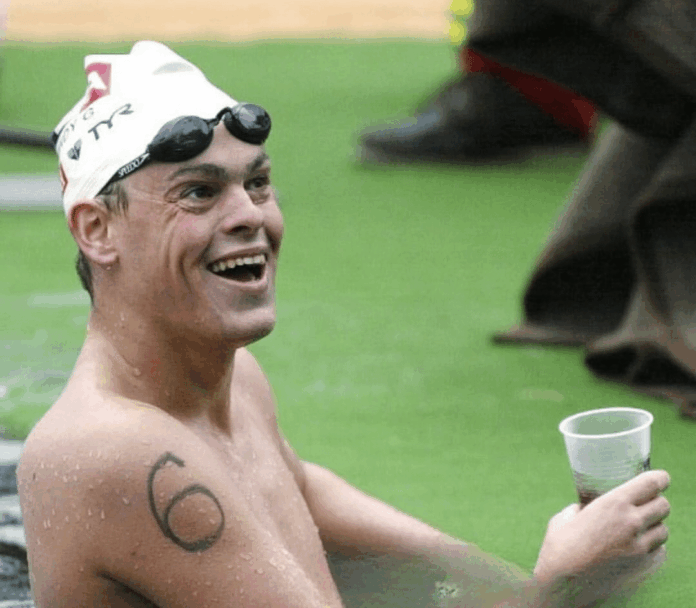
Swimming 180 kilometers across the Mediterranean to connect Calvi to Nice was the challenge that Breton swimmer Gilles Rondy set for himself just days before turning 45. European champion in 2006 over 25 km and present at the Beijing Olympics in 2008, he wanted to become the first to complete this route using only the strength of his arms. An objective that will have to wait, as the weather got the better of him.
When it comes to covering long distances in open water, Gilles Rondy is an expert. He holds the French record for crossing the English Channel, completed in 7h54 in 2004. In 2017, he also became the first swimmer to connect Saint Lucia to Martinique. Earlier in the year, the Breton swimmer covered 80 kilometers in Martinique, between La Trinité and Fort-de-France, in 22 hours of continuous swimming. An experience that was meant to serve as preparation for his Mediterranean project.
Having left Corsica on Sunday at 10:06 am, Gilles Rondy had to interrupt his crossing exactly 24 hours after his departure. Originally, he was supposed to reach Nice in a maximum of 60 hours. After covering 74 kilometers, a weather report announcing violent storms led to the halt of the challenge.
Meeting with an athlete still marked by this premature end, but already focused on the lessons from the adventure:
Can you describe the exact moment when you realized the adventure was going to end for you?
Well, it was when I got out of the water! [laugh]. From the start, I knew there was a risk of storms. That’s why I left Calvi quite quickly, thinking that if I swam fast, it could pass. But no. I understood it was the end when they put the dinghy in the water and came to tell me about the weather. We considered swimming for another half hour, but there was no sporting interest in that, we had to get back before the storm. At the moment, I was very disappointed, of course, because that wasn’t what the challenge was about.
With hindsight, how are you managing this interruption, and in the moment, did the desire to continue take over?
We learned a lot collectively with the team, we analyzed everything we could improve. I think we got there because I perhaps didn’t choose the right dates, but that’s part of the rules of the game. This learning is really the positive side to all this.
As for whether to continue or not, I didn’t try to force it. In the morning, I had been clear with the team. The skipper and the weather officer had the obligation to stop me if there was a problem. I did still ask to push the crossing, to see if there weren’t possible routes without putting the boat and crew in danger. And all the way through, I think we made the right decision.
How did the first 24 hours of the crossing go?
The conditions weren’t great, we had three-quarter swell facing us. It was quite tiring, even for an experienced swimmer. But the night went fairly well. I encountered relatively few jellyfish, a lighting system allowed me to avoid most of them, I got stung five or six times in total. [A stark contrast to his Saint Lucia-Martinique journey in 2017, marked by a swarm of jellyfish that caused him prolonged vomiting, Editor’s note]
I wasn’t too cold either, the water was 24.5°C. At the time of stopping, things were going well. Physiologically, I was fairly fresh and my head wasn’t spinning. I just had a shoulder problem that had been bothering me for two hours.
After discussing with long-distance trail runners, you mentioned the fear of the third night, when hallucinations can occur. Aren’t you disappointed not to know how you would have managed it?
Yes, it’s definitely frustrating. I was already thinking that the second night, I would be even more tired, that I would need to manage the cold better. We had even planned hot drinks for that. I couldn’t accumulate that experience, it’s clear that’s missing.
You who are used to crossings, what goes through your head during such long hours?
Usually, I manage to be really detached, to think of nothing. Here, the start was complicated, with certain decisions to make and changes in posture, so my mind wasn’t very at ease. I thought a lot about supplies, I received one every twenty minutes, and I got a small pasta meal every six hours. In the end, it was quite rhythmic, the kayak crew change happened every two hours. We joked around a bit between us too, there wasn’t really time to feel alone.
What did this experience teach you for a future challenge, perhaps a rematch on the same route?
I need to digest this. It took a lot of energy and some money too! We need to see if there are interested partners, and I’m already going to do weight training to repair this shoulder.
I learned a lot about organization. For example, there should be a boat that allows positioning the swimmer on both sides depending on needs. It sounds silly to say it like that, but I could only swim on the right side of the boat, while the swell was coming from the right! On the other hand, it was a wonderful experience seeing what we saw in the Mediterranean, which was also one of the goals. We were lucky to see manta rays, dolphins, turtles, jellyfish and squid. It’s important to raise awareness about the beauty of our seas.
NicePremium is a free, independent local news outlet.
Help us keep going by supporting our work from €5 per month.


