
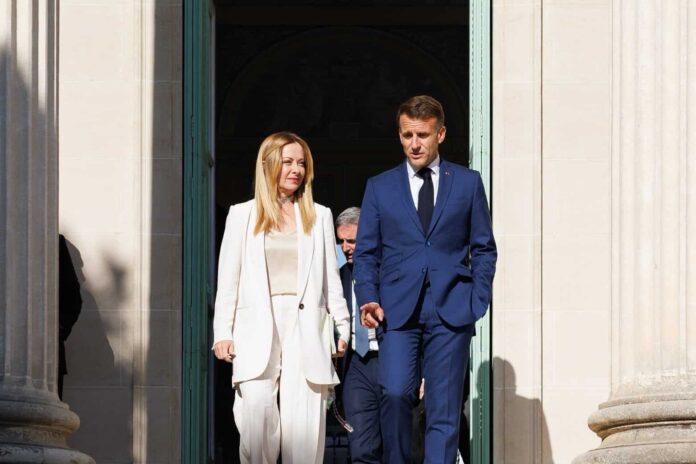
The 36th Franco-Italian summit was held on Thursday, June 25 in Antibes. Emmanuel Macron and Giorgia Meloni displayed their willingness to strengthen cooperation between France and Italy. Several agreements were concluded, notably on cross-border transport, defense and rail infrastructure.
Antibes hosted the 36th Franco-Italian summit on Thursday, June 25. Emmanuel Macron, present for the second time since the beginning of the month in the Alpes-Maritimes, received Giorgia Meloni on the Côte d’Azur for a working day dedicated to relations between France and Italy. The meeting began with a visit to the Picasso Museum before talks at the Villa Eilenroc, followed by the signing of several agreements, a press conference and a working dinner.
This meeting marked the first Franco-Italian summit since 2020 and the first organized since Giorgia Meloni took over the Italian government in 2022. The meeting was in line with the Quirinal Treaty, which came into force in 2023, which provides for strengthened cooperation between the two countries.
Nine ministers from each government participated in the discussions, accompanied by representatives from the business world who gathered at a forum organized in Cannet. The discussions covered several sectors, notably defense, transport, energy, infrastructure, space and nuclear.
Following the discussions, Emmanuel Macron declared: “I am very pleased with what we have managed to build and what emerges from this summit. We believe in the power of bilateral cooperation. We have a common approach.”
Advances for cross-border transport
The summit resulted in several announcements concerning mobility between France and Italy.
The two states signed a declaration of intent on the development of the Marseille-Nice-Genoa rail axis. This project, integrated into the priorities of the future Connecting Europe Mechanism 2028-2034, should modernize this link and open new perspectives for European financing for the New Provence Côte d’Azur Line.
France and Italy also confirmed their commitment to completing the Tende tunnel with two separate tubes. The launch of the call for tenders for the renovation of the historic tunnel is expected during the summer of 2026. Ultimately, this development will end alternating traffic and facilitate exchanges in the Roya valley.
The two governments also discussed the modernization work of the Cuneo-Breil-Ventimiglia railway line to restore an operating speed of 80 km/h by 2030.
Another announcement: the revival of the Alpine rail motorway between Aiton and Orbassano. The facility, interrupted in 2023 after a landslide in the Maurienne valley, should promote the shift of goods transport from road to rail.
France and Italy finally reaffirmed their support for the Lyon-Turin project, which is expected to be operational by the end of 2033.
Philippe Tabarot, Minister of Transport, welcomed these decisions. “I am pleased with the decisions announced on the occasion of this 36th Franco-Italian summit in the Alpes-Maritimes, which illustrate the common will of our two countries to strengthen their cross-border transport infrastructure. The declaration of intent on the Marseille-Nice-Genoa rail axis, the forthcoming launch of new work in the Tende tunnel and the revival of the Alpine rail motorway are evidence of concrete cooperation serving our cross-border territories and their inhabitants, strengthening economic exchanges between our two countries and decarbonizing our modes of transport. Progress that is part of the continuation of efforts undertaken since the Quirinal Treaty initiated by the President of the Republic, and for which I am fully committed since my entry into Government.”
The discussions also addressed defense issues. France and Italy announced their intention to launch a multinational “coalition” following the end of the UNIFIL mandate to strengthen “sovereignty in Lebanon.” Emmanuel Macron clarified: “We want to launch a coalition on the post-UNIFIL mechanism, of course in coordination with the European Union and the United Nations, to strengthen Lebanon’s sovereignty and its armed forces and prevent its territory from becoming a focal point for regional escalation.”
Giorgia Meloni added: “Italy and France can absolutely make a difference. (…) It is necessary, in our view, to guarantee an international presence that prevents an extremely dangerous security vacuum.”
NicePremium is a free, independent local news outlet.
Help us keep going by supporting our work from €5 per month.


