
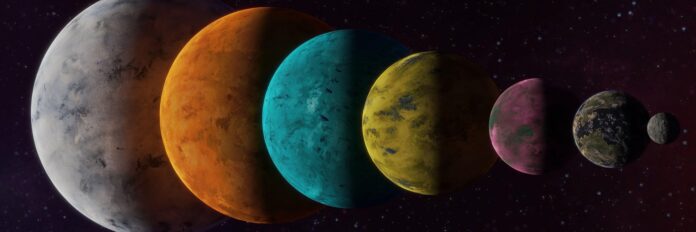
An uncommon astronomical phenomenon will occur on Saturday, February 28, 2026. Six planets will be visible simultaneously in the evening sky. Observation is possible with the naked eye for most of them, under certain conditions.
The sky at the end of February holds an unusual meeting. On Saturday, February 28, 2026, at nightfall, six planets of the solar system will appear at the same time above the horizon. Mercury, Venus, Jupiter, Saturn, Uranus and Neptune will all be present in the evening sky.
The scientific education media Futura announces: “the planets will be aligned, literally, in the sky at the end of February.” For several weeks around February 28, this configuration will remain observable, even though the date will mark a particularly favorable moment.
Seeing several planets during the same evening is not unprecedented. However, observing six simultaneously remains rare. Futura specifies: “this phenomenon is quite rare, because while planets sometimes four or five come together visible at the same time, seeing six is still memorable.”
The last larger configuration dates back to February 2025. Seven planets were then visible at the same time. Such an alignment should not occur again before 2040. In 2026, Mars will not participate in the event, but the configuration remains remarkable.
A cosmic parade under conditions
The expression “alignment” can be misleading. The planets will not form a perfect straight line in space. The arrangement will rather create an arc along the ecliptic, a consequence of a perspective effect from Earth.
The distribution in the sky will follow a west-east axis. To the west and southwest will be Mercury, Venus, Saturn and Neptune. Higher in the sky to the southwest will appear Uranus. In the east will shine Jupiter, close to the Moon.
Most planets will remain visible to the naked eye. Mercury, Venus, Saturn and Jupiter can be spotted without instruments. Uranus and Neptune, on the other hand, will require binoculars or a telescope. Without optical aid, detection will be difficult.
The recommended window is “just after sunset (between 30 minutes and one hour, around 7 p.m. in Nice)”, according to Futura. Some planets, particularly Mercury and Venus, will remain low on the horizon and will only be visible briefly.
A clear horizon to the west will be a decisive advantage. Low light pollution will also improve observation chances. A rural or coastal environment will offer better conditions than a lit city center.
Observing without complex equipment
No advanced expertise will be necessary to enjoy the phenomenon. Simple spotting will allow you to identify the brightest points. Jupiter will serve as a starting point. From this reference point, a visual sweep along the arc formed by the ecliptic will help distinguish other planets. Astronomy applications could supplement the observation, but are not necessary.
Despite the interest generated by the event, certain limitations must be taken into account. An analysis cited on the Space news site tempers the enthusiasm: “the word ‘see’ is a bit exaggerated here.” Four planets will be very close to the Sun and risk blending into the twilight light.
In practice, distinguishing more than three planets at the same time will heavily depend on weather conditions and sky quality. Atmospheric transparency will play a decisive role.
The phenomenon will not occur at a precise moment. Visibility will depend on the local sunset. Depending on location, observation could also extend to March 1st.
This astronomical meeting will above all invite us to look up. A dark location, an open horizon to the west and a little patience will be enough to attempt the experience. On the evening of February 28, the sky will offer a rare configuration. A simple opportunity to observe several worlds in a single evening, with no preparation other than a careful look toward the horizon.
NicePremium is a free, independent local news outlet.
Help us keep going by supporting our work from €5 per month.


