
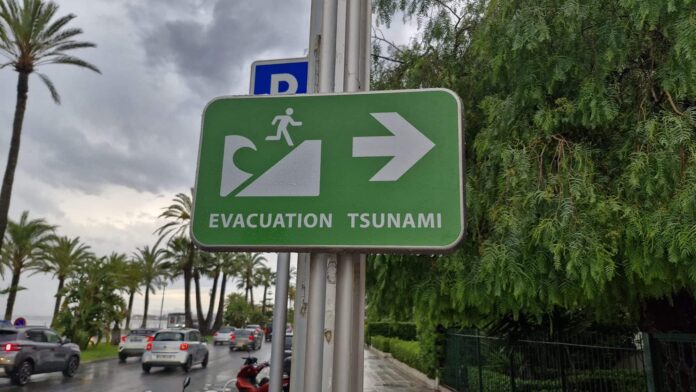
Nearly 800 evacuation signs have been installed on the Côte d’Azur coast to guide residents and visitors in the event of a tsunami. The result of the EVACTSU project, this system is accompanied by information tools and has earned Nice the international “Tsunami Ready” label.
Since the beginning of the week, nearly 300 signage panels have been installed in Nice, and 800 in total in neighboring coastal municipalities — from Eze to Cagnes-sur-Mer. They indicate the evacuation routes to follow in the event of a tsunami, in order to guide residents and visitors to safe areas.
These measures, far from being merely decorative, have been taken to prepare cities to respond as effectively as possible to a tsunami situation. This was done as part of the “EVACTSU – Nice Côte d’Azur” project carried out in partnership with the Laboratory of Geography and Planning in Montpellier (LAGAM) of Montpellier Paul-Valéry University (UMPV), the Agency for Health, Environmental Safety and Risk Management (ASSER) of the Nice Côte d’Azur Metropolis and the teams of coastal municipalities in the metropolis. It was co-financed by the Nice Côte d’Azur Metropolis, Montpellier Paul-Valéry University, and the European Union via the Directorate-General for European Civil Protection and Humanitarian Aid Operations (DG ECHO), as part of the COASTWAVE 2 project, led by the Intergovernmental Oceanographic Commission of UNESCO.

Tools to better understand and anticipate the tsunami risk
In addition to the panels, a dedicated website details how the system works and offers tools to better understand the risk. It reminds us that tsunamis in the Mediterranean, although rare, are caused by “a high-energy phenomenon […] that causes the displacement of a large volume of water” and that they can manifest themselves through “a succession of waves […] that can last from a few minutes to a few hours“. The site explains how to react in case of an alert, recommending in particular to “evacuate immediately on foot inland, beyond five meters in altitude” and to stay in a safe place until the alert ends.
An interactive map also makes it possible to locate the evacuation zones and routes, with the ability to “zoom in on the map to display evacuation routes“. The plans are downloadable “in two versions in PDF format” for each municipality involved. Finally, the site presents the actions taken as part of the EVACTSU project, which made it possible to identify “99 refuge sites” and to strengthen population preparedness in the face of this risk.
The “Tsunami Ready” label: an international recognition
Nice has therefore obtained the “Tsunami Ready” label from UNESCO, a distinction that recognizes territories capable of anticipating and effectively managing tsunami risk. To be labeled, the city must have clearly identified evacuation routes, mapped risk zones and validated refuge sites. This label thus confirms that Nice meets international standards in terms of tsunami preparedness, thanks in particular to the work carried out as part of the EVACTSU project and the implementation of alert systems, evacuation plans and information tools for the public.
The achievement of the “Tsunami Ready” label confirms that Nice has taken an important step in terms of preparedness, but this is not enough to eliminate the risk. The tools exist, the routes are marked and the evacuation plans accessible, but their effectiveness will depend above all on the ability of residents and visitors to use them. The city is better equipped, certainly, but vigilance and awareness remain essential for this preparation to bear full fruit.
NicePremium is a free, independent local news outlet.
Help us keep going by supporting our work from €5 per month.


