
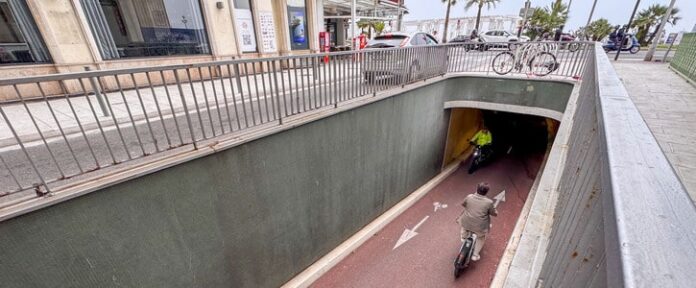
In Nice, the future of the cycling tunnel on Rue du Congrès is a focus of mobilization. The association Nice à Vélo has launched a petition to request the preservation of this infrastructure, which is presented as beneficial for safety, daily commutes, and local life.
The debate on mobility continues in Nice. Recent announcements regarding carpooling have reignited discussions about road sharing. In this context, the association Nice à Vélo has opposed a potential reopening of the Rue du Congrès tunnel to automobile traffic. A petition has been launched online to advocate for maintaining this infrastructure reserved for active mobility.
The mobilization quickly gained traction. Launched on Saturday, April 18, the petition surpassed 1,000 signatures by Sunday evening. The total now exceeds 2,700 supporters in 72 hours. The association is concurrently conducting awareness activities in public spaces. A meeting is scheduled for Thursday, April 23, with Laurent Merengone, deputy mayor for traffic and parking, and Jean-Marc Governatori, deputy for the environment.
The Rue du Congrès tunnel is a busy passageway for cyclists and scooter users. The infrastructure provides a direct link between several routes. The path remains protected from motorized traffic and traffic lights, ensuring continuity in commutes.
Without this setup, the route requires crossing several heavily trafficked lanes on Promenade des Anglais. This situation is seen as a safety risk. The tunnel offers a more peaceful environment for travel, providing a suitable setting for families and less experienced individuals. It also serves as an introductory tool for urban cycling practices.
Impact on living conditions and local activity
The issue of maintaining the tunnel also affects residents and businesses. Reopening it to cars would lead to increased traffic in the area, described as causing an influx of vehicles and affecting the living conditions nearby.
The current setup has helped stabilize noise levels and improve air quality. The cycling tunnel contributes to calming the neighborhood. Walking and cycling also promote different interactions with local businesses.
The association emphasizes a phrase used in its communications: “The customer is a human being, not a car.” This approach is based on practices observed in urban centers. A motorist frequently passes through a neighborhood without stopping, whereas a pedestrian or cyclist takes more time to visit shops.
Another factor is highlighted in this analysis: “51% of downtown households do not own a car (according to a study by the Alpes-Maritimes department in 2023). They are the loyal customers of local shops and demand safe routes.”
Data showcased in the debate
The association relies on several figures for its argument. Approximately 900 trips are recorded through the tunnel daily. This volume is equivalent to eight high-capacity buses or 700 cars. The perception of a rarely used space is due to the compact nature of bicycles.
Automotive traffic data is also mentioned. A 25% decrease was observed between 2012 and 2020, prior to the cycling tunnel’s implementation. The infrastructure aligns with an ongoing trend.
Traffic flow is also assessed. Increasing road capacity might lead to more vehicles. This mechanism is often observed in transportation policies. Thus, reopening the tunnel could create bottlenecks upstream.
A stance already expressed during the municipal campaign
Active mobility had already surfaced in the public debate. During the March 2026 municipal elections, the association Nice à Vélo launched a site focusing on candidates’ positions. The tool allowed for the comparison of commitments on thirty measures related to cycling, road safety, and transportation organization in the metropolis.
Several candidates responded to the association’s proposals. Scores varied based on expressed positions. Among them, Eric Ciotti received the lowest score.
Éric Ciotti scored 20.5 out of 30. His responses indicated limited support for certain proposals. The candidate did not fully endorse the creation of a metropolitan Express Cycling Network. The project included plans for “blue corridors” along the Paillon and Var with bidirectional lanes. An initiative to revamp the Vélo Bleu service and a project for “reconfiguring and securing the Promenade” were also among the proposals. However, Éric Ciotti conditioned the creation of new bike lanes on preserving car parking and avoiding impacts on motorized traffic.
The petition remains accessible online and continues to gather signatures. Discussions with elected officials could influence the final decision. The issue concerns traffic conditions, living standards, and urban mobility organization in the city.
NicePremium is a free, independent local news outlet.
Help us keep going by supporting our work from €5 per month.


