
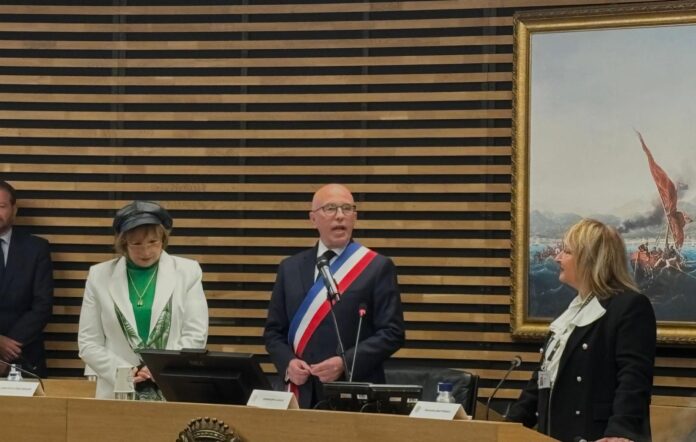
The Nice city council adopted this Friday the reduction in local tax rates promised by Mayor Éric Ciotti. While the financial resolutions were voted on, the discussions were marked by fierce criticism from the opposition regarding the funding and methods used.
Gathered this Friday at the town hall, the city council was set to examine a block of thirteen financial resolutions, the most anticipated concerning the reduction of local tax rates. This measure was among the central commitments of the new municipal majority.
Presented by the deputy for finance, Olivier Breuilly, the reform notably plans for a reduction of property tax on built properties, as well as on unbuilt properties and secondary residences. “This measure is not symbolic; it’s about purchasing power. It’s also a measure for our region’s attractiveness,” defended the elected official. According to the municipality, this reduction is expected to result in several tens of millions of euros in less revenue for the city.
Opposition criticizes the funding
While several officials acknowledged that a tax cut could be a legitimate political goal, the opposition contested the way it is financed. Philippe Pradal, president of the Tous pour Nice group, notably pointed out that the city’s financial situation partly depended on the previous mandate’s management. “In 2025, the city of Nice generated a budget surplus of 24 million euros,” he recalled.
According to him, a large part of the revenue loss would be offset by non-sustainable resources, such as the use of budget surpluses or canceled credits. The elected official also highlighted a reduction in certain investments. “When we look at the planned cuts, sports are affected, culture too, and even the video surveillance plan has been reduced,” he stated. Philippe Pradal also criticized the method used, as the savings plan was presented publicly before being debated in the finance committee. “The 60 million euro savings plan seems to mix apples and oranges a little,” he remarked ironically.
An “ideological” choice according to the left
On the left, Julien Picot, president of the finance committee and elected member of the Unis pour Nice group, denounced a budgetary orientation he considers risky. “An opposition member on the left must know how to act: be a safeguard, and embody a demanding and transparent counter-power. You know my total opposition to your orientations and your political camp. But in the general interest of Nice residents, we must have substantial debates: project against project. That is our only compass.”
He continued: “The reduction in property tax can be appealing at first glance. It seems popular. But it is primarily based on a ultra-liberal, demagogic, and dangerous ideology,” he declared before the assembly. According to him, eliminating more than 50 million euros in revenue could eventually weaken local public services. “Less revenue means fewer services: less for schools, less for nursery schools, less for culture, less for sports,” he estimated.
Addressed by Julien Picot regarding the future evolution of taxation, Éric Ciotti was categorical, not ruling out further reductions: “No, I do not commit to that. I fervently hope that we will continue the reduction,” the mayor replied, asserting that the savings made should be “used to improve the purchasing power of Nice residents.” These remarks were met with applause from the majority. Despite these criticisms, the entire financial block was finally adopted.
However, the Tous pour Nice group chose not to participate in the vote on several resolutions, including the one concerning the tax reduction.
NicePremium is a free, independent local news outlet.
Help us keep going by supporting our work from €5 per month.


