
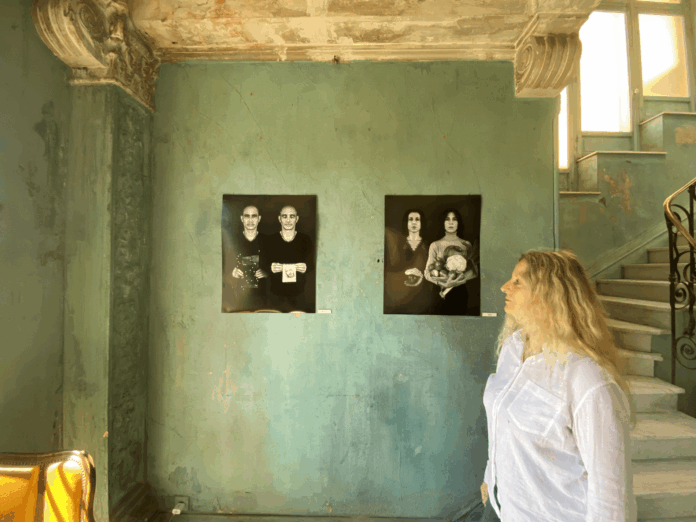
Until May 17, artist Hannaka takes over Villa Cameline in Nice with an exhibition titled Simple Stories. Photographs, drawings, texts and installations dialogue with each other in the different rooms of this atypical residence, inviting visitors on an artistic journey that is both intimate and universal.
Born in 1966 and a graduate of the École nationale supérieure des Beaux-Arts in Paris, Hannaka lives and works in Nice. Her work, which blends several artistic disciplines, is primarily interested in observing human nature and how emotions are expressed in the body and mind.
An artistic journey through a house transformed into a gallery
For this exhibition, the artist chose to transform the space of Villa Cameline into a true field of exploration. The works are scattered throughout the different rooms of the house, like so many stages of an artistic journey. “There are several rooms, seven in total,” explains Hannaka. “In each room, there are small exhibitions with a few explanations. But I didn’t want there to be a lot of text.”
Visitors are thus invited to circulate freely, moving from one room to another and from one floor to the next. Portraits, drawings, objects and installations make up an ensemble that tells personal stories while addressing universal themes. At the entrance, a series of portraits welcomes visitors. Placed in the staircase, these faces seem to observe those who pass. “I wanted the characters to be a little above us, as if they were looking at us,” explains the artist. “When I was a child, my aunt lived in a convent. There were portraits of the mother superiors in the staircase. When I saw this house, I thought of that again.”
The “Invisibles,” mirror of our contradictions
Among the series presented is The Invisibles, a photographic work focused on the human face and its contradictions. The principle is simple: start with a portrait and transform it into a symmetrical image. The facial expressions are then reworked to create two different halves. “I take a portrait and I separate the expressions on the right and left,” explains Hannaka. “When you put them side by side, you see two different faces appear for a single person.”
For the artist, this approach reveals the tensions that run through each individual. “In our faces, there is often a harder part, another softer one, sometimes masculine, sometimes feminine. We carry all these facets within us. That’s why I call them the Invisibles.”
Some works are also based on visual metaphors. In one of the portraits, a woman holds both a rock and a flower. “The rock represents the hardness she shows on the outside,” says Hannaka. “But the flower symbolizes her sensitivity. She’s someone very direct, very hard sometimes, but who can also be extremely emotional.”
An exhibition built around life stories
Upstairs, several rooms are devoted to more personal narratives, often inspired by the artist’s family. A slideshow retraces certain memories, accompanied by texts. One room also recreates a bedroom frozen in time. The photographed characters posed there before the exhibition, as if they still inhabited the space. To enhance immersion, a fragrance was specially created for the room. “I wanted it to be a room a little suspended in time,” explains Hannaka. “The fragrance is deliberately a bit old-fashioned, with a powder scent.”
In another room, visitors can discover singular stories told through drawings and texts. Some are inspired by people close to the artist. One, for example, tells the story of a cousin who left her wedding ceremony at the last moment. “Everything was ready, the families were there, the hall too… and at the last moment, she didn’t enter the town hall,” Hannaka recalls. “People live incredible things.”
A box of secrets for visitors
One of the installations also invites the public to participate directly in the exhibition. A small desk and box allow visitors to leave a secret, a memory or a confession. “The idea is for people to be able to write stories that are a bit unmentionable,” explains the artist. “Some are very touching, others very harsh. But that’s also what interests me: showing all that we are.” These testimonies could moreover fuel a future artistic project. “I might work from these words, in photography or drawing. It could be a next series,” she confides.
The artist finally insists on the accessible nature of her work. “It’s not something elitist,” she assures. “Even people who aren’t particularly interested in art can recognize themselves, because these are simple stories, things that everyone experiences.”
The exhibition Simple Stories is on view at Villa Cameline, 43 avenue Monplaisir in Nice, until May 17, with openings mainly on Wednesday and Saturday afternoons.
NicePremium is a free, independent local news outlet.
Help us keep going by supporting our work from €5 per month.


