
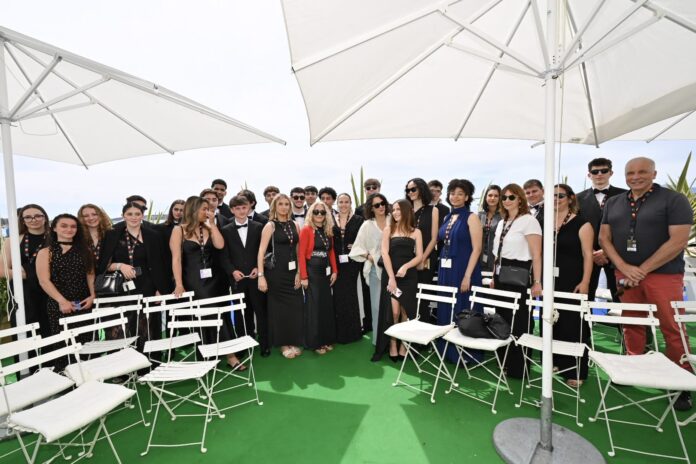
On the occasion of the Cannes Film Festival, Margaux Fournier reflected on her journey, her vision of cinema and the creation of her documentary The Ladies’ Bath. Between personal confidences, social reflection and filming anecdotes, Margot Fournier revealed the behind-the-scenes of a deeply human and political film. The director also spoke about the emotion she felt after receiving the César for best short film.
Originally from Marseille, Margaux Fournier explains that she studied cultural management at Sciences Po Lille before joining La Fémis in distribution and exhibition. From the start of the conference, Margaux Fournier wanted to send a message to young people wishing to work in cinema: “you have to trust yourself and always try.”
For Margaux Fournier, cinema remains a fragile sector but supported by local authorities. The director recalls that The Ladies’ Bath received aid from the Region after self-financed shooting began. The director recounts that a friend lent her his camera as well as a microphone to launch the project. Once the first images were recorded, Margaux Fournier was able to seek regional funding.
The choice of short format was not without reason. Margaux Fournier explains that a short film represents a budget between 40,000 and 100,000 euros while a feature film often reaches a million euros. According to her, making a thirty-minute documentary was also a distribution strategy: many festivals promote this more accessible format more prominently.
Margaux Fournier films Marseille and bodies without filters
In The Ladies’ Bath, Margaux Fournier films Marseille’s public beaches, a setting she knows intimately since she herself comes from Marseille. For Margaux Fournier, these beaches represent unique social spaces where differences temporarily fade: “we are half naked, we don’t know what others do or where they come from.” According to her, public beaches still allow different socioprofessional categories to mix.
The relationship with the body occupies a central place in Margaux Fournier’s cinema. The director clearly asserts that “the body is political.” Through The Ladies’ Bath, she wanted to show bodies rarely visible in cinema: aged bodies, natural bodies, far from usual standards. Margaux Fournier also insists on the fact that the filmed women reveal themselves naturally, without artifice or staging.
At first, the director imagined fiction. But as she was writing, she understood that she wanted to work with non-professional actors. Finding elderly actresses with an authentic Marseille accent seemed complicated to her. The Marseille native then decides to transform her project into a documentary. She recruits participants directly on the beach. Margaux Fournier recounts meeting Joël and Régine simply by walking around before proposing they participate in the film the very next day.
The shooting of The Ladies’ Bath took place in only one week. Margaux Fournier explains having worked in a very spontaneous manner: shooting during the day then writing scenes in the evening. Some sequences were even improvisational theater. Margaux Fournier also clarifies that no scene was truly scripted since the filmed people simply lived their usual daily life on the beach between 9 am and 6 pm.
Margaux Fournier wants to recreate connection between generations
During the conference, Margaux Fournier also returned to certain important artistic choices. The director explains having deliberately cut several scenes so that viewers could never precisely identify the social category of the characters: “everything is choice, everything is political.”
With humor, Margaux Fournier also recounted her memory of the César Awards. After receiving her award, she mostly remembers being extremely thirsty: “they only served champagne and I was just asking for water.” The people around her wondered where she would be able to find water in this context. A moment she describes as very quick, almost unreal, and marked more by surprise than by the solemnity of the ceremony.
The reception of the film particularly moved Margaux Fournier, especially among younger generations. The director explains having discovered many comments from viewers aged 18 or 19 stating: “life doesn’t end at 60” or even “If it’s to age like that, I’m in.” According to the Marseille native, these reactions give the documentary its full meaning. After the Covid-19 period, Margaux Fournier specifically wanted to “recreate connection” between generations rather than oppose them.
Finally, she took the opportunity to reveal her future projects. The director is currently working with ARTE on a 52-minute documentary with the provisional title Boules Film. This new project by Margaux Fournier will follow elderly men passionate about petanque in order to question male aging. In parallel, she would also like to venture into fiction soon.
NicePremium is a free, independent local news outlet.
Help us keep going by supporting our work from €5 per month.


